-
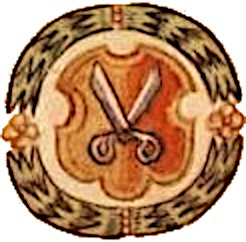
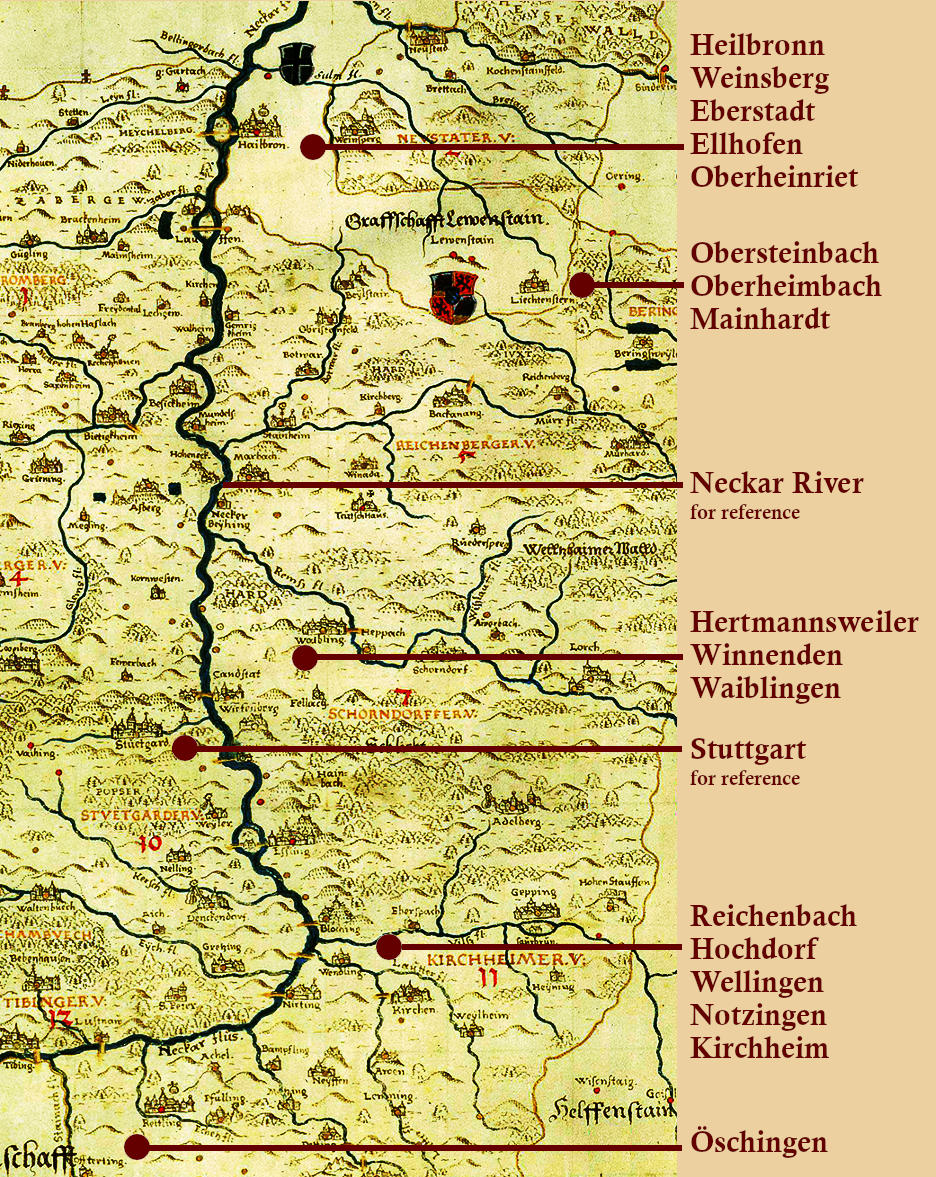
Württemberg with the locations of Schneiders
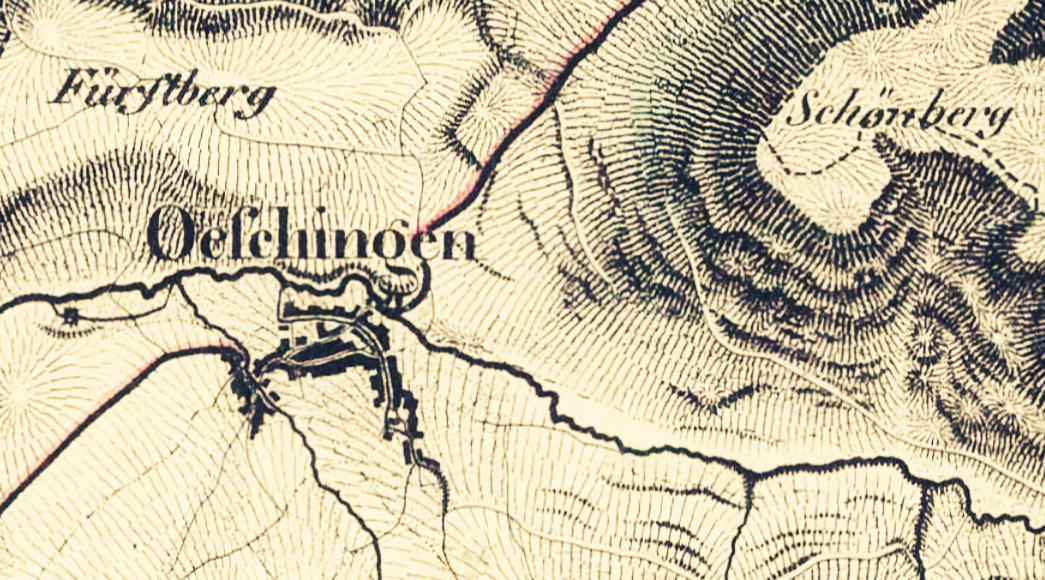
Oeschingen on an old map
An older description of Oeschingen by a peaceful pastor (Ulrich Bollinger) says, like the two-pointed Parnassus, the snowpeaked Roßberg still towers up to the sky above, the fertile earth still bears its fruit in the quiet valley, the mild air still blows, the tranquility of life still lingers here in the peaceful little village, while the generations of people and the works of their hands have swum down without a trace in the stream of time.
from "Descriptions of the Districts of Rottenberg" ("Beschreibung des Oberamts Rottenburg")
1828, by Johann Daniel Georg von MemmingerThe Schneiders
Where They Were and What They Did
Although the first of our Schneiders who migrated to Australia were Johann Heinrich and his wife Rosina, along with their baby daughter Christina, they were soon to be followed by Johann's parents, and his siblings, Gottfried, Friederike, Sophie, Johann and Christina. So the father, Johann Georg Schneider, at the age of 55 was actually the eldest of the family members (born as a Schneider) to have migrated.
The majority of the traceable ancestors of Johann Georg Schneider and his wife Heinricke Margaretha Lauer, hailed from the far north of the Kingdom of Württemberg, within about 60km of the capital, Stuttgart. The region of interest stretches from Oeschingen, 50km south of Stuttgart, then on to Hochdorf, 20km southeast of Stuttgart, up to Hertmannsweiler, a further 25km north of Hochdorf, and then on to Weinsberg district near Heilbronn, 40km north of Hertmannsweiler. The rest of the places roughly lie within 25 km east of those already mentioned.
Looking back in time earlier than the beginning of the 17th century is greatly hindered by the disarray caused by the "Thirty Years' War" which occurred between 1618 and 1648. Not only was a huge amount of the population decimated but also their towns, buildings and records. To find anything substantial and continuous from that period of time would be nothing short of miraculous, yet due to the work of some people, then and now, more is gradually coming to light.
The earliest known ancestor of Johann Georg bearing the name Schneider was his 4x-g-grandfather, Jacob (1617-1689) who was, in 1683 and 1685, the Schultheiß (Modern: Bürgermeiser, English: Mayor) of Oeschingen, a village at the foot of the Swabian Alps. Jacob's first wife, Catharina, later known as Marina was about twenty years old in 1642 when the couple were married. She passed away at the age of forty after having borne nine children. In 1623 Jacob married again, this time to Apollonia Scheck with whom he had another six children. The eldest son from the first marriage, Conrad (1645-1709), was a weaver in Oeschingen and in 1670 married Barbara Leipp (1650-1729) who belonged to a rather large family with many more members than Johann's. Together they had four sons and two daughters.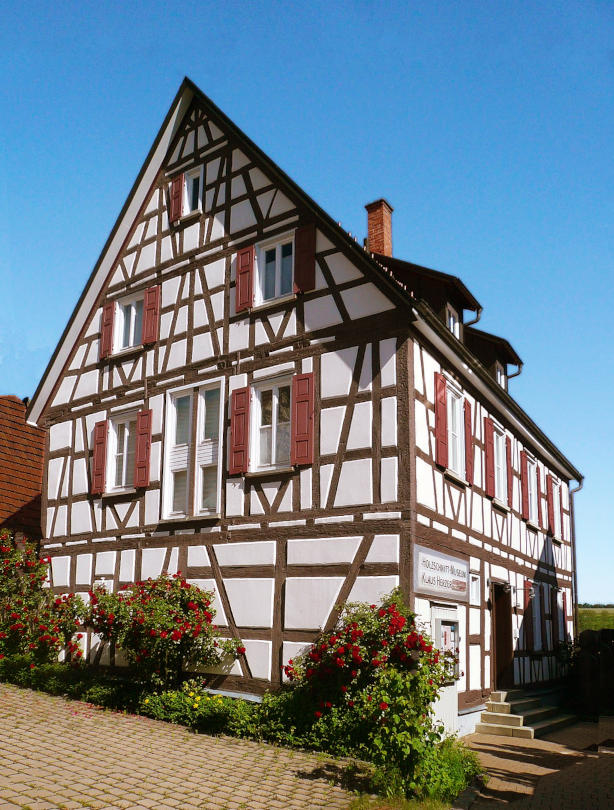
Former Mayor's House (Schultheißenhaus) in Oeschingen
Jacob Schneider was twice the Mayor (Schultheiß) of Oeschingen and as such likely occupied this building during his service to the village.
The building shown here is of the type known in German as Fachwerk, and in English as Timber Frame or Half-Timbered With Infill.
Their fourth son, Johann Conrad (1678-1738), later known as Hanss, was also a weaver. He moved to Hochdorf, a village a little further to the north-west but still not far from the Neckar River. In Hochdorf in 1707 he married a 24 year old local girl Anna Margaretha Schmid (1683-1766). In the span of 17 years, from 1708 to 1725, the couple managed to have 11 children, 8 of which were boys and 3 girls, all born in Hochdorf. Their son Andreas (1715-1794) followed in his father's footsteps by also becoming a weaver and he too married in Hochdorf, his wife being Maria Agnes Unger (1717-1782). The family tradition somewhat changed its direction when their first son, Georg Friedrich, became a soldier and their other son, Johannes, became a Master Stone Mason, the first of a dynasty of masons and builders.
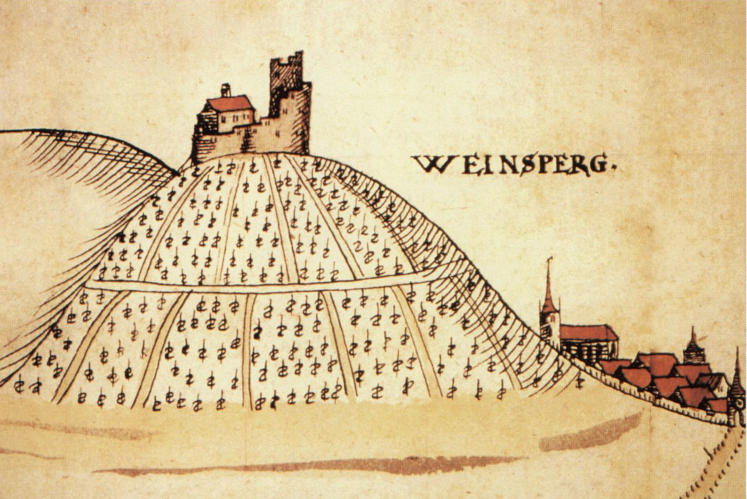
In 1775, Johannes moved from Hochdorf to Hertmannsweiler where he married Philippina Caroline Rincker (also known as Margaretha). Hertmannsweiler, as well as the neighbouring villages such as Leutenbach, Winnenden and Waiblingen, already had many generations of Schneiders living and working there as stone masons, dignitaries, winegrowers and farmers and they could very likely have been related to our Schneiders from nearby Hochdorf.
From Hertmannsweiler, the later generations gravitated towards the Weinsberg district near Heilbronn, with a distinct concentration formed in and around the town of Ellhofen, first noted down in the year 1037 under the name of Ellenhouven. By the end of the 14th century, Ellhofen consisted of a collection of nine farming settlements ("Höfe"). In 1774, it was a village with 75 houses, 43 barns, 9 stables and 6 wells.
Below: Scenes from the Forestry Stock Book of the Duke of Württemberg's War Councillor, Lieutenant Colonel Andreas Kieser.
The Forestry Stock Book served the purpose of determining where new forests should be planted.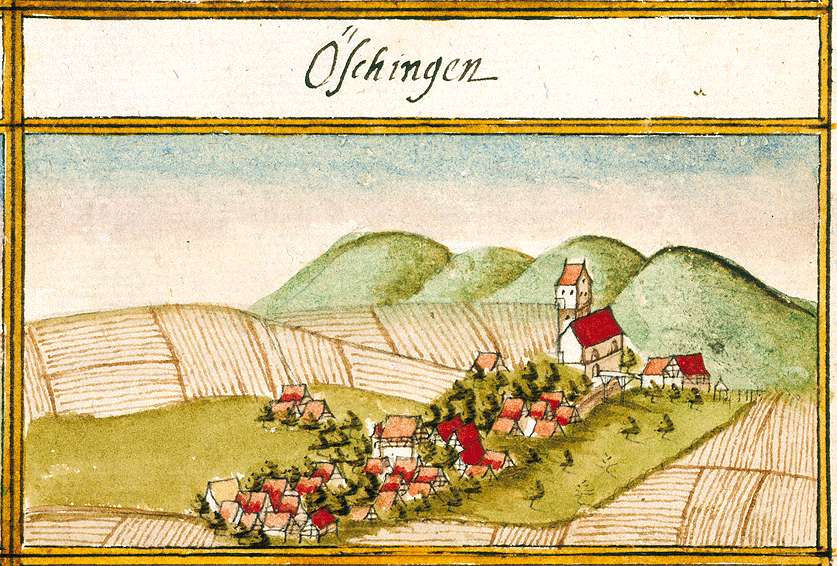
Oeschingen
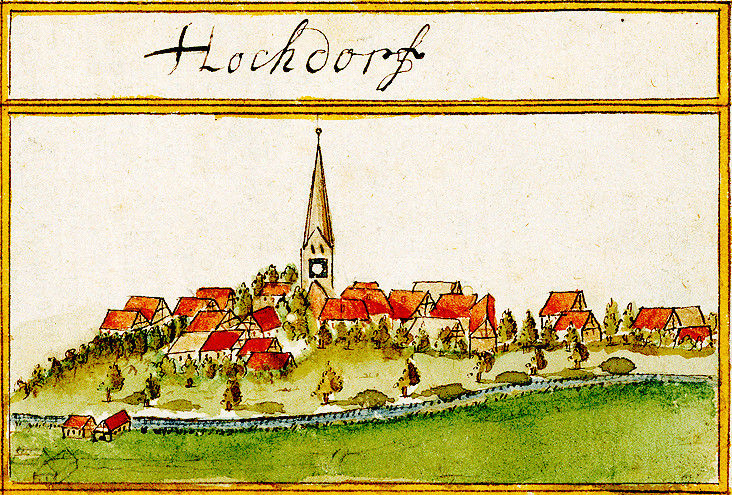
Hochdorf
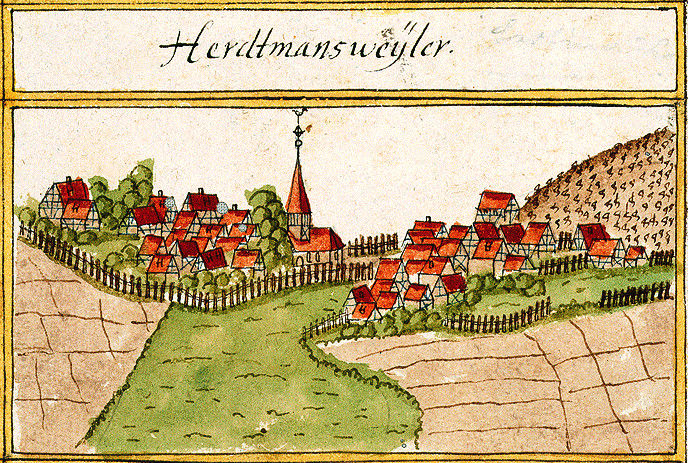
Hertmannsweiler
The Ancestors of Johann Georg Schneider (George, or John)
click the button to the left to show or hide the ancestors
and Heinricke Margaretha Lauer
Below: Extracts from the Archives holding Family Registers showing the Schneider lineage in Germany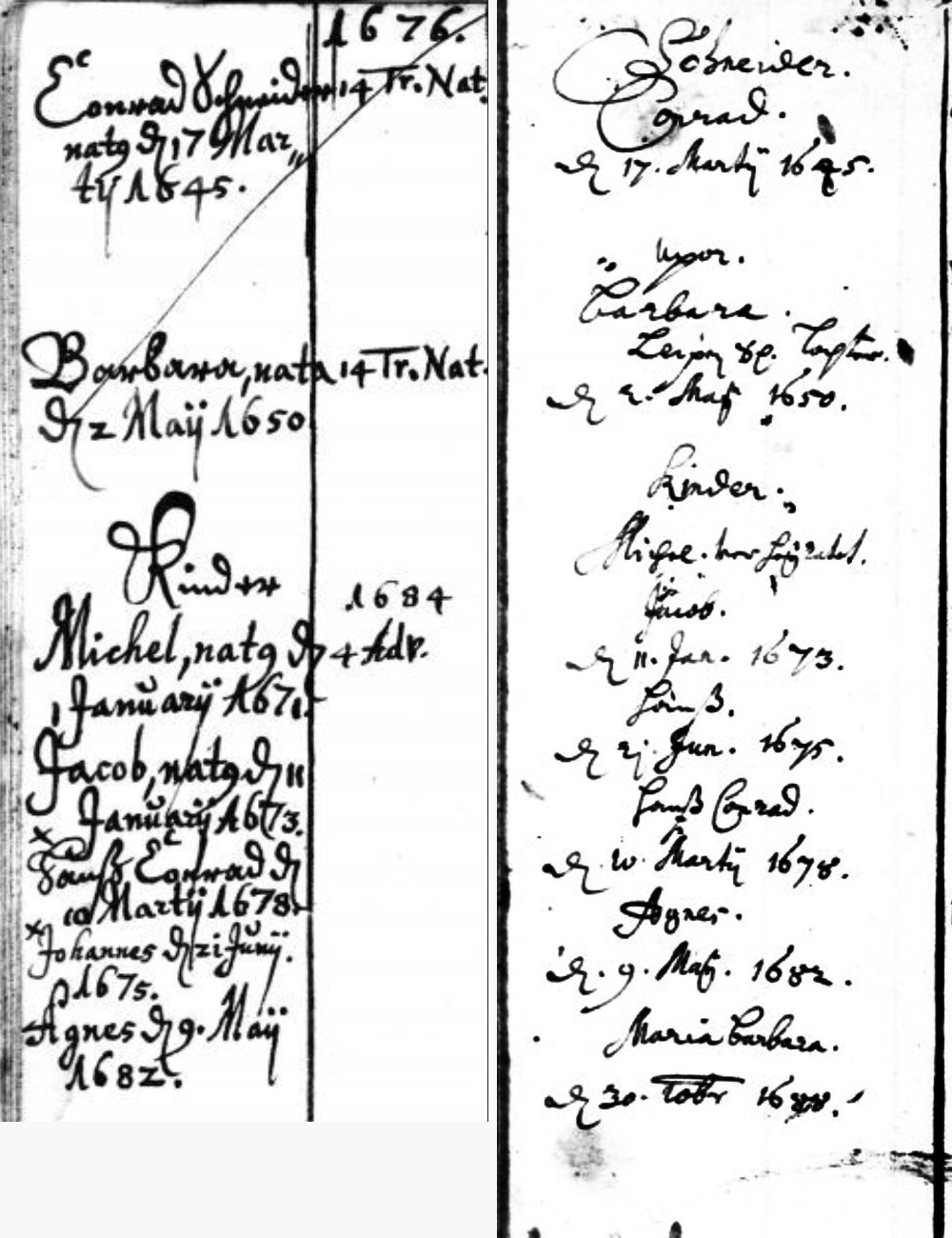 Oeschingen
Conrad +
Barbara Leipp
married 1670
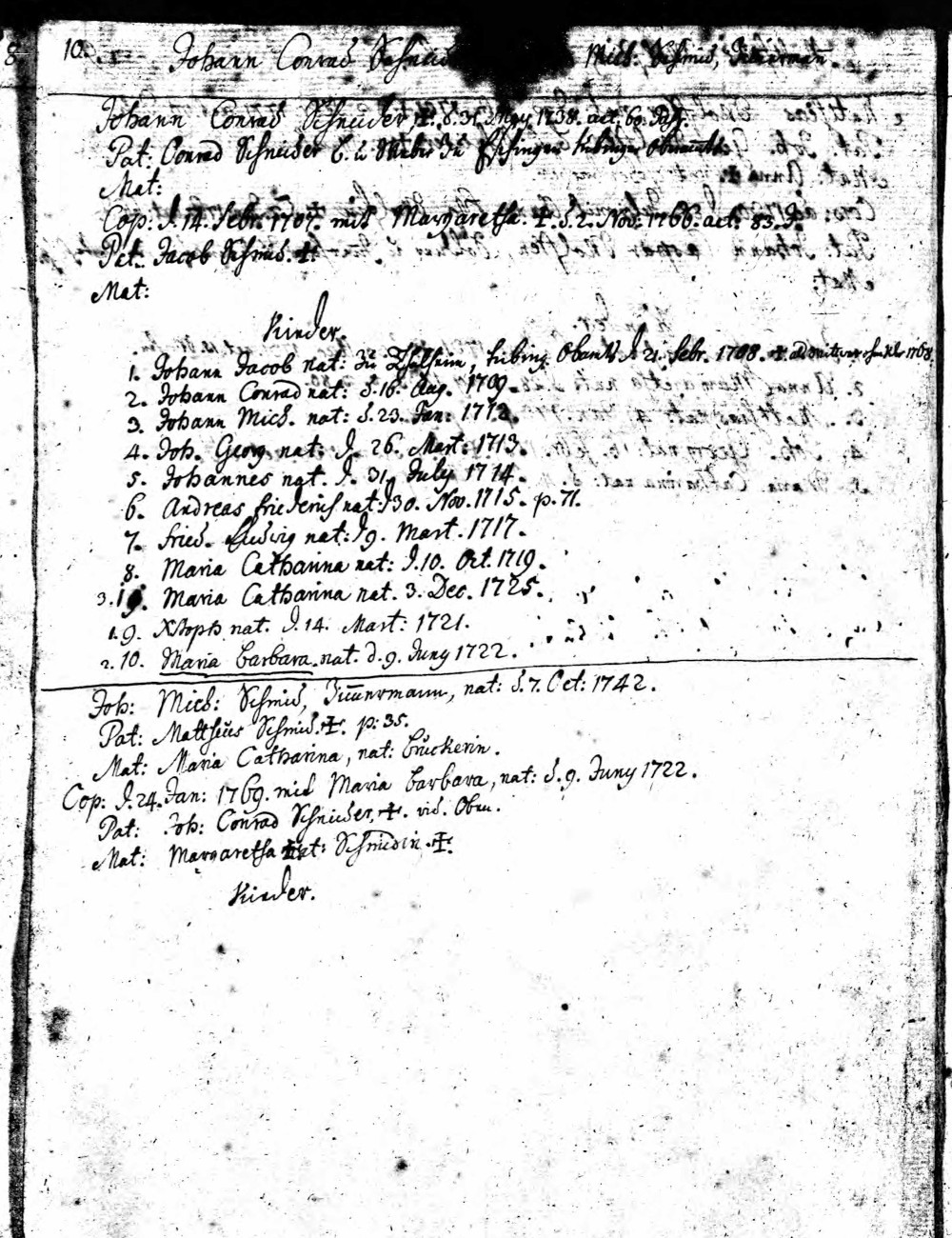 Hochdorf
Johann Conrad +
Margaretha Schmid
married 1707
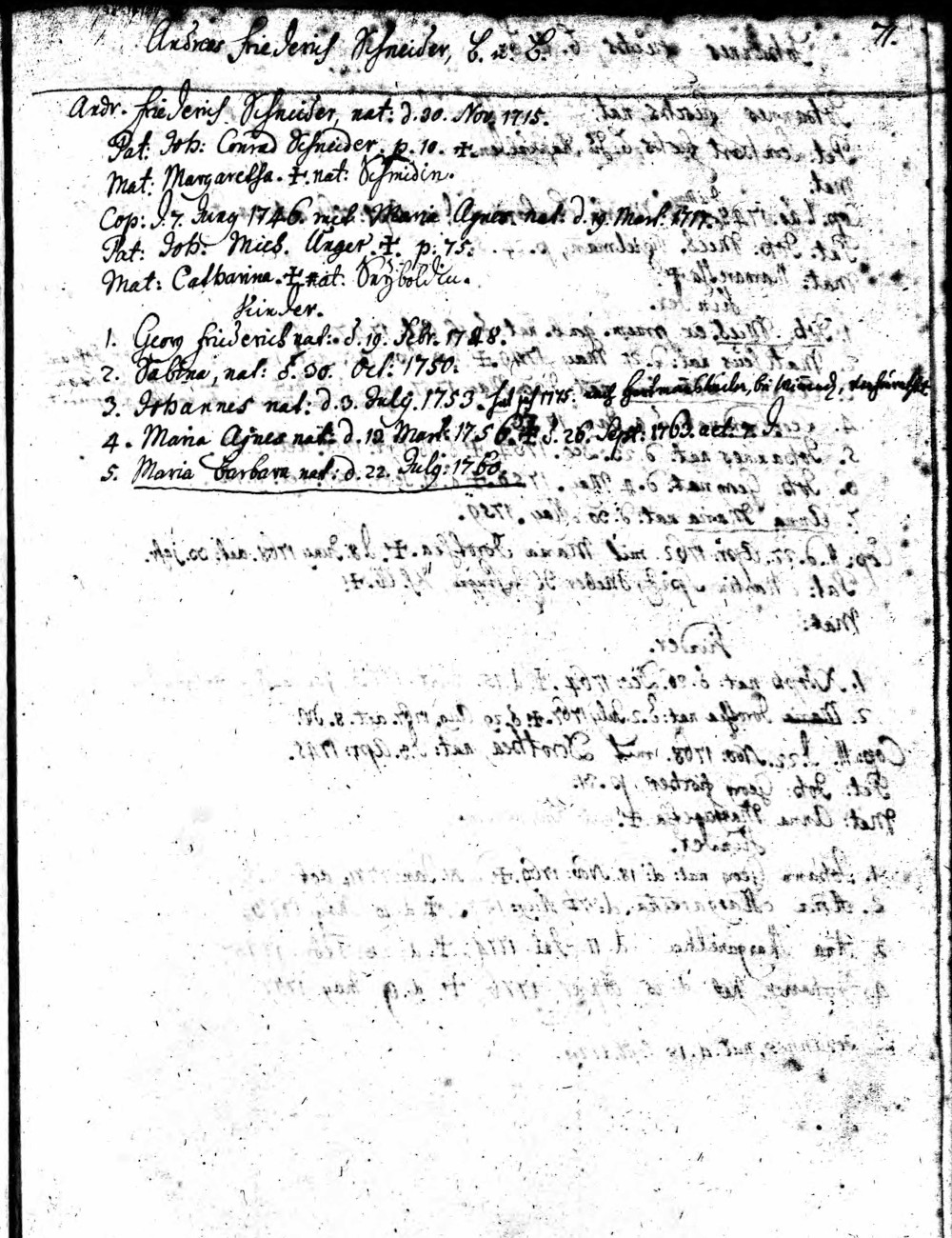 Hochdorf
Andreas Friedrich +
Maria Agnes Unger
married 1746
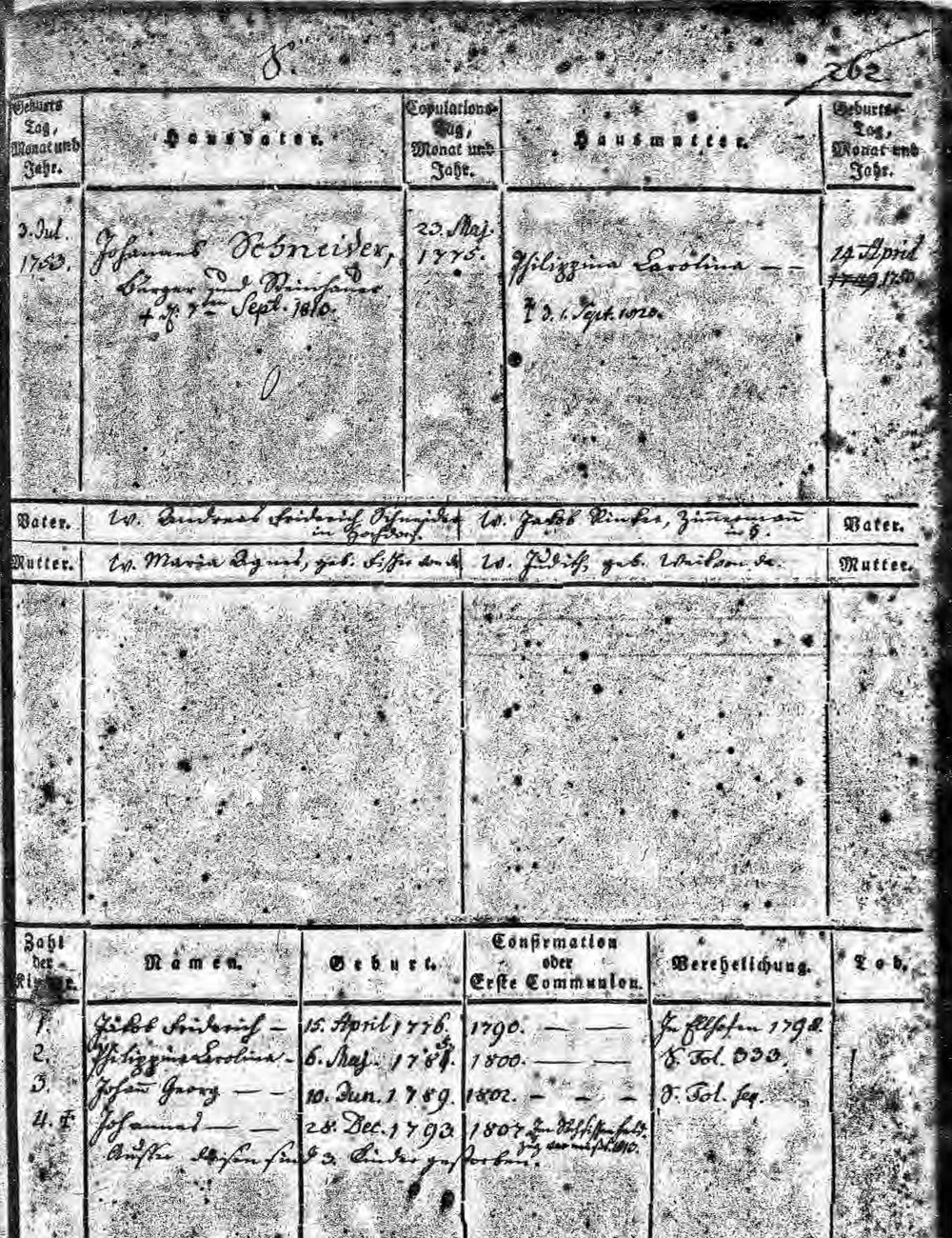 Hertmannsweiler
Johannes +
Philippina Rincker
married 1775
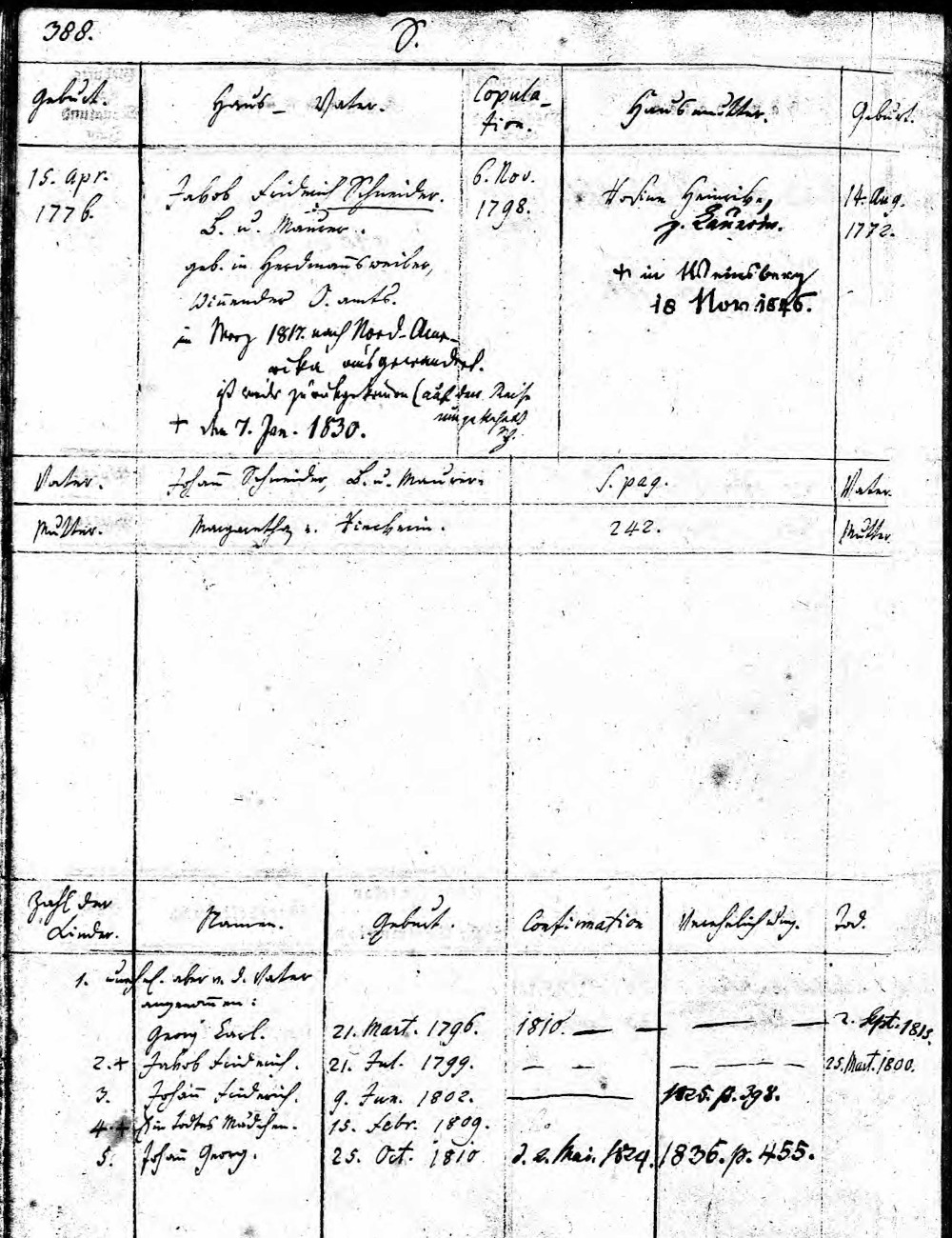 Ellhofen
Jakob Friedrich +
Rosina Lauer
married 1798
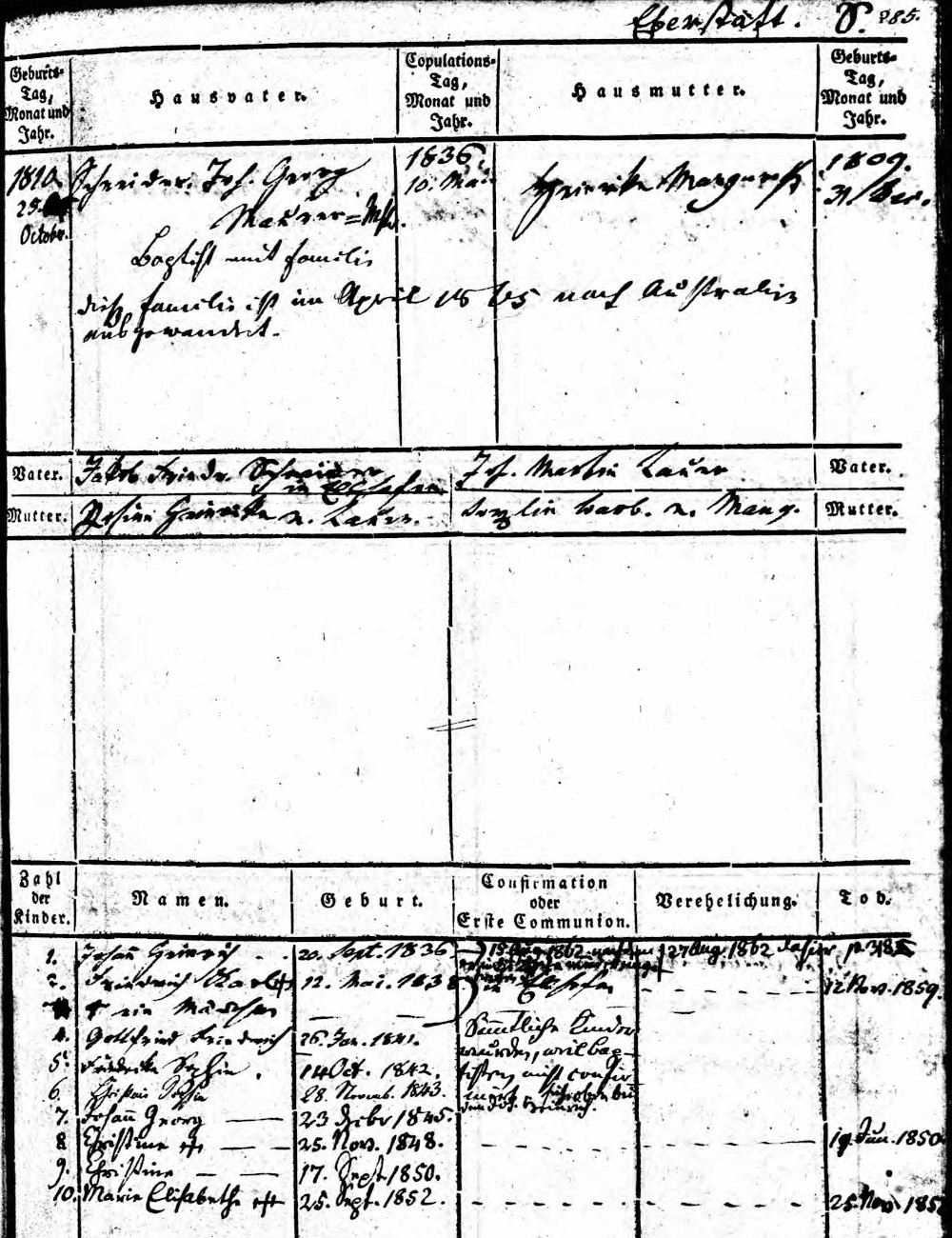 Eberstadt
Johann Georg +
Heinricke Lauer
married 1836
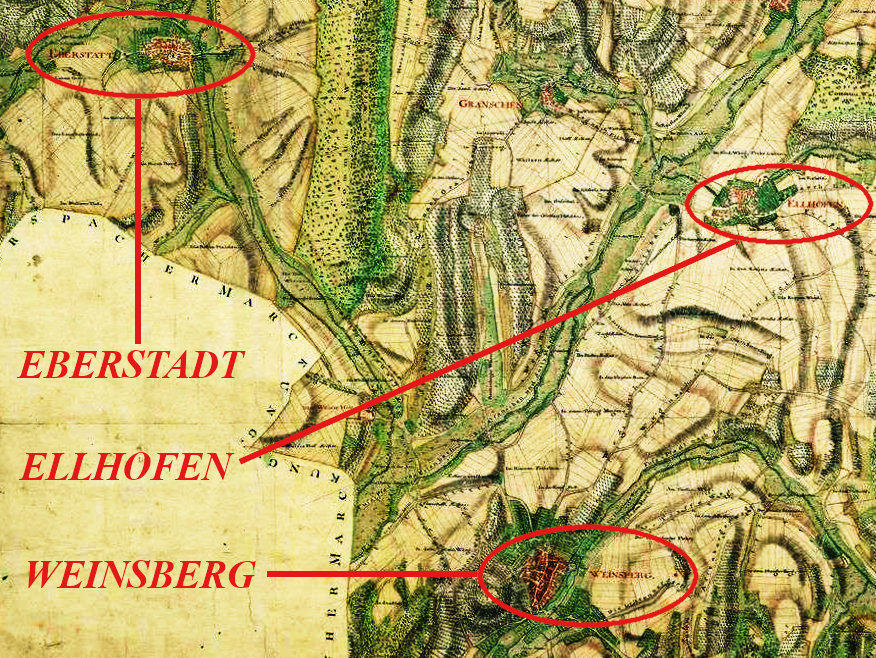
An old topographical map showing the relative locations of Eberstadt, Ellhofen and Weinsberg
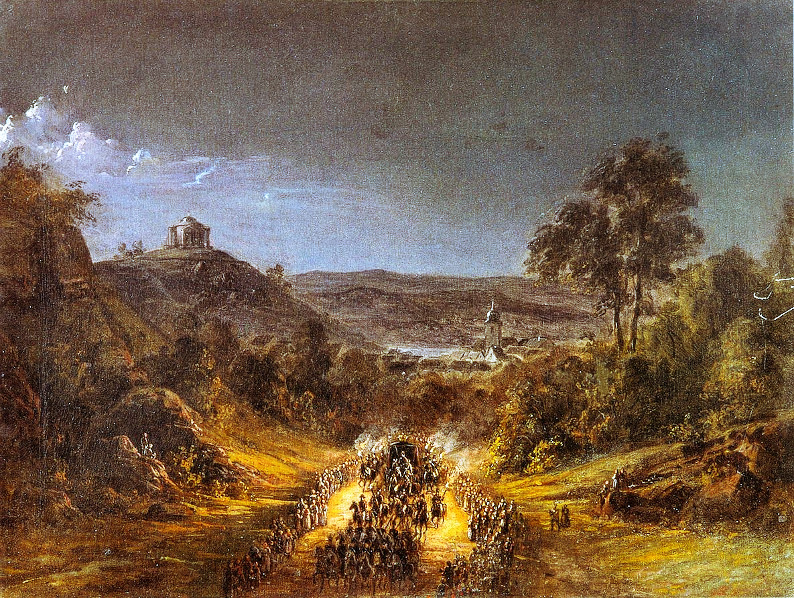
The Death of the King Wilhelm I (1864)
Time For A Change
In May of 1864, Johann Heinrich Schneider was the first of our ancestors with the name Schneider to have migrated to Australia. He came from a place called Eberstadt, near his birthplace of Ellhofen, both of which were in the administrative district of Weinsberg in the Kingdom of Württemberg. To understand some more of the lands of our forebears, a little history can be helpful.
Since medieval times, Württemberg was an independent self-ruled member state of the Holy Roman Empire. The empire was finally dissolved in 1806 which made way for Württemberg to be made into a kingdom. In Johann's day, the country of Germany had not yet formed and the kingdom was still under the rule of the very last German king, Wilhelm I.
From a Duke to a King
Wilhelm I descended from a long line of Kings, Princes, Dukes and so forth. For instance, one of his great-great-grandfathers was King George II of Great Britain & Ireland. Another was the Prussian King Friedrich Wilhelm I on both his great-grandmother's and great-grandfather's sides.
Wilhelm's father was the 16th Duke of Württemberg, Friedrich II, commonly known as Fat Freddie (Dicker Friedrich). During his reign, Friedrich also managed to become a Kurfürst, one of seven or more high ranking Dukes within the the Holy Roman Empire who held the collective right to elect a King. That wasn't all, though. He also became the first king of Württemberg as Friedrich I.
This came about because he had struck a deal with Napolean Bonaparte to supply a massive auxiliary force to France. In return Württemberg was raised to the status of a kingdom but at a cost. Over 15,000 Württembergers died in the battle against Russia alone. It was no coincidence either that Frederick's daughter, Princess Catharina happened to be married to Jerome Bonaparte, Napolean's youngest brother.
For 48 years, from September 1819, Frederick's son King Wilhelm I ruled over the Kingdom of Württemberg. Upon his death in June 1864, the land was destined for major change. Before he died though he had made a lot of changes of his own. More than a century later, in 1949, the lands which were once Württemberg became part of the Republic of Germany. Since 1952, Württemberg and its bordering neighbour, Baden, have been part of the German modern state of Baden-Württemberg.
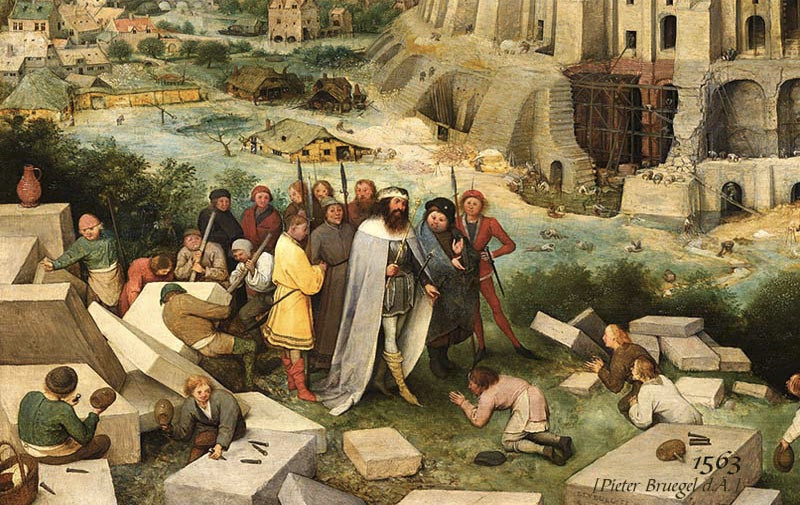
Stone masons at work (by Pieter Bruegel)
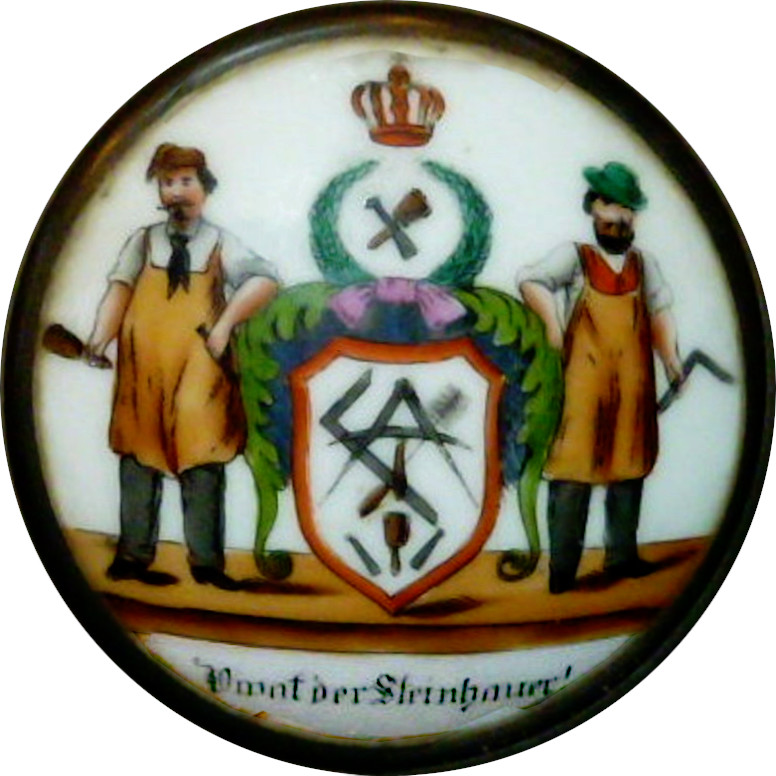
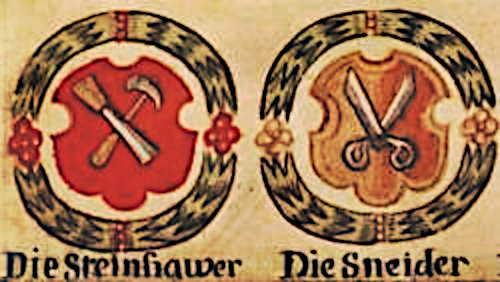 Guild Coat of Arms of both
The Stone Mason and The Tailor (Gildewappen der Steinhauer und der Schneider), 1636A Family of Master Stone Masons
The profession of the Stone Mason is one of the oldest occupations in existence, dating back at least 40,000 years. It also has a long history in the Schneider family. Quite a number of the generations which can be traced to have lived in Germany had the head of the family and at least one son working as masons or stone masons, sometimes as both, and often as masters of their art. The earliest of the stone mason Schneiders were settled in Hertmannsweiler in the district of Winnenden.
Stone masons would likely have been in big demand in and around Hertmannsweiler. The nearby settlement of Winnental held the royal seat, Winnental Castle (Schloss Winnental), belonging to the ruler of the land. Each Duke who took over the title naturally enough had to expand his domain and that involved new designs and new extensions to be built, out of stone.
As well as that, the Duke had a summer residence, Rosenstein Castle (Schloss Rosenstein), also requiring lots of attention to its stonework. There were also churches, government buildings and other edifices to keep both architects and stone masons busy.
The Generations of Masons
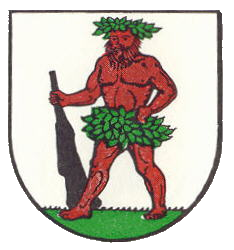 Hertmannsweiler Coat of Arms depicting a leafy wild man holding a black club
Johannes Schneider (1753–1810) Mason, Stone Mason Hertmannsweiler Jakob Friedrich Schneider (1776–1830) Master Stone Mason Hertmannsweiler d. Ellhofen Johann Friedrich Schneider (1802–1863) Master Mason Ellhofen, d. Ellhofen Johann Georg Schneider Sr (1810–1878) Master Mason Eberstadt, d. Queensland Johann Heinrich Schneider (1836–1905) Master Mason, Stone Mason Eberstadt, d. Queensland Johann Georg Schneider Jr (1845–1929) Mason Eberstadt, d. Queensland According to the official reports of the Administrative Offices of Württemberg (1861), all the residents of the districts of Winnenden and Weinsberg, including Ellhofen and Eberstadt, occupied themselves with small scale farming. This was the case even for qualified tradesmen and professionals.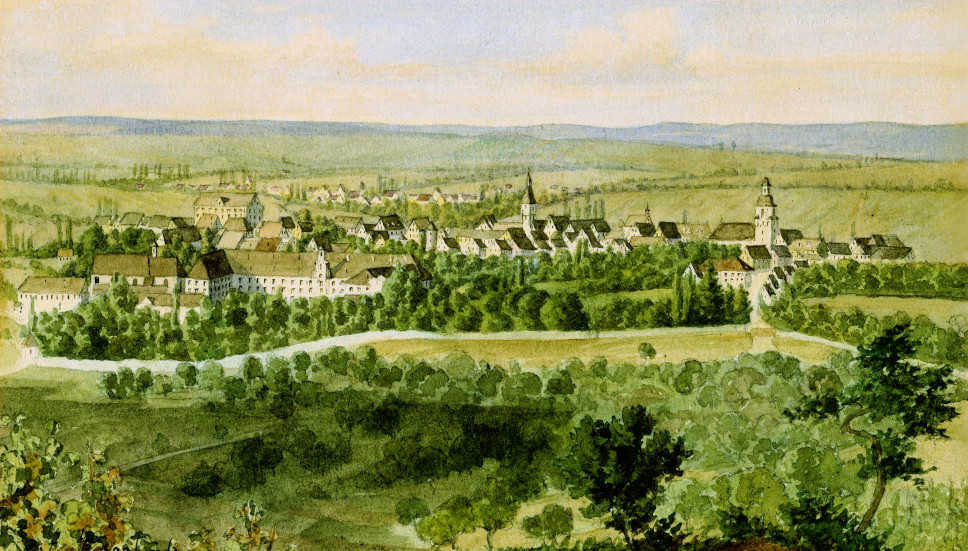
Winnenden (by Julius Kornbeck)
Every household supplied enough food for family use, without any being sold. This meant that the residents were all maintaining a self-sufficient lifestyle, ensuring they had plenty of food and produce from their own fields including grains, fruits, wine and dairy. So the Schneiders, having come from there, would have had plenty of experience and confidence to take up farming upon arrival in Australia, which they all did. Needless to say, if the men were all busy at their day jobs, it was actually left to the women-folk to do all the hard 'yakka' on the farm as well as raising the children.
As was done at the time for occupations with a guild, the generations of our Schneiders formed a family of trained and qualified specialists. Masons and stone masons worked side by side, brother with brother, father with son, passing on both experience and responsibility.
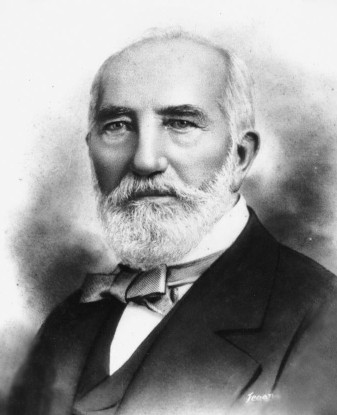
Johann Christian Heussler
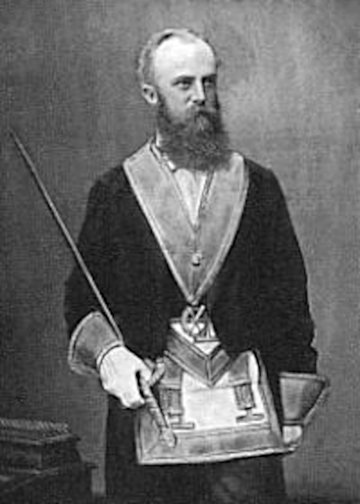
Karl Ludwig Wilhelm Kirchner
How to get to Australia from Germany
1859 saw the creation of the new Colony of Queensland, separating itself from the already existing New South Wales. Around the end of that year, a group of 206 German migrants living in Drayton and Toowoomba petitioned the newly formed Government to encourage more German migration to Queensland. In response to this Johann Christian Heussler was appointed to go to Germany to act as immigration agent for the Queensland Government.
He spent about two years there and eventually two ships, the "Grasbrook" carrying 123 new German settlers and the "Caesar Godeffroy" with 295 more new colonists were sent out. They both arrived in the new land on the same day, November 27, 1861. A few years later, Heussler became a member of the Queensland Legislative Council and his home 'Fernberg' eventually became and still is the residence of the Governor of Queensland.
Back in 1848 though, a German from Frankfurt by the name of Wilhelm Kirchner had already paved the way by writing a book in the German language encouraging his kinsfolk to migrate to the colony of New South Wales. Kirchner had migrated himself in 1839 and returned to Germany in 1848 to espouse the wonders of his newly adopted land. He was so successful with his campaign that the Prussian Government appointed him Consul for the Colony.
The New South Wales Government, also being thrilled by his exploits, enabled him to offer cheap tickets for prospective migrants. One of his big selling points was that the first Governor of New South Wales, Arthur Phillip, was the son of a German who had migrated from Frankfurt to England. That was accompanied by glowing accounts of more food than there were people to eat it, more jobs than there were workers to fill them, a wonderful climate and land just waiting to be owned.
The Schneiders Go to Australia
Whatever the real reason the Schneiders had for migrating to Australia, there had been quite a few tragedies preceding it. In 1859, Johann Georg's second eldest son, Friedrich Karl died from an 'unlucky work accident' at only 21. By then three of his daughters had also died. Johann Georg's eldest brother, Georg Karl, had been lost to Tuberculosis when only 19. Another brother, Johann Friedrich who not only lost two wives and most of his infant children, also died in 1863. For a family business which relied so much on fathers, sons and brothers working together as highly trained and qualified specialists, as well as being close family, to lose so many members must have been shattering to say the least.
So, Johann Heinrich, later known as Henry, along with his young family were the first of our Schneiders to migrate to Australia. They arrived in Moreton Bay on board the 'La Rochelle' in September 1864. Earlier that year, in January, the Lobegeier family migrated on board the 'Susanne Godeffroy'. The mother of that family, Wilhelmina, would later become Henry's second wife. In 1865 Henry's parents Johann Georg and Heinricke Margarethe with the rest of their children also migrated to Australia.
1864 May 28, Departure from Hamburg on the 'La Rochelle'
 Heinrich Schneider, Eberstadt, age 28
Rosine Schneider, age 28
Friederike Schneider, age 6 months1863 September 21, Departure from Hamburg of the 'Susanne Godeffroy'
showing Wilhelmine with her first husband Gottlieb and their four children, all from Stegelitz, Preussen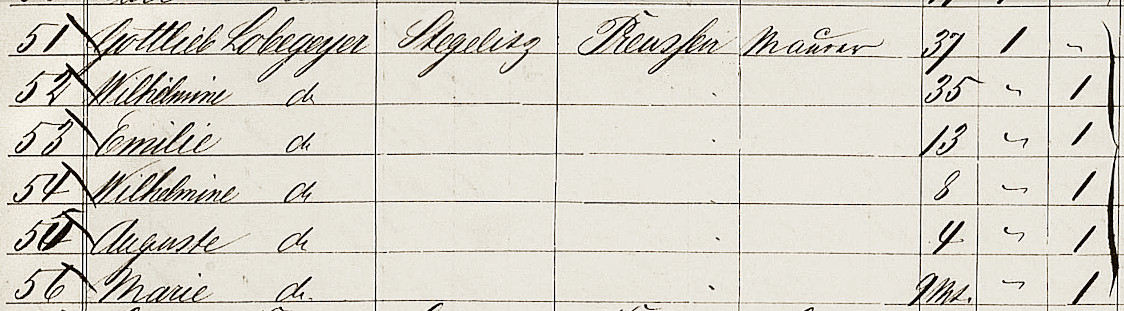 Gottlieb Lobegeyer, age 37
Wilhelmine (born Topp), age 35
Emilie, age 13
Wilhelmine, age 8
Auguste, age 4
Marie, 9 months1865 April 23, Departure from Hamburg of the 'Sophie' with Johann Georg's family.
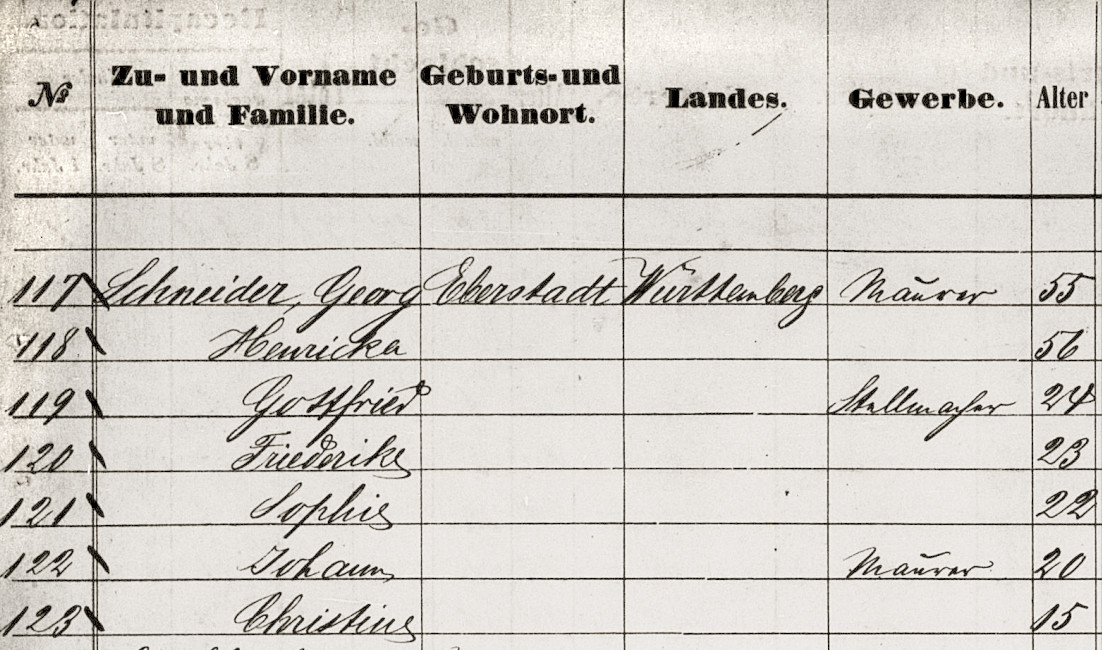
Schneider, Georg 55 Mason Eberstadt Württemberg Henricke 56 Gottfried 24 Wheelwright Friederike 23 Sophie 22 Johann 20 Mason Christine 15
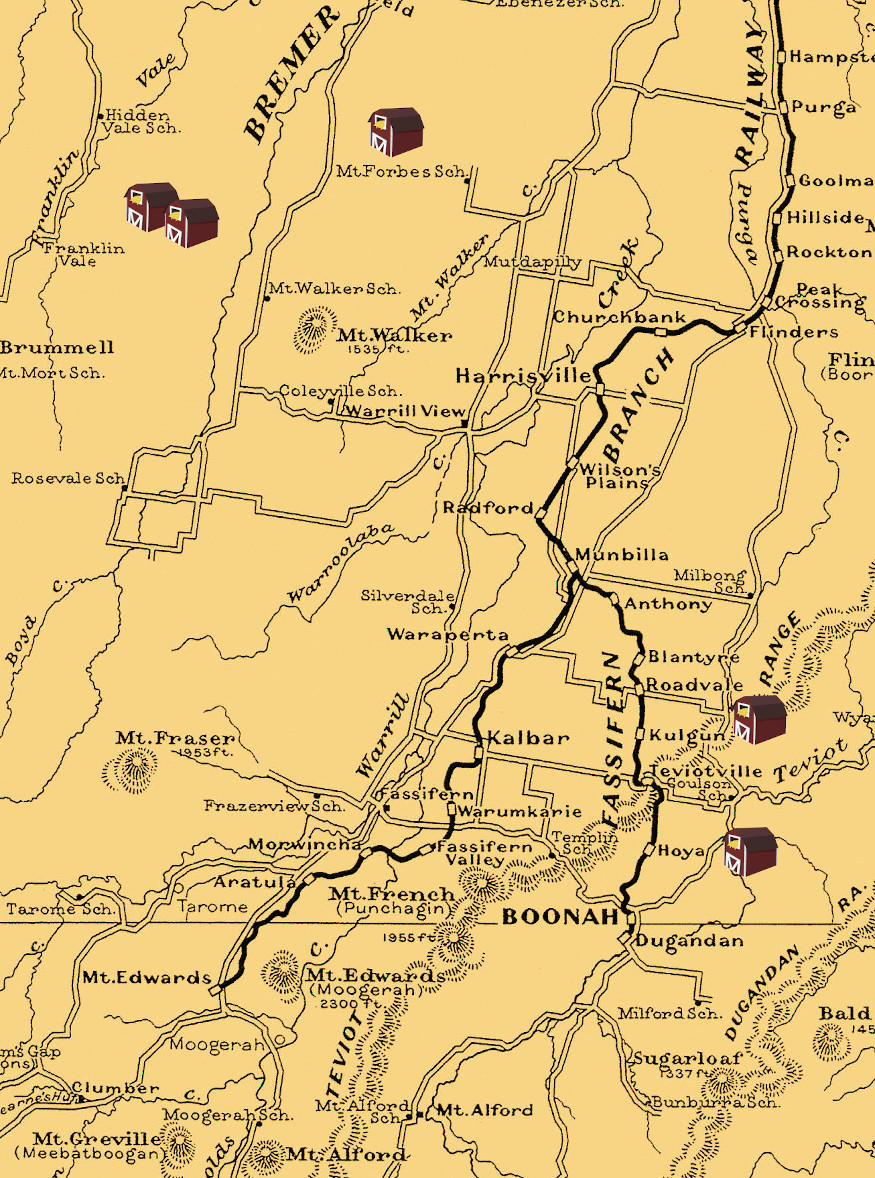
The Fassifern and Boonah district, highlighting some Schneider farms
What the Schneiders Did Next
Upon landing in the new colony on September 5th 1864, Henry and Rosine applied for their own land. Five months after they had first set foot on Australian soil on the 18th February 1865,their application for Land Order 488 in both their names was accepted. That was rather timely because six months later Johann's father, mother, two brothers and three sisters all arrived on August 17th of that year.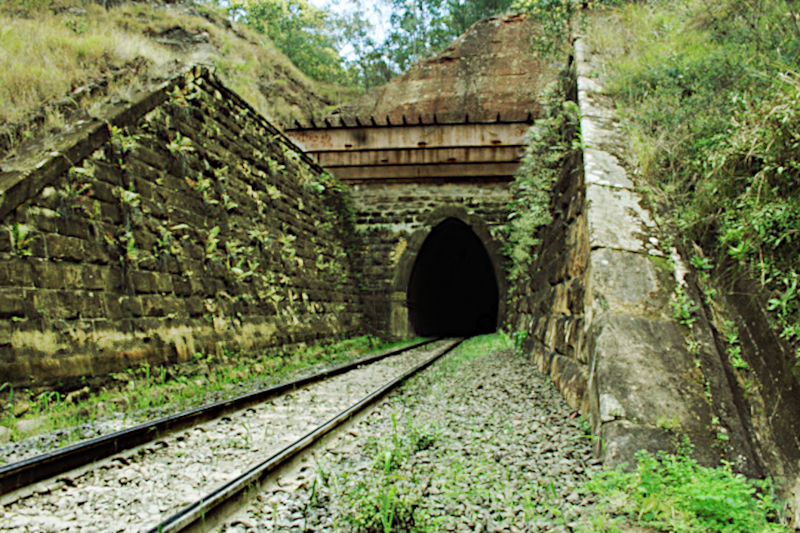
The Victoria Tunnel
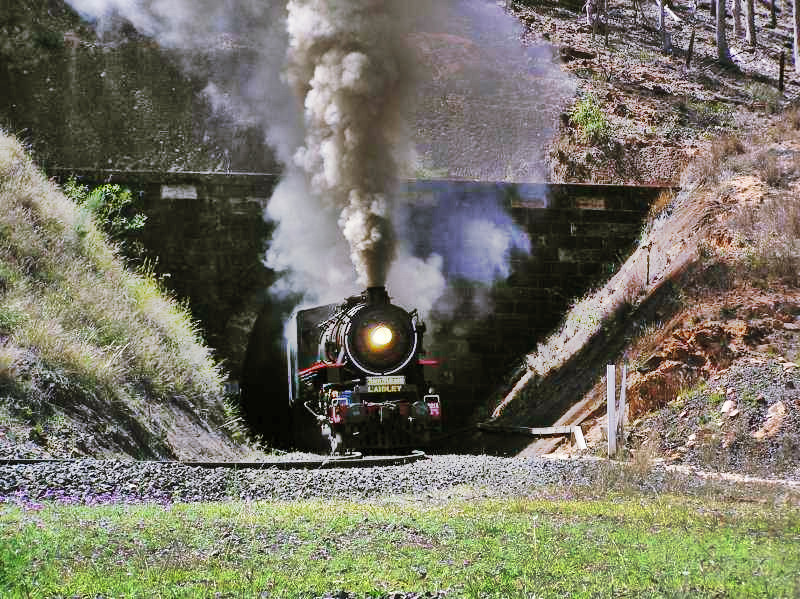
The four Schneider men, Johann Georg and his three sons, Johann Heinrich, Gottfried Friedrich and Johann Georg jun., went to Toowoomba where they prepared stone for the Victoria Tunnel at Grandchester on the new railway line being built between Ipswich and Toowoomba. That was followed by a contract to cut billets to fuel the railway engines already running to Grandchester.
They also very likely contributed to the masonry work on what is now the Govenor's House, Fernberg, in Brisbane, being built at the time for J. C. Heussler (note that some have said that they worked on building Government House but that construction was finsished three years before the Schneiders arrived).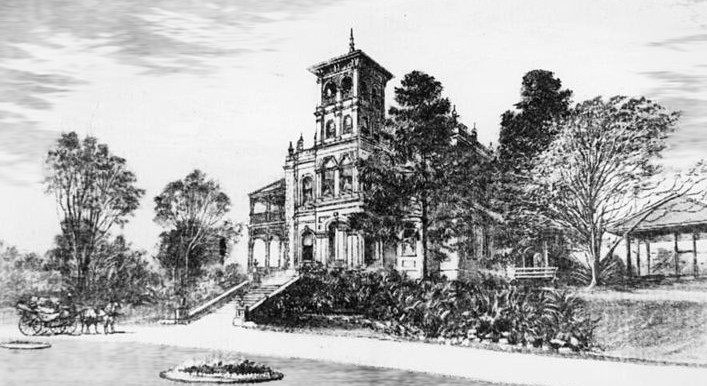
Fernberg in 1891
By 1869 Johann Heinrich and Johann Georg had taken up adjoining land at Franklyn Vale with each having about 122 acres. By 1871 they were both listed, along with Fred, as having homesteads at Mt. Walker and Franklyn Vale, more recently known as Rosevale.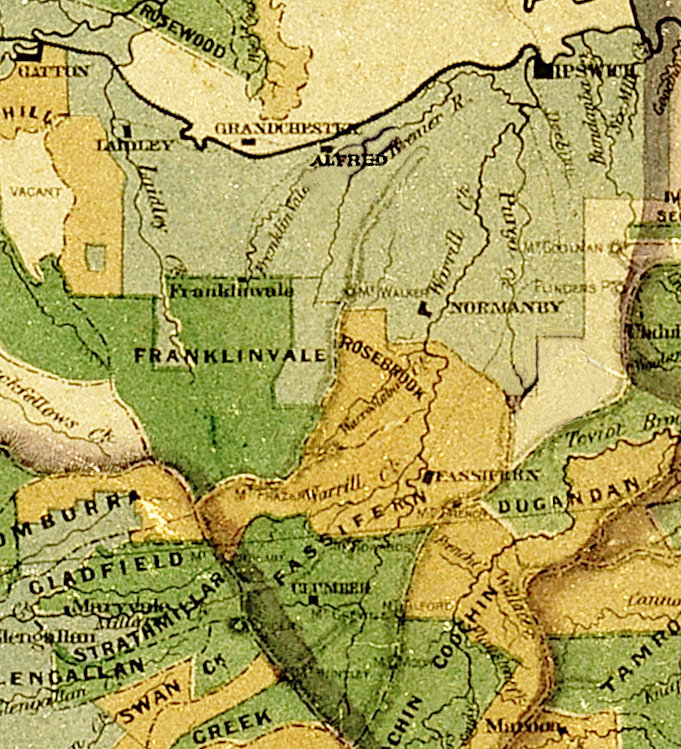
Map showing the Franklinvale and Fassifern Districts
(Ipswich is in the top right corner)
Johann Heinrich's father George had his selection of 40 acres of agricultural land and 80 acres of first class pastoral land in the Parish of Franklin accepted in 1873. At the same time Fred went for 40 acres nearby at Forbes. In 1877 Johann Heinrich took on another 200 acres in the Fassifern district at Kulgun. These are only a few examples of the land purchases but enough to show that the Schneiders were settling in to a place already notorious for its brigalow scrub.
Brigalow is a tenacious plant which spreads rapidly via underground suckers when the bushy outcrops are cut off. Clearing the land of it and establishing farms was intensely back breaking arduous work. The land they worked was nothing short of a wilderness, but as Fred said later in a news article about his life, 'they slaved and saved'. The womenfolk did too. While the men were off earning their living with railway construction, George's wife and daughters went out picking cotton at Booval near Ipswich.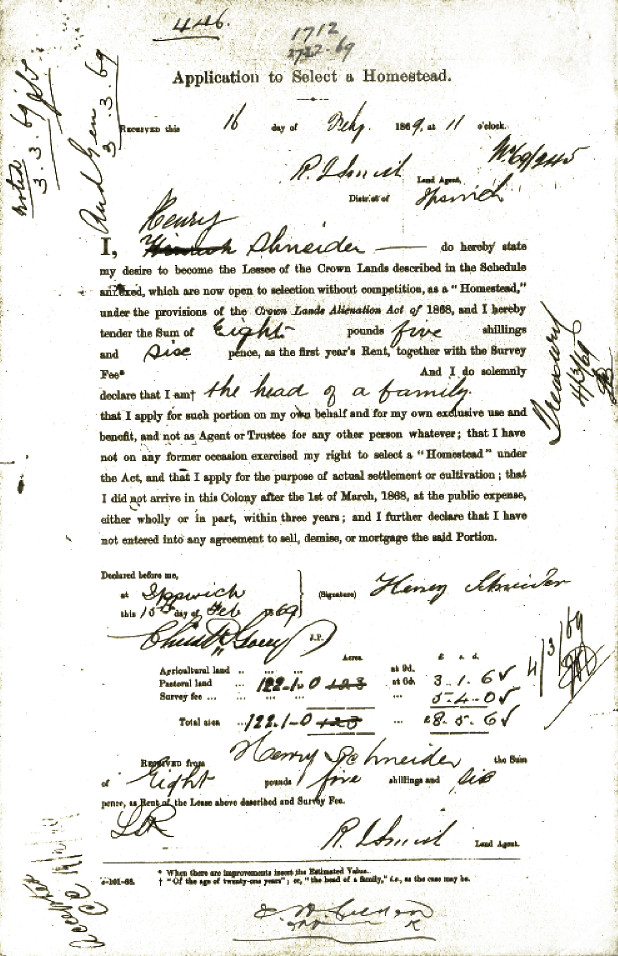
Henry's application to select land
121 acres, 1 rood at Franklyn Vale
Mrs Enid Bell wrote of her 1875 journey into the Fassifern:The train in those days only went as far as Peak Crossing. From there was a 32 mile drive by four in hand to Coochin with a change at Milbong. There was no township at Boonah then. Thick tropical scrub green for miles between Harrisville and Boonah where the train now runs. - Enid Bell manuscript 1904, John Oxley Library, OM80-50and T. R. Paton in his Soils Survey described the historical development of land use in the scrub country:The growing demand by the increasing population for locally produced food crops, together with the 1868 Conditional Purchase Act, led to farming settlement of parts of the area. Since pastoral interests held the more desirable land, the only areas available to the immigrant farmers, mainly German, were the softwood and brigalow scrubs. Thus, between 1870 and 1890 the whole of the Fassifern scrub around Boonah was cleared and occupied. The first crops after clearing were maize and lucerne. By 1900 most of the scrub farms had turned to dairying as the main source of income. This change was hastened by the opening of the railways (Harrisville 1882, Boonah 1887, and Beaudesert 1888).
.jpg)
1856 The Track through Cunningham’s Gap (Conrad Martens)
The Fassifern's Early Days
The earliest Europeans to explore the region later known as the Fassifern were Scots. The first attempt was made in 1827 by the notoriously detested Commandant of the Moreton Bay Penal Settlement, Captain Patrick Logan who hailed from Berwickshire in Scotland. At the very same time, Allan Cunningham, a Scot from Renfrewshire made his way up from the Upper Hunter Valley guided by the Perthshire Scot Peter McIntyre but the party was eventually forced back by the terrain. In 1828 Cunningham made another attempt, this time setting out from Moreton Bay, accompanied by Logan and yet another Scot, the Colonial Botanist Charles Fraser from Blair Atholl in Perthshire. Of course, Cunningham's main interest was his obsession over finding a gap in the Great Dividing Range that would allow the Darling Downs to be connected to Brisbane, for which he was successful on July 24.
The first settlers of the Fassifern Valley were John Cameron from Stirling in Scotland and Robert Coulson who had married Cameron's sister. Cameron's father was a soldier and an early settler of the Upper Hunter Valley having been granted 1280 acres of land near Scone, not far from Peter McIntyre's property. Cameron, not wanting to be a soldier like his father turned his hand to sheep grazing. After first moving to New England and then to the Darling Downs, he finally took out the first lease on the 'Fassifern Run'.Coulson soon followed suit with the neighbouring 'Mooggerah Run'. Altogether the husbands of four of Cameron's sisters took up large runs in the Fassifern: Robert Coulson, Moogerah, William Turner, Tarome, Macquarie McDonald, Dugandan and John Rankin, Maroon.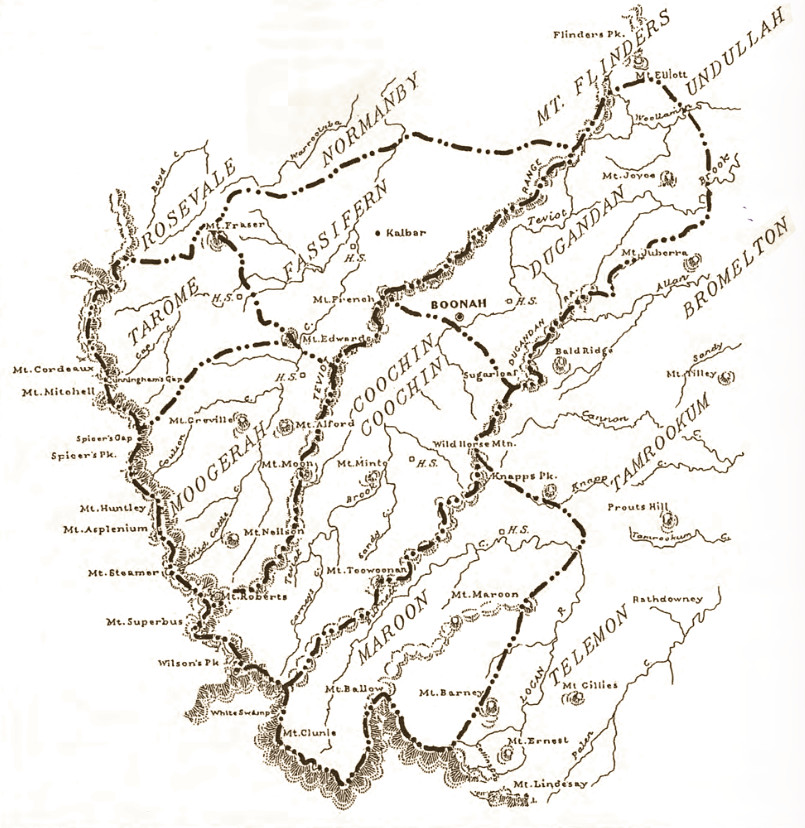
The Runs
The name Fassifern is taken to be derived from the Scottish highland hamlet of Fassiefern on the north shore of Loch Eil and about six miles west of Fort William. The area eventually came under the authority of Clan Cameron. There are many other place names in the Fassifern Valley of Scottish origin but eventually the German influence made itself known.
Place Name Changes in the Scrub Country
The changes that occurred to place names give an indication that the scrub country was being transformed into settlements and towns:Schneiders Road » Kulgun
Fassifern Scrub » Engelsburg » Kalbar
The Scrub » Cornhill » Lowood
One Eye Waterhole » Blantyre » Milbong
Teviotville » Coulson
Dugandan Scrub » Blumbergville » Boonah
Walloon Scrub » Kirchheim » Haigslea
First Plain » Sally Owens' Plains » Rosewood Scrub » Frederick » Marburg » Townshend » Marburg
Rosebrook (run) » Normanby
Normanby » Warrill View
The Schneider Families
So far (2023), the Schneider lineage can be traced back successfully to the beginning of the 1600s, starting with Jacob and Marina. The precise details about this couple are unfortunately unavailable and will require further research. It is interesting to note that as time progressed, the records contained more information, such as occupations, places where they lived and names of godparents.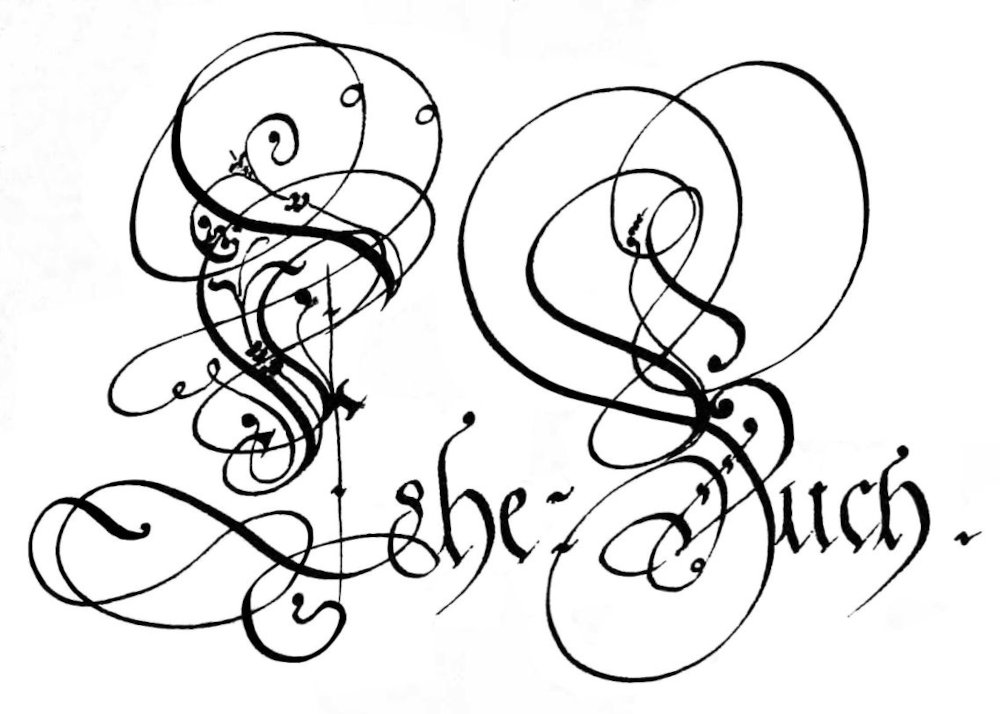
Jacob Schneider was the "Schultheiß" (Mayor) for Oeschingen, a person commissioned by the sovereign or the municipal council with the collection of taxes, the administration of justice and the administration of a municipality. As well as that he was a "Gerichtsverwandter" (clerk of the court) and "Amtsverweser" (district administrator).
From Jacob's death in Oeschingen:
9th (Jan) Jacob Schneider, Mayor, ...
(9. (Jan) Jacob Schneider, Schuldtheiß
From Jacob's son Bernhard's marriage in Mössingen:
Jacob Schneider, Clerk of the Court and District Administrator
for Oeschingen, Office Tübingen, ...
(Jacob Schneider, Gerichtsverwandter und Amtsverweiser
zu Eschingen, Tübingeramt, ...)
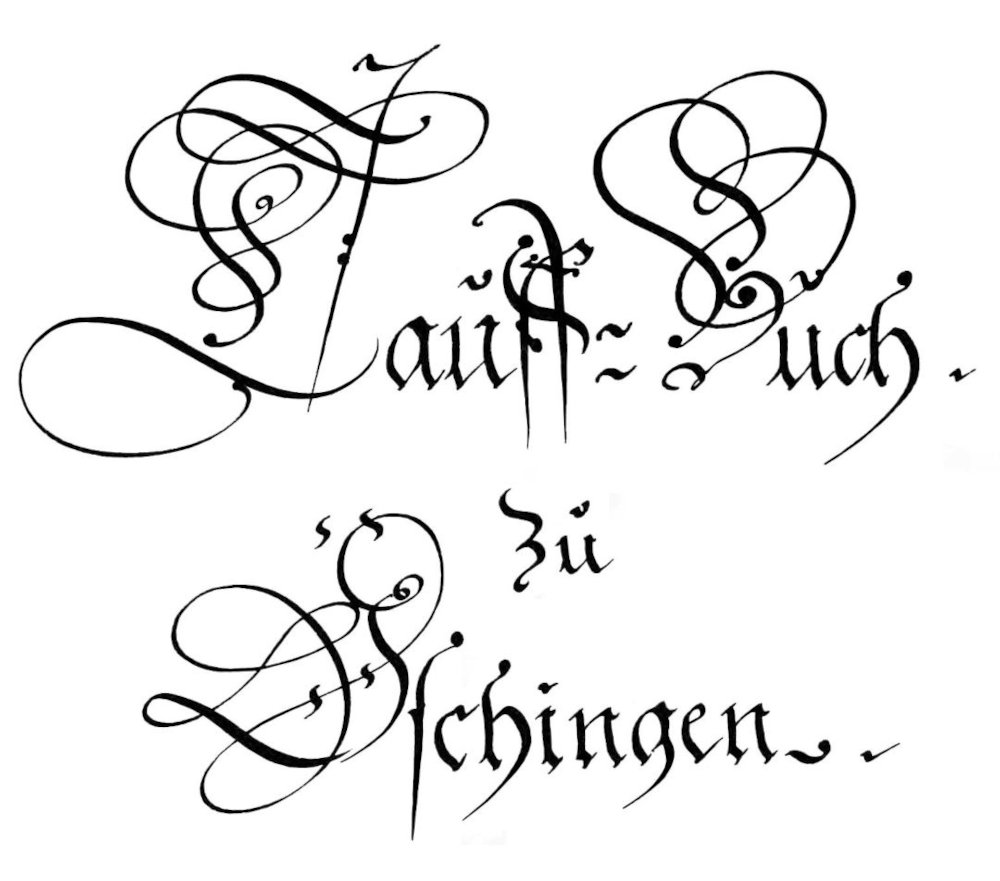
Presented below is a collection of extracts from the Marriage-Book (Ehe-Buch), Baptism-Book (Tauf-Buch) and Burial-Book (Sterbe-Fälle) for each location of the Schneiders, starting from Oeschingen, then on to Hochdorf and Hertmannsweiler and so on as the descendants moved from one place to the next. The elaborate calligraphy shown above comes from the title pages of the relevant volumes in Oeschingen, started in 1700. The one on the left says "Ehe-Buch" (Marriage Book) and the other "Tauff-Buch zu Oeschingen" (Christening Book for Oeschingen).
Just like in many places across the Empire, the Thirty Years War (1618-1648) left a wake of destruction. Six years after the war there were only 223 people left living in Oeschingen. Not many records before 1645 are to be found for Oeschingen. That year the recording of deaths was restarted and in the following year, births and marriages were to follow. Legend has it that in 1643 some French troops on their way home from Austria set fire to Oeschingen and completely destroyed everything except for a chapel and three houses. The dates of the new books seem to add substance to that story.
In 1676, a new type of register, called a "Seelen Register" (Register of Inhabitants) was started and some of the oldest families that were mentioned in the registers had the surname of Schneider. The eldest males listed with their families were Jacob born 29 Jan 1617, Ludis Hanß born 18 Feb 1622, Hans Barthle born 24 Aug 1623 and Jerg Schneider born 9 Nov 1634, mentioned as the son of Alexander.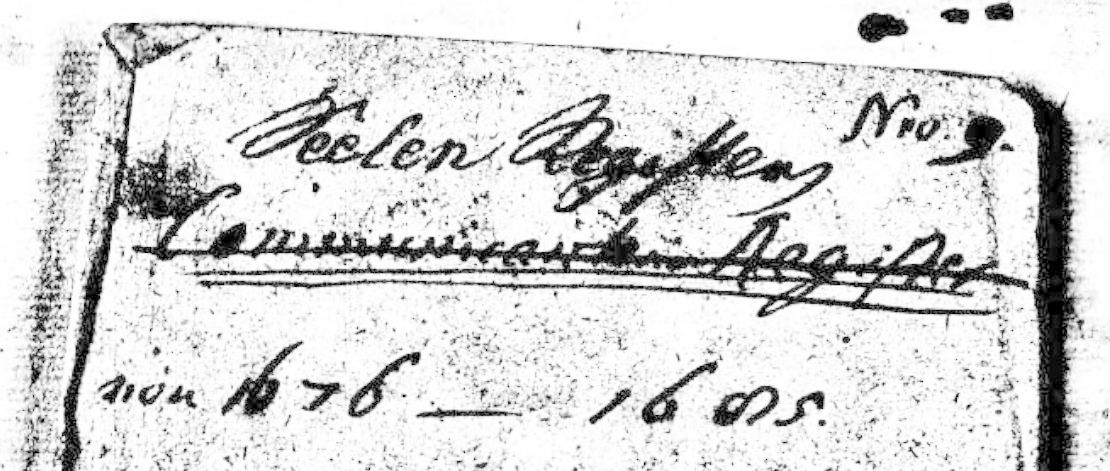
From the registers of deaths it can be gleaned that there were other Schneiders living in Oeschingen in the mid to late 1600s. These people represent the eldest generations (listed in the order of their passing):
Name                   Born   Died       Age  Notes
Anna Maria Schneider   1624   1.Sep.1651  27  (daughter of Pfarrer Martin Schneider)
Joseph Schneider       1599   3.May.1656  57
Lena Schneider               30.Dec.1658      (1st wife of Ludis Hanß Schneider)
Marina Schneider              8.Jan.1662      (1st wife of Jacob Schneider)
Alexander Schneider    1594  25.Feb.1664  73
Barbara Schneider      1600  26.Nov.1664  64  (wife of Alexander Schneider)
Margaretha Schneider   1584  13.Feb.1664  80  (wife of Ulrich Schneider)
Magdalena Schneider           5.Oct.1669      (daughter of Joseph Schneider)
Hanß Caspar Schneider  1591  25.May.1671  80  (Totengräber / Undertaker)
Catharina Schneider    1591  14.Jun.1671  80  (wife of Hanß Caspar Schneider)
Ludwig Hanß Schneider  1622  17.Jan.1677  55  (also known as Ludis Hanß)
Hanß Barthle Schneider 1623  16.Feb.1680  56  (Barthle is short for Bartholomäus)
Jerg Schneider         1634  27.Feb.1681  46  (son of Alexander)
Jacob Schneider        1617   9.Jan.1689  72  (Schuldtheiß / Mayor / Administrator)
Barbara Schneider      1623   2.Oct.1689  66  (widow of Hanß Barthle Schneider)
Apollonia Schneider    1632   9.Feb.1690  58  (2nd wife/widow of Jacob Schneider, sen.)
Anna Schneider         1640  21.Aug.1696  64  (2nd wife of Jacob Schneider jun.)
Ursula Schneider       1640   9.Sep.1696  45  (widow Of Jerg Schneider)
» Jacob Schneider
and Marina (Unknown Surname) (1st marriage)
and Apollonia Scheck (2nd marriage)(the 4x-g-g-parents of the Johann Georg Schneider who migrated to Queensland)
» Jacob Schneider (29.01.1617 – 09.01.1689)
(Schultheiß / Gerichtsverwandter / Ortsgerichtsmitglieder / Amtsverweser / Amtsverwalter)
and 1. Marina (1622 – 08.01.1662)
were married about 1642
and they had the following children:
Barbara Schneider 19.03.1643 –
*Oeschingen06.02.1673
†Oeschingenm. Hanß Frey in Oeschingen, 01.05.1672 » Conrad Schneider 17.03.1645 –
*Oeschingen20.05.1709
†Oeschingenm. Barbara Leipp in Oeschingen, 03.05.1670 Maria Schneider 19.02.1646 –
*Oeschingen08.01.1728
†Oeschingenm. Michel Mauser in Oeschingen, about 1668 Caspar Schneider 28.07.1650 –
*Oeschingen17.10.1724
†unknownm. Maria Rantz in Oeschingen, 27.10.1675 Jerg Schneider 19.03.1652 –
*Oeschingen03.01.1728
†unknownm1. Ursula von Au in Oeschingen, 22.04.1684
(Ursula was the widow of Wolfgang Philipp Sartorius (or Sartorÿ), m. 12.06.1679)
m2. Anna Waldpurga Kuppler in Oeschingen, 18.02.1696
Jacob Schneider
(Major/Amtmann)01.02.1654 –
*Oeschingenunknown
†unknownm. Anna Maria Fell (widow of Hanß Frey) in Oeschingen, 29.06.1681
m. Anna (widow of Christian Gummel) in Oeschingen, 06.02.1694
m. Anna Eissler in Oeschingen, 20.04.1697Johannes (Hanß) Schneider (Blacksmith) 04.05.1656 –
*Oeschingen06.01.1729
†Oeschingenm Agnes Scheck in Oeschingen, 25.02.1685 Bernhard Schneider
(Linen Weaver)24.02.1658 –
*Oeschingen12.11.1713
†Moessingenm. Margaretha Mueller in Moessingen, 10.07.1683 Anna Schneider 04.03.1660 –
*Oeschingenunknown
†unknownstatus unknown
» Jacob Schneider (29.01.1617 – 09.01.1689)
(Schultheiß / Gerichtsverwandter / Ortsgerichtsmitglieder / Amtsverweser / Amtsverwalter)
and 2. Apollonia Scheck (18.10.1632 – 09.02.1690)
were married in Oeschingen, 13.01.1663
and they had the following children:
Martin Schneider 07.08.1664 –
*Oeschingen29.05.1729
†Oeschingenm. Catharina Lutz in Oeschingen, 21.04.1691 Agnes Catharina Schneider 15.03.1666 –
*Oeschingen24.05.1715
†Gomaringenm. Jacob Koenig in Gomaringen, 16.10.1693 Bartholomaeus Schneider 10.08.1668 –
*Oeschingen12.08.1671
†Württemberg(3 years old) Sebastian Schneider 24.02.1670 –
*Oeschingenunknown
†unknownstatus unknown Ursula Schneider 13.04.1672 –
*Oeschingenunknown
†unknownstatus unknown Apollonia Schneider 19.12.1673 –
*Oeschingen08.03.1707
†Oeschingenumarried (was on record as an orphan)
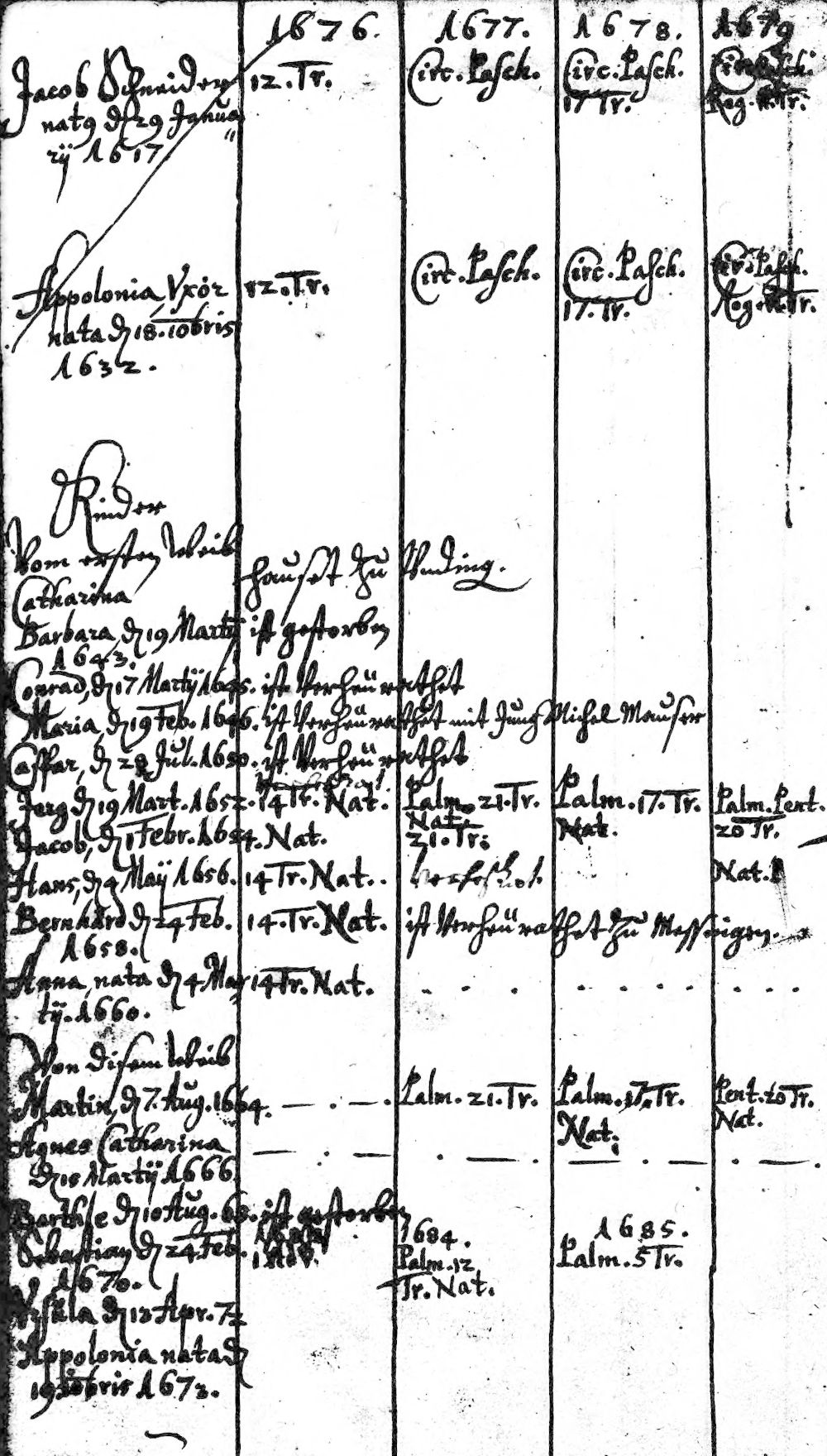 Family Register
1643 Birth of Barbara
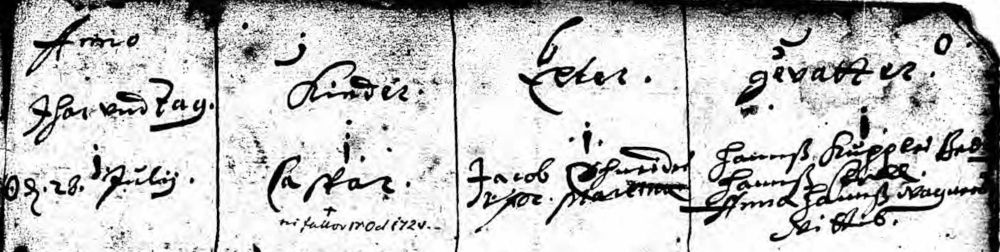
1650 Birth of Caspar

1656 Birth of Johannes

1664 Birth of Martin

1670 Birth of Sebastian
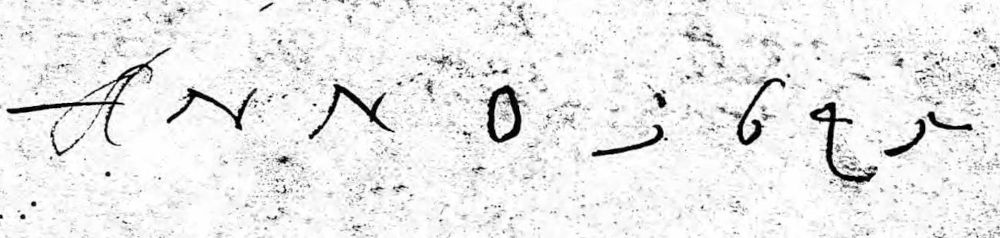
1645 Birth of Conrad

1652 Birth of Jerg
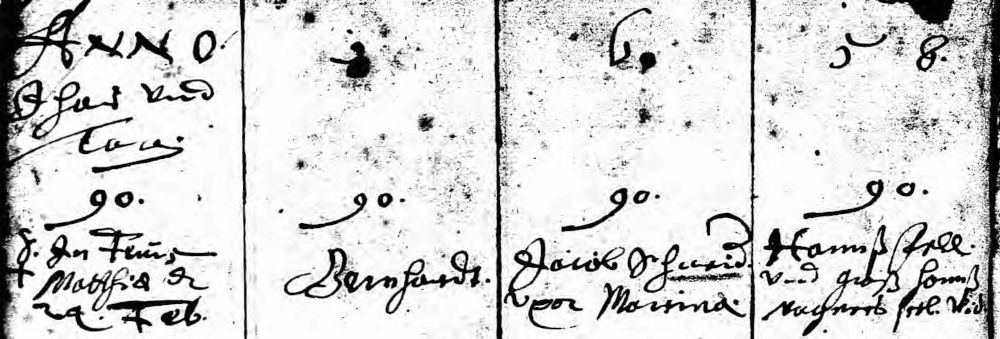
1658 Birth of Bernhard
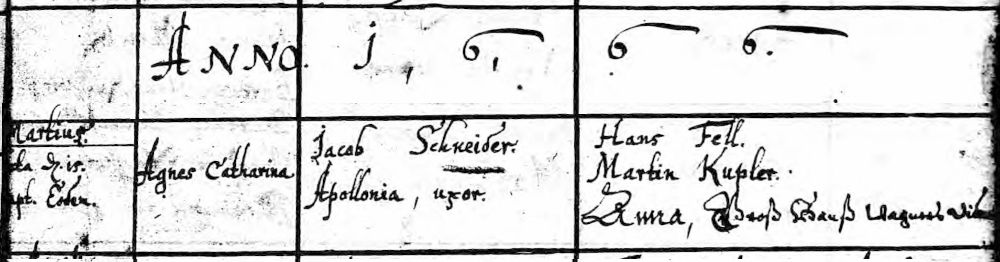
1666 Birth of Agnes Catharina

1672 Birth of Ursula
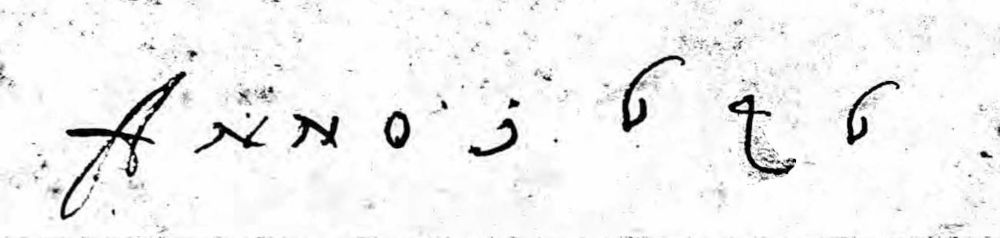
1646 Birth of Maria
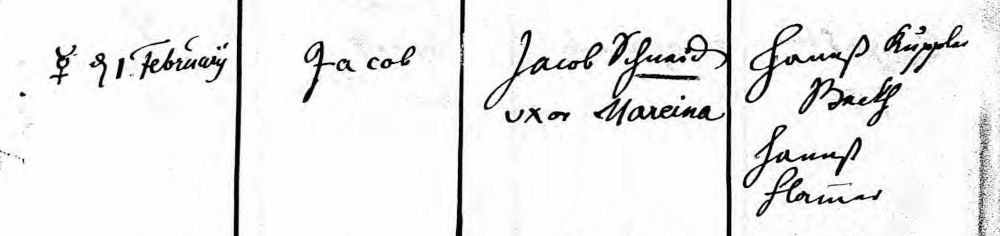
1654 Birth of Jacob

1660 Birth of Anna

1668 Birth of Bartholomaeus
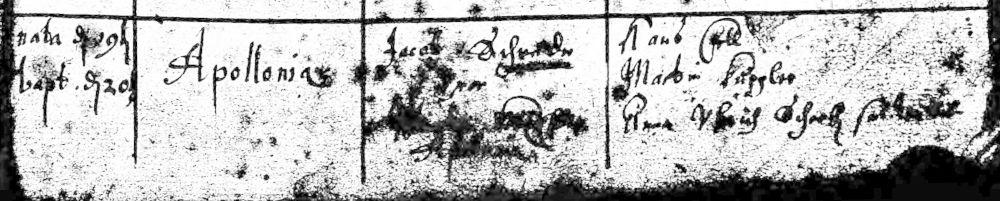
1673 Birth of Apollonia
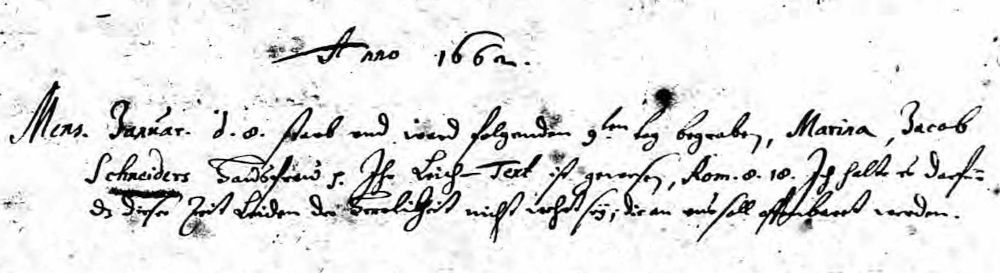 1662 Jan 18 - Death of Jacob's 1st wife, Marina in Oeschingen, aged 40
 1663 Jan 13 - Jacob's 2nd marriage - to Apollonia Scheck
Above: Oeschingen Records for the family of Jacob Schneider with his first wife Marina (Unknown Surname), married about 1642 and his second wife Apollonia Scheck, married in 1663
1663 Jan 13 - Jacob's 2nd marriage - to Apollonia Scheck
Above: Oeschingen Records for the family of Jacob Schneider with his first wife Marina (Unknown Surname), married about 1642 and his second wife Apollonia Scheck, married in 1663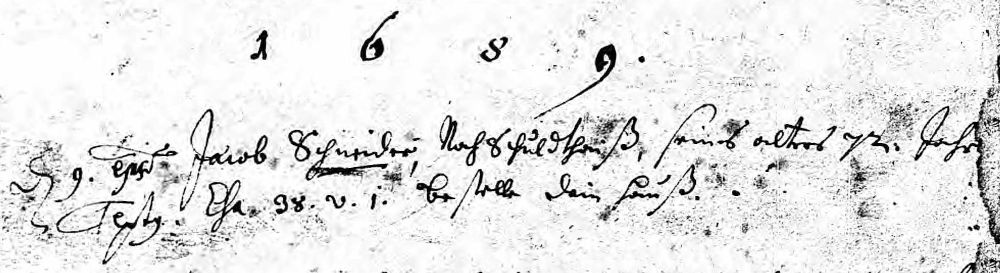 1689 Jan 9 - Death of Jacob in
Oeschingen, aged 72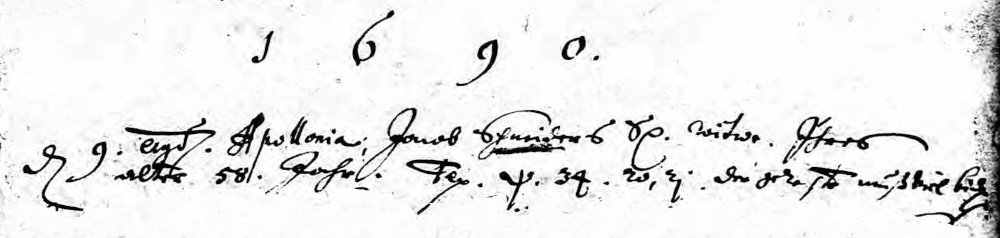 1690 Feb 9 - Death of Jacob's 2nd wife, Apollonia in Oeschingen, aged 58
» Ludis (Ludwig) Hanß Schneider
(was very likely a younger brother of Jacob Schneider 1617-1689)
» Ludis Hanß Schneider (18.02.1622 – 17.01.1677)
and Magdalena (unknown surname) ( – 30.12.1658)
were married about 1644and they had the following children:Above: Oeschingen Records for the family of Ludis (Ludwig) Hanß Schneider including the family register listing his children, as well as those of the death of his first wife Magdalena (Unknown Surname) in 1658 (married about 1644), his second marriage to Agnes (Unknown Surname) in 1664, and his own death in 1677.
Maria Schneider ??.??.1645 –
*Oeschingenunknown
†unknown(moved to Tübingen) Anna Schneider 23.05.1649 –
*Oeschingenunknown
†unknownstatus unknown Hans Jerg Schneider 22.01.1650 –
*Oeschingenunknown
†unknownstatus unknown Martin Schneider 26.01.1653 –
*Oeschingen03.03.1704
†Oeschingenunmarried Matthias Schneider 03.06.1655 –
*Oeschingenunknown
†unknownm. Anna Scheck in Oeschingen, 04.02.1679
» Ludis Hanß Schneider (18.02.1622 – 17.01.1677)
and Agnes (unknown surname) (1634 – )
were married in Oeschingen, 02.05.1664
and they had the following children:
Catharina Schneider 23.04.1665 –
*Oeschingenunknown
†unknownstatus unknown Anna Maria Schneider 20.09.1666 –
*Oeschingenunknown
†unknownstatus unknown Margaretha Schneider 16.01.1670 –
*Oeschingenunknown
†unknownstatus unknown Barbara Schneider 16.01.1670 –
*Oeschingenunknown
†unknownstatus unknown Agatha Schneider 16.01.1670 –
*Oeschingenunknown
†unknownstatus unknown Magdalena Schneider 18.04.1671 –
*Oeschingenunknown
†unknownstatus unknown
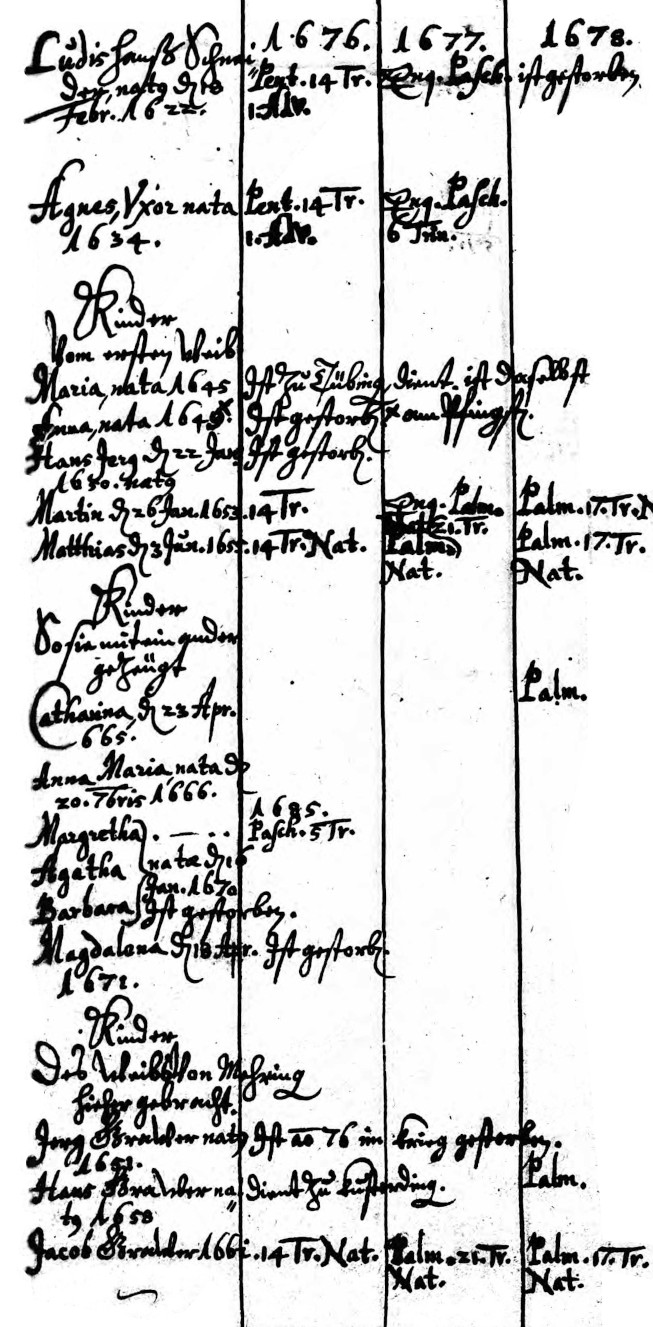 Family Register
(Seelenregister)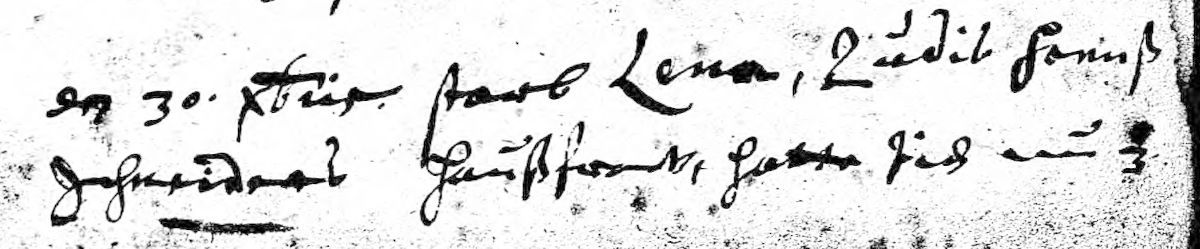 1658 Dec 30
Death of Lena (Magdalena)
in Oeschingen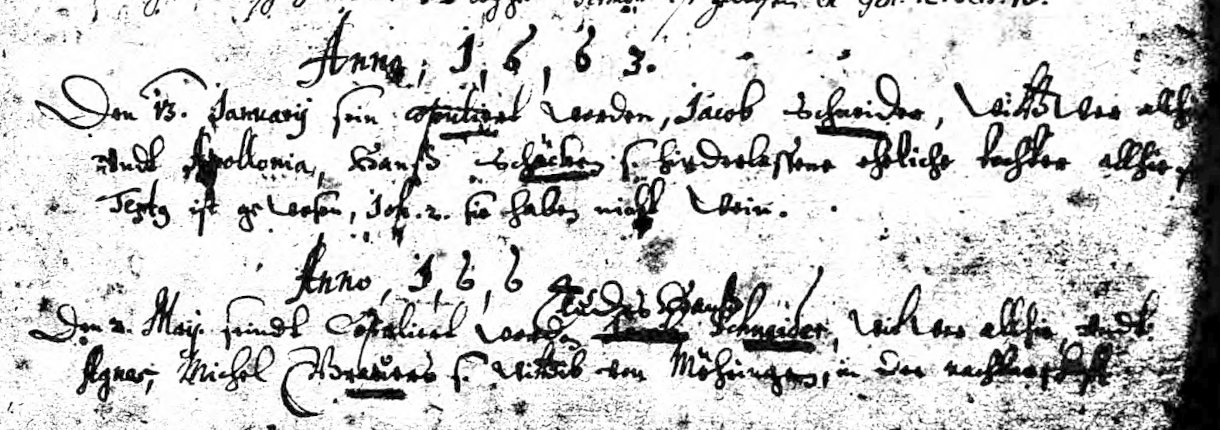 1664 Jan 13
Marriage of Ludis and Agnes in Oeschingen
(lower section)
The 1663 record (upper section) is that of Jacob Schneider's second marriage. 1677 Jan 17
Death of Ludis in Oeschingen, aged 55
» Hans Barthle Schneider
(was very likely a younger brother of Jacob Schneider 1617-1689)
» Hans Barthle Schneider (24.08.1623 – 16.02.1680)
and Barbara von Au (10.11.1622 – 02.10.1689)
were married in Oeschingen, 06.06.1649and they had the following children:
Anna Schneider 17.12.1650 –
*Oeschingenunknown
†unknownm. Hanß Mauser in Oeschingen, 07.05.1672 Marthen Schneider 19.11.1654 –
*Oeschingenunknown
†unknownm. Anna Eissler in Oeschingen, 31.10.1682 Barbara Schneider 06.01.1657 –
*Oeschingenunknown
†unknownm. Adam Bader in Oeschingen, 11.02.1681
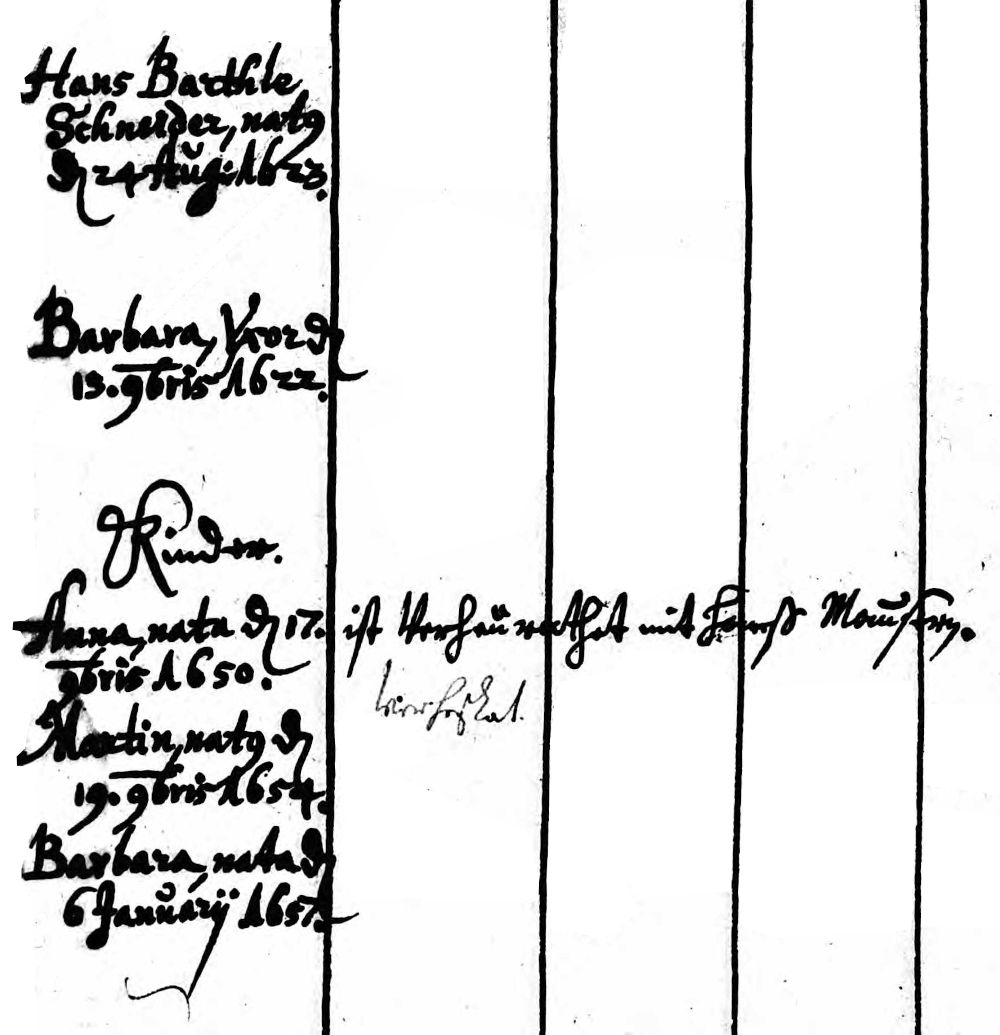 Family Register
 1649 Jun 6 Marriage of Hans Barthle and Barbara in Oeschingen
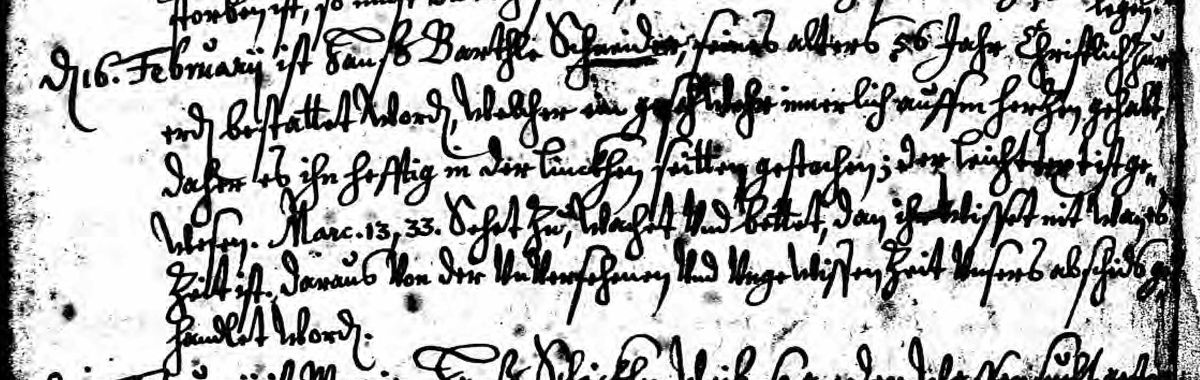 1680 Feb 16 Death of Hans Barthle, aged 56, in Oeschingen
 1689 Oct 2 Death of Barbara, aged 66, in Oeschingen
» Conrad Schneider
and Barbara Leipp(the 3x-g-g-parents of the Johann Georg Schneider who migrated to Queensland)
» Conrad Schneider (17.03.1645 – 20.05.1709)
and Barbara Leipp (02.05.1650 – 05.09.1729)
were married in Oeschingen, 03.05.1670and they had the following children:
Michel Schneider (Weaver) 21.01.1671 –
*Oeschingen05.08.1704
†Oeschingenm. Maria Wagner in Oeschingen, 24.02.1696 (bride was pregnant) Jacob Schneider 11.01.1673 –
*Oeschingen10.04.1742
†Oeschingenm. Anna Barbara Scheck in Oeschingen, 25.07.1701 Johannes (Hanß) Schneider 21.06.1675 –
*Oeschingenunknown
†unknownm. Anna Heintz in Oeschingen, 24.06.1702 » Johann Conrad (Hanß Cunrad) Schneider (Weaver) 10.03.1678 –
*Oeschingen31.05.1738
†Hochdorfm. Anna Margaretha Schmid in Hochdorf, 14.02.1707 Agnes Schneider 09.05.1682 –
*Oeschingen16.01.1747
†Oeschingenm. Jakob Haug, 24.10.1715 Maria Barbara Schneider 30.12.1688 –
*Oeschingen1.03.1753
†unknownm. Hans Holfinger in Oeschingen, 16.10.1709
 1670 Marriage of Conrad Schneider and Barbara Leipp in Oeschingen
Family Register
1670 Marriage of Conrad Schneider and Barbara Leipp in Oeschingen
Family Register
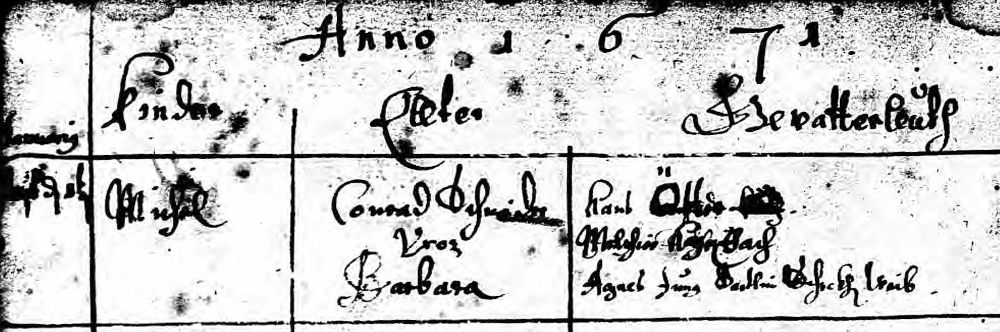
1670 Birth of Michel
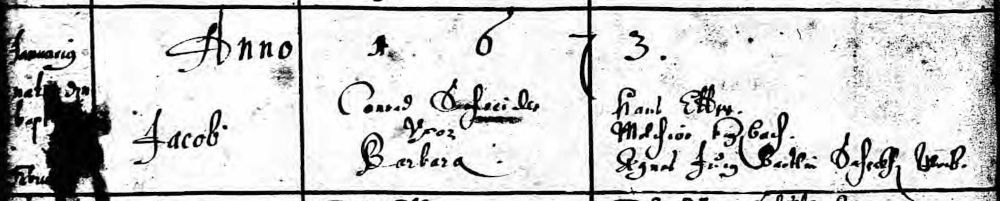
1673 Birth of Jacob

1675 Birth of Johannes
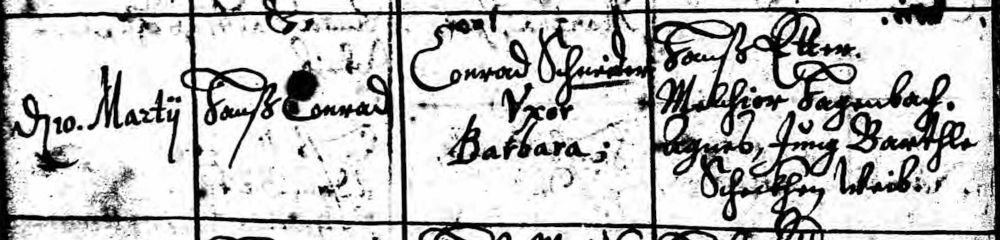
1678 Birth of Hanss Conrad
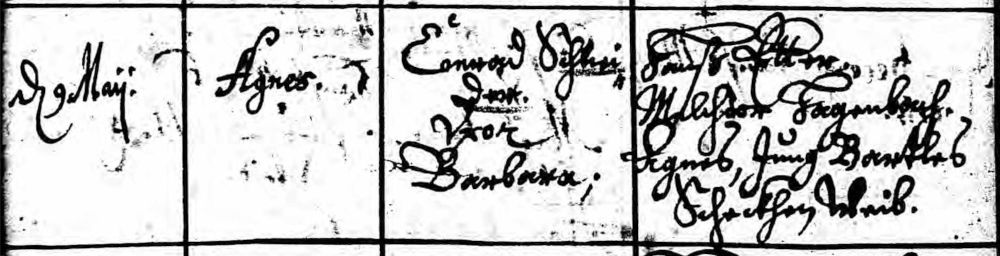
1682 Birth of Agnes
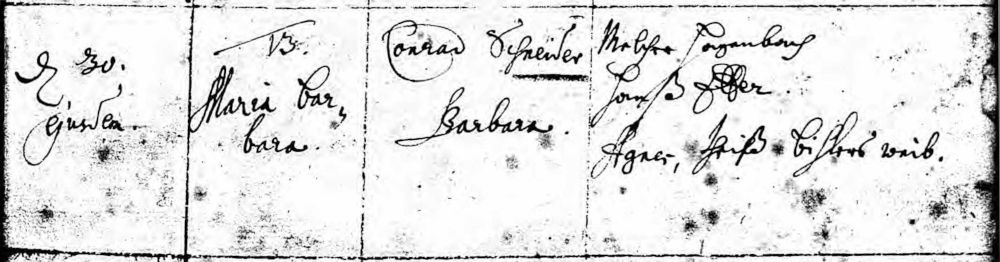
1688 Birth of Maria Barbara
Above: Oeschingen Records for the family of Conrad Schneider and his wife Barbara Leipp, married 1670 1709 May 30 - Death of Conrad in Oeschingen, aged 64
 1729 Sep 5 - Death of Barbara in Oeschingen, aged 78
» Johann Conrad (Hanß Cunrad) Schneider
and Anna Margaretha Schmid(the 2x-g-g-parents of the Johann Georg Schneider who migrated to Queensland)
» Johann Conrad (Hanß Cunrad) Schneider (10.03.1678 – 31.05.1738)
(Weaver)
and Anna Margaretha Schmid (31.07.1683 – 02.11.1766)
were married in Hochdorf, 14.02.1707and they had the following children:
Johann (Hanß) Jacob Schneider 21.02.1708 –
*Thalheim13.03.1768
†Hochdorfm. Agatha Schott (widow of Jacob Schott) in Hochdorf, 04.11.1738 Johann (Hanß) Conrad Schneider 16.08.1709 –
*Hochdorfunknown
†unknownstatus unknown Johann (Hanß) Michel Schneider 23.01.1712 –
*Hochdorfunknown
†unknownstatus unknown Johann Georg (Hanß Jerg) Schneider 26.03.1713 –
*Hochdorf02.01.1776
†Hochdorfstatus unknown Johannes Schneider 31.07.1714 –
*Hochdorfunknown
†unknownstatus unknown » Andreas Friedrich Schneider 30.11.1715 –
*Hochdorf17.07.1794
†unknownm. Maria Agnes Unger in Hochdorf, 07.06.1746 Friedrich Ludwig Schneider 09.03.1717 –
*Hochdorfunknown
†unknownstatus unknown Maria Catharina Schneider 10.10.1719 –
*Hochdorf16.12.1724
†Hochdorf(almost 5 years old) Christoph Schneider 14.03.1721 –
*Hochdorf26.09.1726
†Hochdorf(died aged 5 from Typhus) Maria Barbara Schneider 09.06.1722 –
*Hochdorf31.12.1804
†Hochdorfm. Johann Michael Schmid in Hochdorf, 24.01.1769 Maria Catharina Schneider 03.12.1725 –
*Hochdorfunknown
†unknownstatus unknown
Above: Hochdorf Records for the family of Johann Conrad Schneider and his wife Anna Margaretha Schmid, married 1707
Family Register

1708 Birth of Johann Jacob
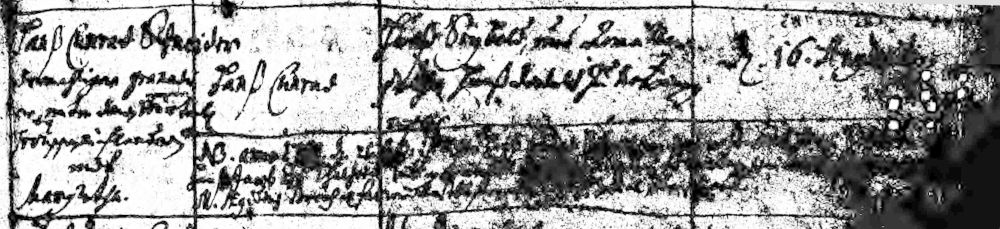
1709 Birth of Hanss Conrad
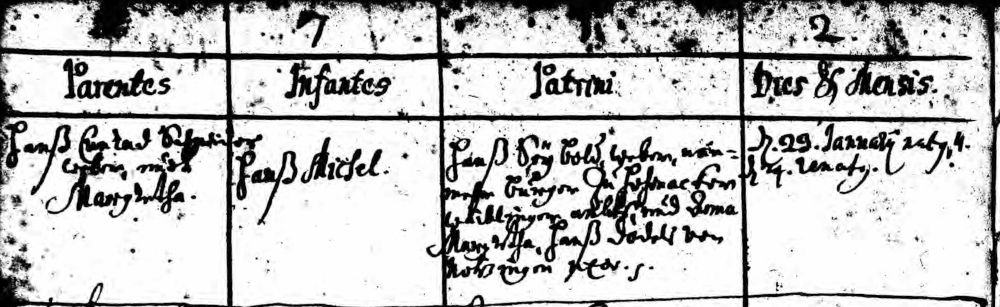
1712 Birth of Hanss Michel

1713 Birth of Hanss Jerg

1714 Birth of Johannes

1715 Birth of Andreas Friedrich

1717 Birth of Friedrich Ludwig

1719 Birth of Maria Catharina

1721 Birth of Christoph

1722 Birth of Maria Barbara

1725 Birth of Maria Catharina
By the age of 29, Johann Conrad had moved from his birthplace of Oeschingen to a place called Hochdorf about 50km to the north-east. Since he is recorded many times as a weaver in both places he obviously took up work there. Hochdorf at the time was a place full to the brim with weavers (Weber) and tailors (Schneider). It's interesting to note that Johann Conrad Schneider was actually called Hanß (or Hanss) Cunrad Schneider when he was born. Early in his life, namely for the births of his first nine children, his name was recorded as Cunrad (or Conrad) but for the last two children it was Hanß (or Hanss). Likewise when Johann's son, who was born as Hanß Jerg, died, he was recorded as Johann Georg. This could indicate a general modernistation of names around the middle of the eighteenth century.
When his daughter, Maria Barbara was 46, she married the 26 year old carpenter, Johann Michael Schmid. A year after she died at the age of 82, Johann Michael, who was then 62 was remarried to a 26 year old Eva Rosina Unger and together they had 5 children.
Andreas Friedrich Schneider
and Maria Agnes Unger(the great-grandparents of the Johann Georg Schneider who migrated to Queensland)
» Andreas Friedrich Schneider (30.11.1715 – 17.07.1794)
(Bürger und Bauer / Resident and Farmer)
and Maria Agnes Unger (19.03.1717 – 05.11.1782)
were married in Hochdorf, Kirchheim, 07.06.1746and they had the following children:
Georg Friedrich Schneider
(Soldier)19.02.1748 –
*Hochdorf21.09.1801
†Hochdorfm. Maria Agnes Spilmann in Hochdorf, 28.01.1777 Sabina Schneider 30.10.1750 –
*Hochdorfunknown
†unknownmarriage status unknown » Johannes Schneider
(Steinhauer & Maurer /
Stone Mason & Builder)03.07.1753 –
*Hochdorf07.09.1810
†Hochdorfm. Philippina Caroline Margarethe Rincker in Hochdorf, 23.05.1775
(in 1775, moved to Hertmannsweiler)Maria Agnes Schneider 13.03.1756 –
*Hochdorf26.09.1763
†Hochdorf(about 7 years old) Maria Barbara Schneider 22.07.1760 –
*Hochdorf12.12.1819
†Hochdorfm. Johann Michael Fischer in Hochdorf, 12.08.1783
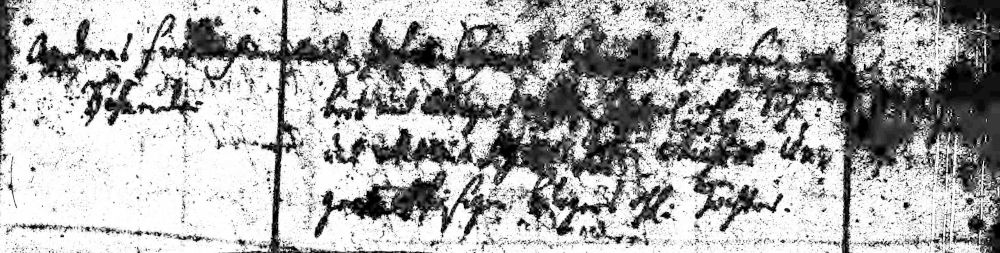 1746 Marriage of Andreas and Maria in Hochdorf
Above: Hochdorf Records for the family of Andreas Friedrich Schneider and his wife Maria Agnes Unger, married 1746
1746 Marriage of Andreas and Maria in Hochdorf
Above: Hochdorf Records for the family of Andreas Friedrich Schneider and his wife Maria Agnes Unger, married 1746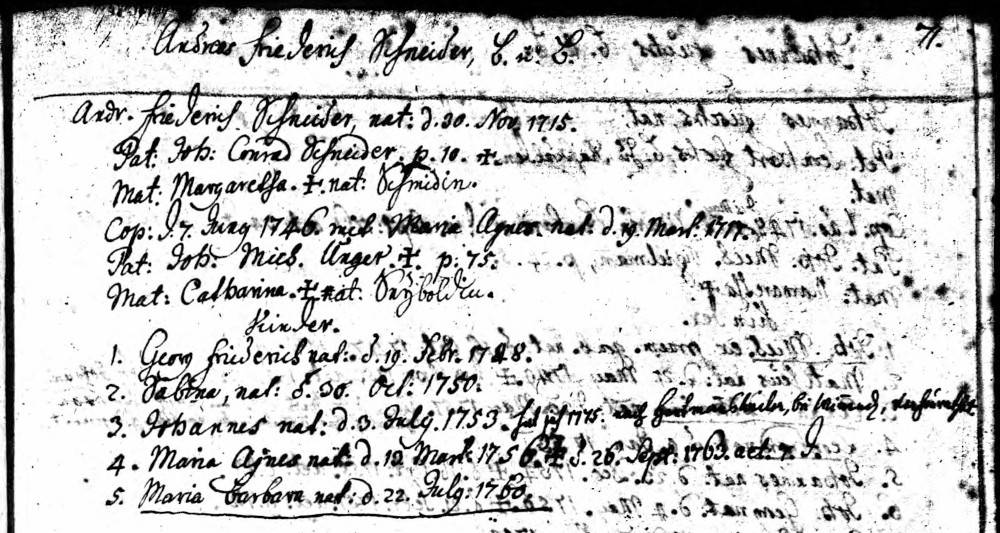 Family Register
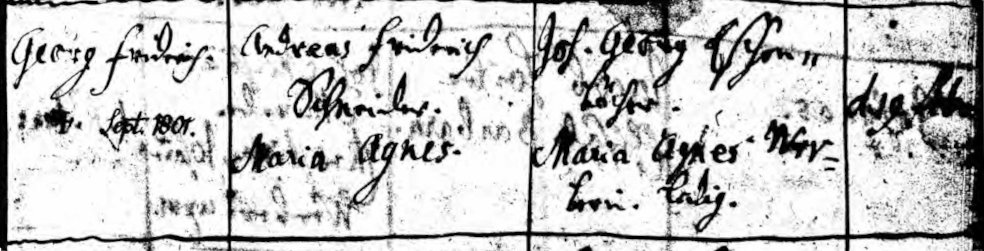
1748 Birth of Georg Friedrich
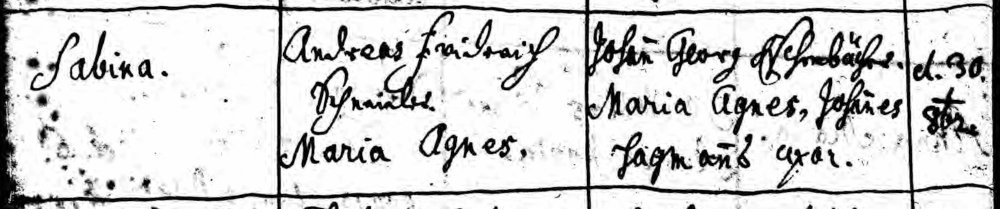
1750 Birth of Sabina
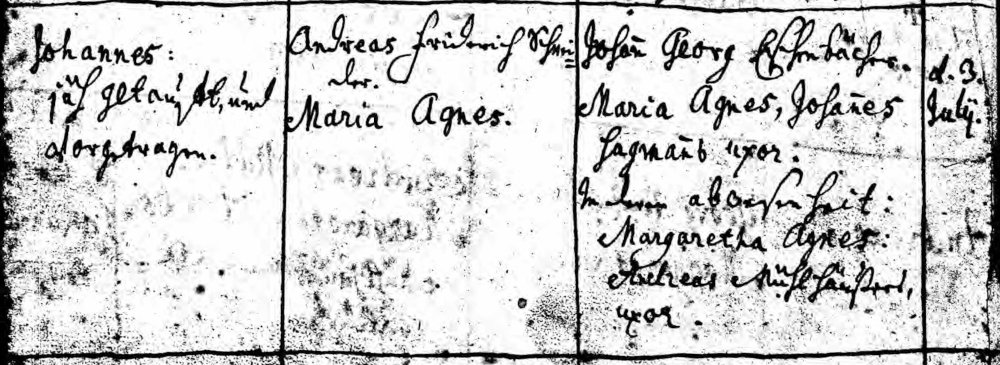
1753 Birth of Johannes
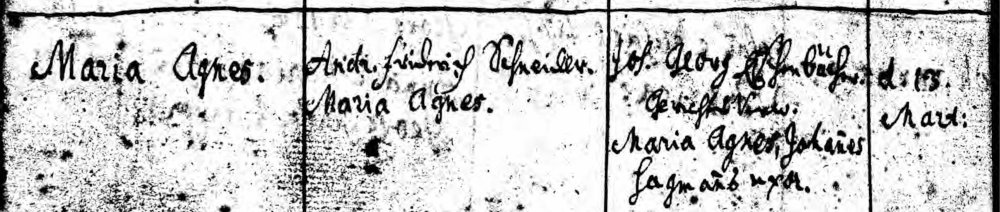
1756 Birth of Maria Agnes
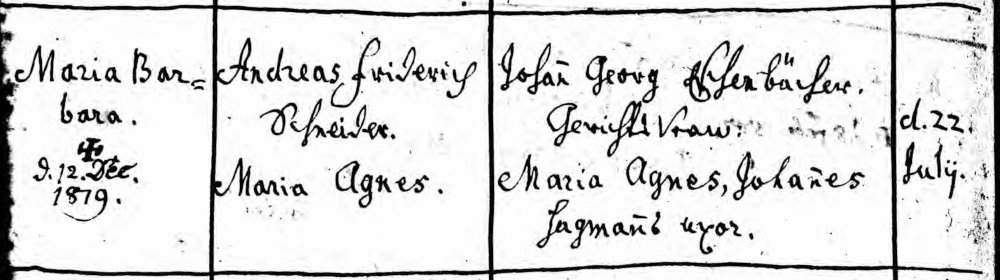
1760 Birth of Maria Barbara
» Johannes Schneider
and Philippina Caroline Margarethe Rincker(the grandparents of the Johann Georg Schneider who migrated to Queensland)
» Johannes Schneider (03.07.1753 – 07.09.1810)
and Philippina Caroline Margarethe Rincker (24.04.1750 – 01.09.1820)
were married in Hochdorf, Kirchheim, 23.05.1775and they had the following children:
» Jakob Johann Friedrich Schneider 15.04.1776 –
*Hertmannsweiler07.01.1830
†Ellhofenm. Rosina Heinrica Lauer in Ellhofen, 06.11.1798 Philippina Carolina Schneider 06.05.1785 –
*Hertmannsweilerunknown
†unknownm. Johann Gottlieb Winkle (shoemaker) in Hertmannsweiler, 25.04.1804 Johann Georg Schneider
(Schneidermeister)
(Master Tailor)10.06.1789 –
*Hertmannsweiler29.10.1839
†Hertmannsweilerm. Christina Margaretha Klöpfer in Hertmannsweiler, 22.06.1813
m. Maria Caroline Kienzle in Heutensbach, 08.05.1832
(Maria migrated to America in 1851 with her 3rd husband Johann Gottlieb Bös)Johannes Schneider 28.12.1793 –
*Hertmannsweilerunknown
†unknownmarriage status unknown
the family register states that there were another four children who had died
Above: Hertmannsweiler Records for family of Johannes Schneider and wife Philippina Caroline Margarethe Rincker, married 1775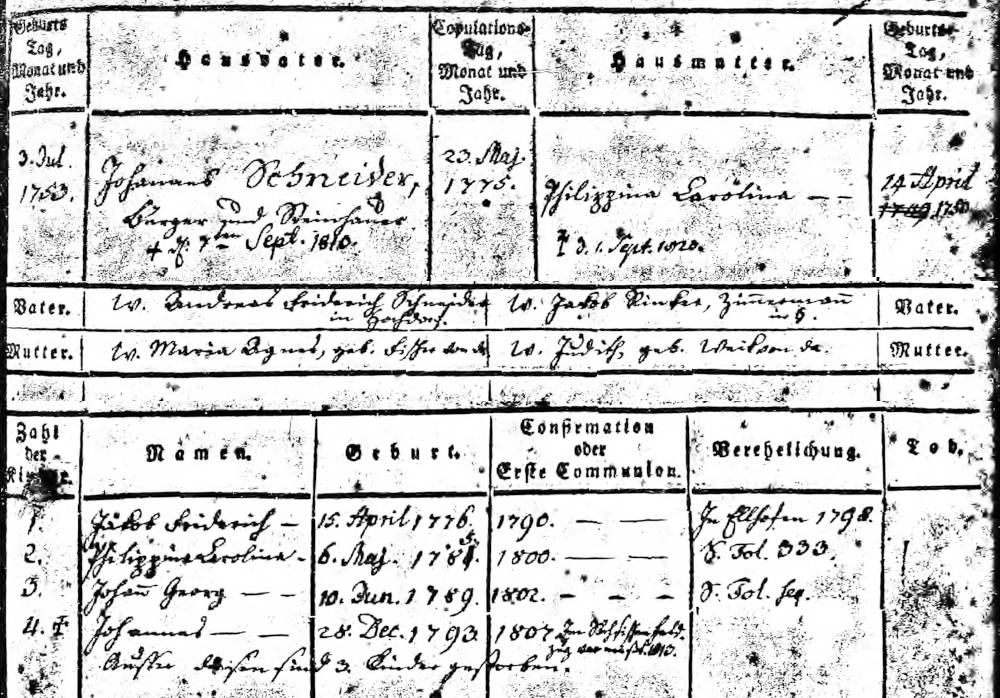 Family Register

1776 Birth of Jacob Friedrich

1785 Birth of Philippina

1789 Birth of Johann Georg
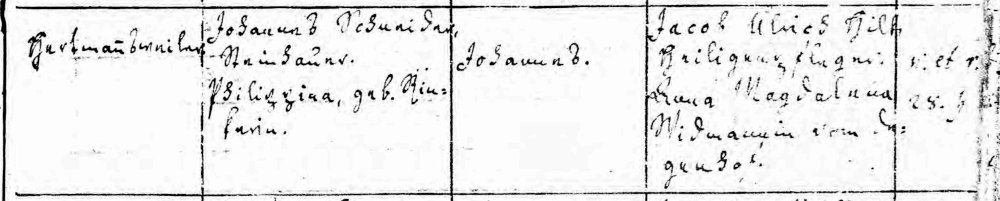
1793 Birth of Johannes
» Jakob (Johann Friedrich) Schneider
and Rosina Heinrica Lauer(the parents of the Johann Georg Schneider who migrated to Queensland)
» Jakob (Johann) Friedrich Schneider (15.04.1776 – 07.01.1830)
(Master Stone Mason / Steinhauermeister, son of Johannes)
and Rosina Heinrica Lauer (14.08.1772 – 18.11.1846)
were married in Ellhofen, 06.11.1798
and they had the following children:
Georg Karl Schneider 21.05.1796 –
*Hertmannsweiler04.09.1815
†Ellhofen(19 yrs old) died from Tuberculosis,
unmarriedJakob Friedrich Schneider 21.07.1799 –
*Hertmannsweiler25.03.1800
†Hertmannsweiler(8 months old) Johann Friedrich Schneider 09.06.1802 –
*Ellhofen17.08.1863
†Weinsbergm. Rosina Magdalena Riedle in Ellhofen, 20.07.1825
m. Johanne Christiane Lauer in Ellhofen, 10.05.1836
m. Rosina Margaretha Lauer (1814–1898)
in Öhringen 11.05.1856
and again in Weinsberg 25.05.1856Female Schneider 15.02.1809 –
*Ellhofen15.02.1809
†Ellhofen(less than 1 day old) » Johann Georg Schneider 25.10.1810 –
*Ellhofen04.04.1878
†Franklyn Valem. Heinricke Margarethe Lauer in Ellhofen, 10.05.1836
migrated to Queensland in 1865
with family
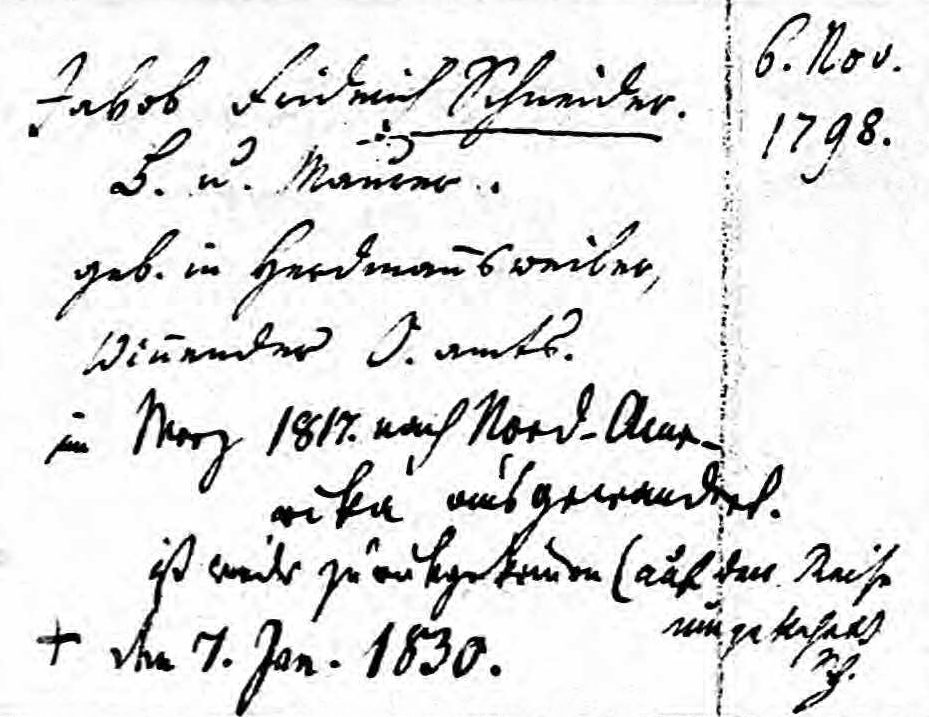
Family Register, Ellhofen
Jakob Friedrich Schneider (m. 6 Nov 1798)
Resident and Stone Mason
born in Hertmannweiler, Winnenden District
in March 1817, migrated to North America
but returned here (turned back on the trip)
died on the 7 Jan 1830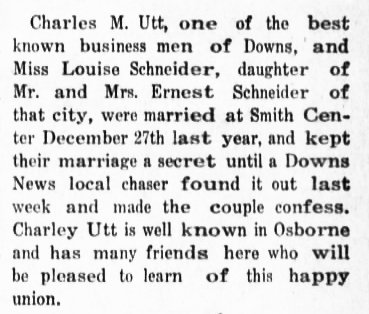
5 October 1922 newspaper announcement
Germany, America, Australia
In 1863, Jakob's eldest son, Johann Friedrich, died in Weinsberg, leaving Johann Georg as Jakob's only surviving child. The two brothers must have been very close, having married the Lauer sisters on the same day. The loss of his brother could quite well have been the deciding factor for Johann Georg to want to make a fresh start by shifting the whole family to Queensland in 1864 and 1865.
Yet by 1851, this branch of the Schneiders had already become rather unsettled with at least one member having already migrated to America, with more to follow. Indeed, Jakob himself had already attempted to migrate to North America in March of 1817 but during his trip had turned around and gone back home to Ellhofen.
Maria Caroline Schneider nee Kienzle, the widow of Jakob's brother, Johann Georg, remarried twice and left for America in 1851 with her third husband, Johann Gottlieb Bös. On 23 August 1887, Johannes Ernest Schneider, the grandson of Jakob's brother, Johann Georg, arrived in Baltimore having migrated to America after which he later settled in Downs, Kansas. Johann Georg's son, also called Johann Georg died in 1883 but his widow, Regina Dorothea nee Sigle migrated to America in 1891 and so did their daughters Pauline Friederike Schneider and Luise Marie Schneider with her daughter Luise Friederike Schneider. That year also saw Margaretha Brandt, the future wife of Johannes Ernest Schneider make her way to America.
That wasn't all. Four children of the first marriage of Jakob's son, Johannes Friedrich Schneider, namely Christiane Catharine, Christian Friedrich, Johann Carl and Rosina Catharina also migrated to America, the dates as yet remaining unknown.
Those Schneiders who followed the call to America were mostly from the earlier home town of the family, Hertmannsweiler, closer to Stuttgart. In Hertmannsweiler there were and still are a lot more family branches than those of the breakaway branch which settled slightly further north in the Heilbronn district containing Eberstadt, Ellhofen and Weinsberg.
Some of the American Family
Pictured here is the grandson of Jacob's brother, Johann Georg, Johannes Ernest Schneider, known later as Ernest, with his wife and some of their children. Ernest migrated to America in 1887 with one of his sisters, In the same year another sister migrated with her husband and more family members. The rest followed in 1891.
They all settled in Kansas with Ernest and his family living in Downs, where he was a baker.
Their tree can be found by clicking here: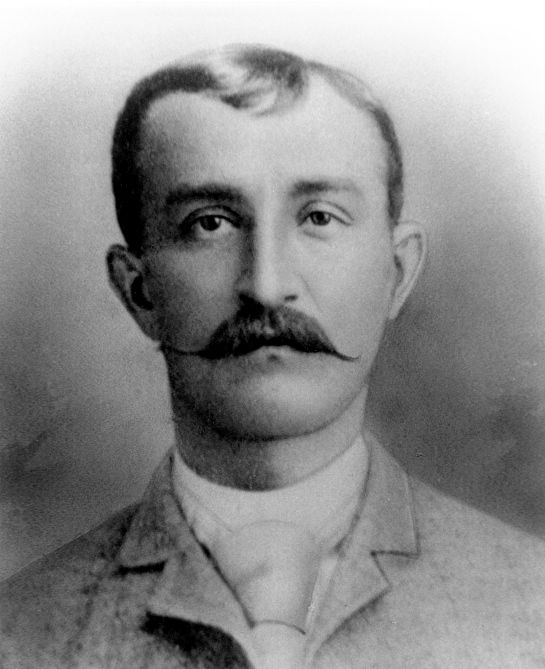
Johannes Ernest Schneider
m. Margaretha Brandt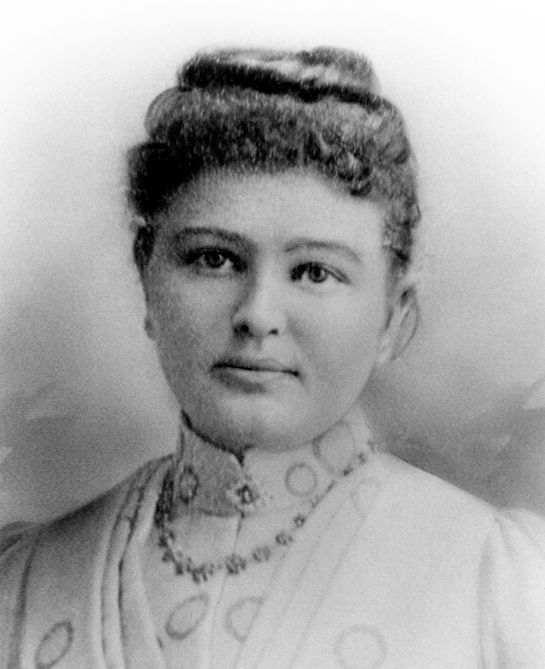
Margaretha Katharine Marie (Brandt) Schneider
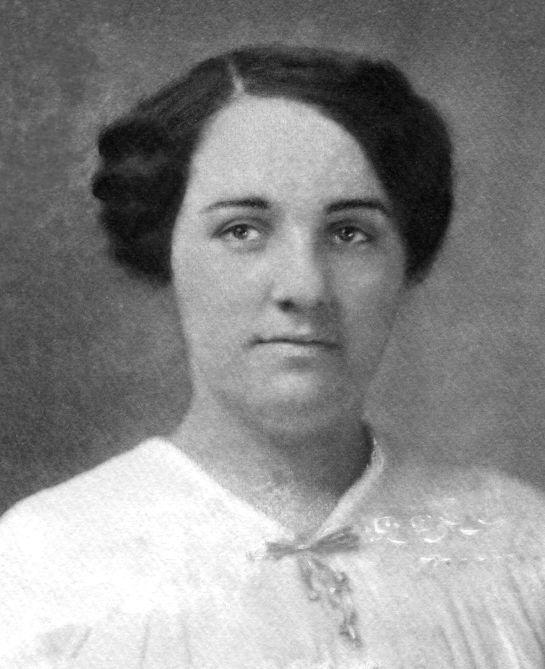
Margaret Pauline Schneider
m. Roy Radford Slusher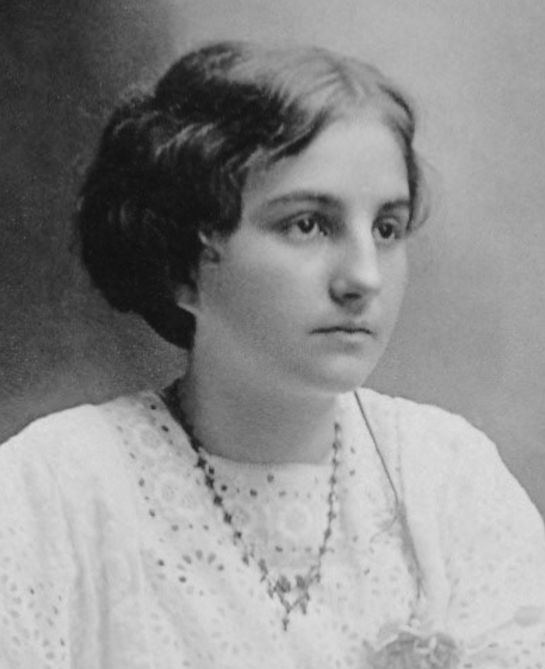
Luisa Friederike Schneider
m. Johann Gottlieb Bihlmaier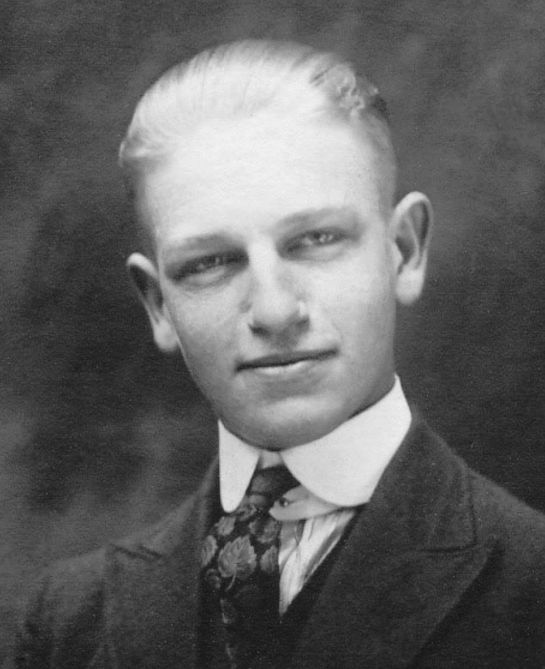
Irvin Schneider
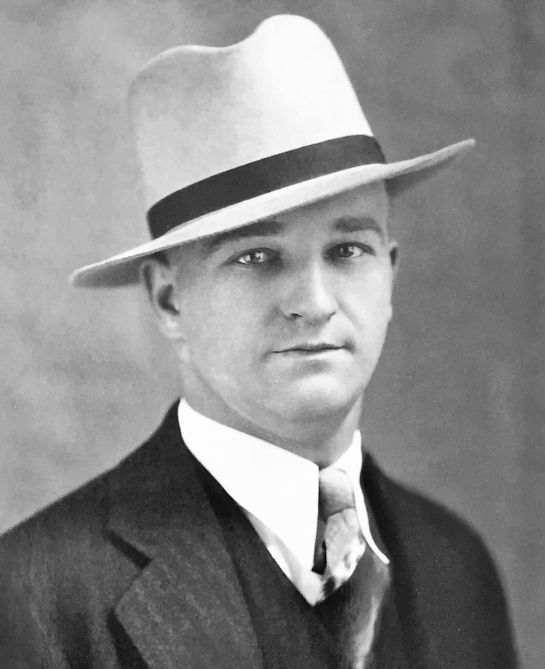
Carl Gottlieb Schneider
m. Verna Bernice Young
Jacob and Rosina (details)
 Baptism 1776, 15 April, in Hertmannsweiler, of Jacob Friedrich Schneider, son of Johannes Schneider and his wife: Margaretha, born Rincker
 Baptism 1772, 14 August, of Rosina Heinrica Lauer, daughter of Georg David Lauer, Winegrower, and his wife: Maria Barbara, born Breuninger
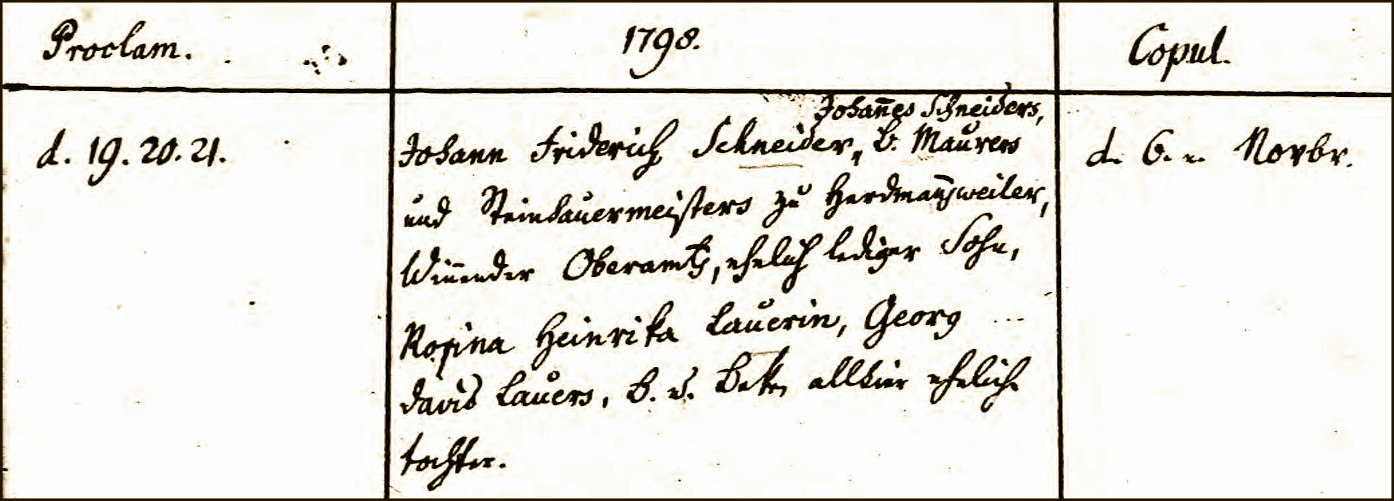 Marriage 1798, 6 November, in Ellhofen, of Johann Friderich Schneider, lawful unmarried son of Johannes Schneider, Resident, Mason and Master Stone Mason of Herdmannsweiler, Winnenden, with Rosina Heinrika Lauer, daughter of Georg David Lauer, Resident and Baker
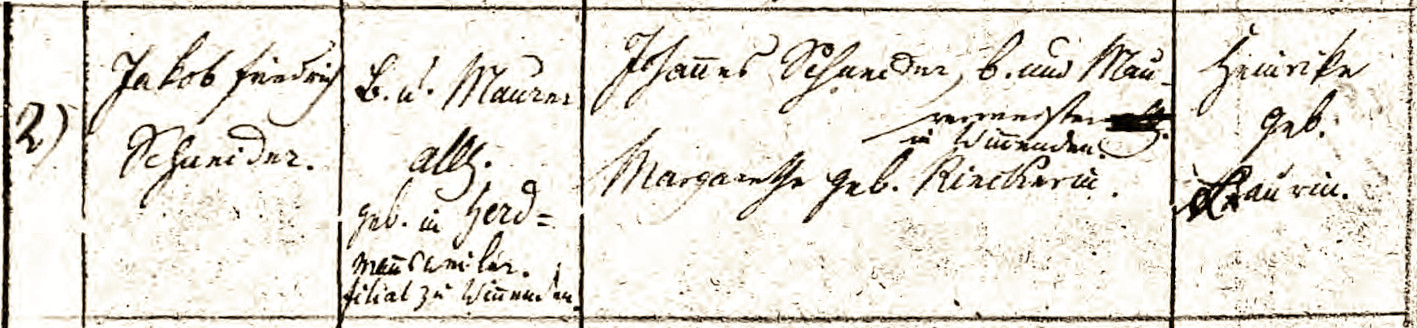 Death 1830, 7 January, in Ellhofen, of Jakob Friedrich Schneider, Resident and Mason, born in Herdmannsweiler, Winnenden, son of Johannes Schneider, Resident and Maurermeister in Winnenden and his wife Margaretha born Rinckerin. Wife Heinrike born Lauer
 Death 1815 Jakob's son Georg Karl, aged 19
Single, 19y 6m 11d, Tuberculosis, Ellhofen, Sept 2, Morning 7 o'clock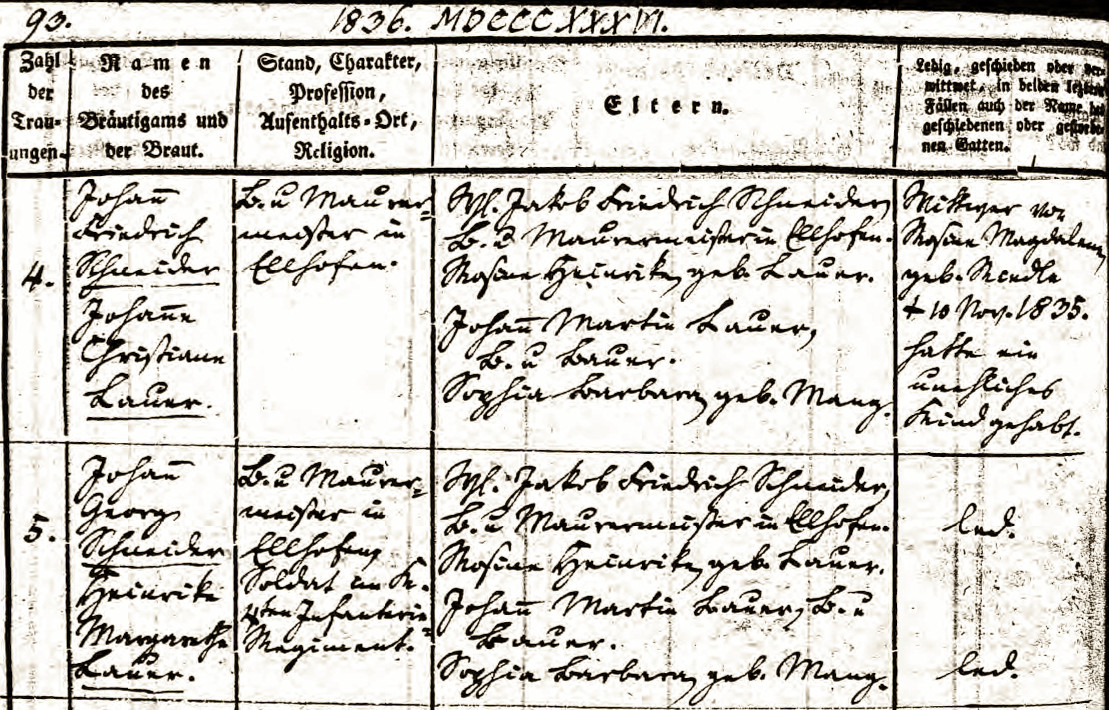 Double Wedding 10 May 1836
The Schneider brothers Johann Friedrich and Johann Georg married the Lauer sisters Johanne Christiane and Heinricke Margarethe on the same day.
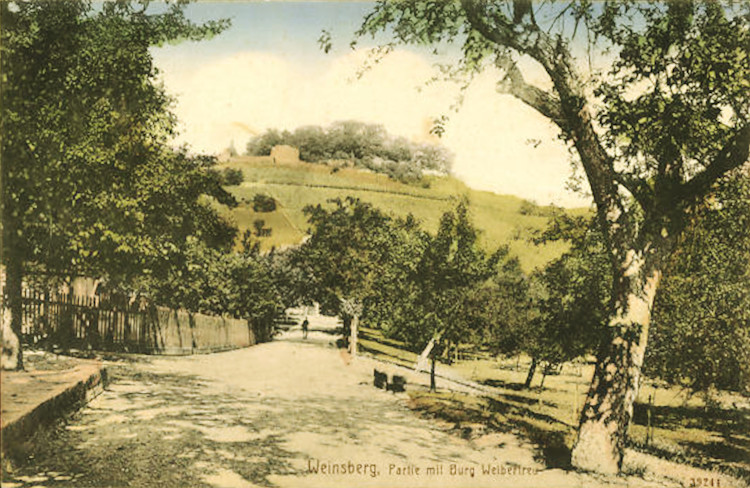
Weinsberg, near Burg Weibetreu
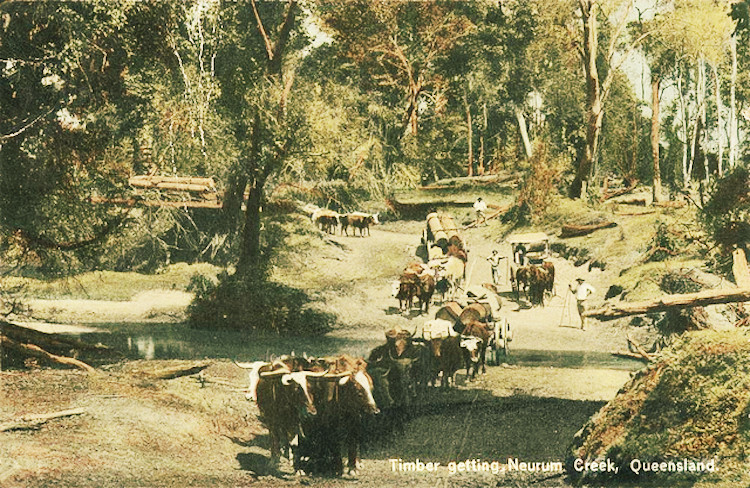
Queensland, Neurum Creek near Somerset
» Johann Georg Schneider (George)
and Heinricke Margarethe Lauer» Johann Georg Schneider (25.10.1810 – 04.04.1878)
(son of Jakob Friedrich Schneider, Master Mason / Maurermeister)
and Heinricke Margarethe Lauer (31.12.1809 – 22.07.1882)
were married in Ellhofen, 10.05.1836,and they had the following children:
» Johann Heinrich (Henry) 20.09.1836 –
*Eberstadt10.06.1905
†Teviotvillem. Rosine Friederika Eckert in Eberstadt, 24.08.1862
m. Wilhelmina Fredericka Topp in Ipswich, 21.08.1869Friedrich Karl 12.05.1838 –
*Ellhofen14.11.1859
†Eberstadt(21 years old) fell from scaffolding in Hölzern (1km east of Eberstadt) and died from a broken neck Friederike Heinricke 19.02.1840 –
*Ellhofen29.02.1840
†Eberstadt(10 days old) Gottfried Friedrich (Fred) 26.01.1841 –
*Eberstadt03.07.1934
†Boonahm. Johanna "Caroline" Wilhelmine Dickfos in Ipswich, 08.07.1871 Friederike Sophie (Heinricke) 14.10.1842 –
*Eberstadt16.03.1875
†Mutdapillym. Johann Joachim Friedrich Hinrichsen in Ipswich, 20.08.1866 Christine Sophie (Sophia) 28.11.1843 –
*Eberstadt26.01.1917
†Coleyvillem. Johann Friedrich "August" Dickfos in Qld, 11.12.1869 Johann Georg Jr (John) 23.12.1845 –
*Eberstadt24.04.1929
†Boonahm. Auguste Wilhelmine Marie Ernestine "Friederike" Henselin in Ipswich, 16.11.1872 Christine 25.11.1848 –
*Eberstadt19.06.1850
†Eberstadt(18 months old) Christine 17.09.1850 –
*Eberstadt12.01.1942
†Kalbarm. Johann "Carl" Dickfos in Ipswich, 01.07.1871 Marie Elisabethe 25.09.1852 –
*Eberstadt25.11.1852
†Eberstadt(2 months old)
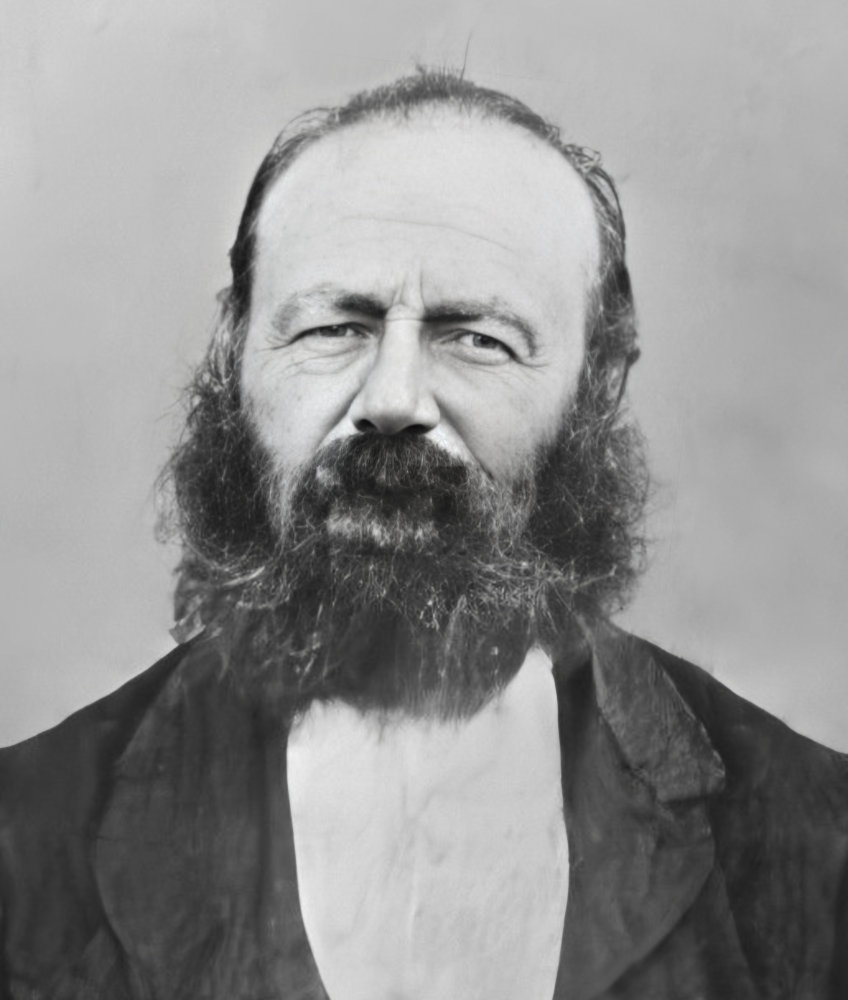
Johann Heinrich "Henry" Schneider
m. Rosina Eckert
m. Wilhelmine "Minnie" Topp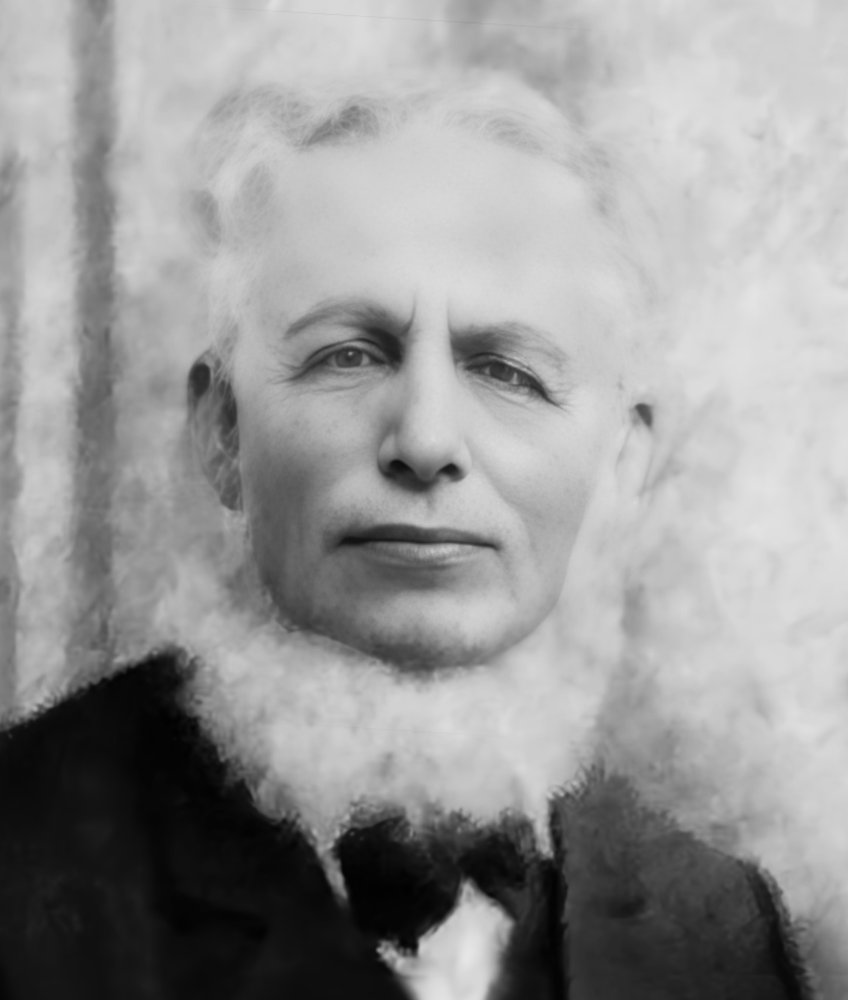
Gottfried Friedrich "Fred" Schneider
m. Johanna "Caroline" Dickfos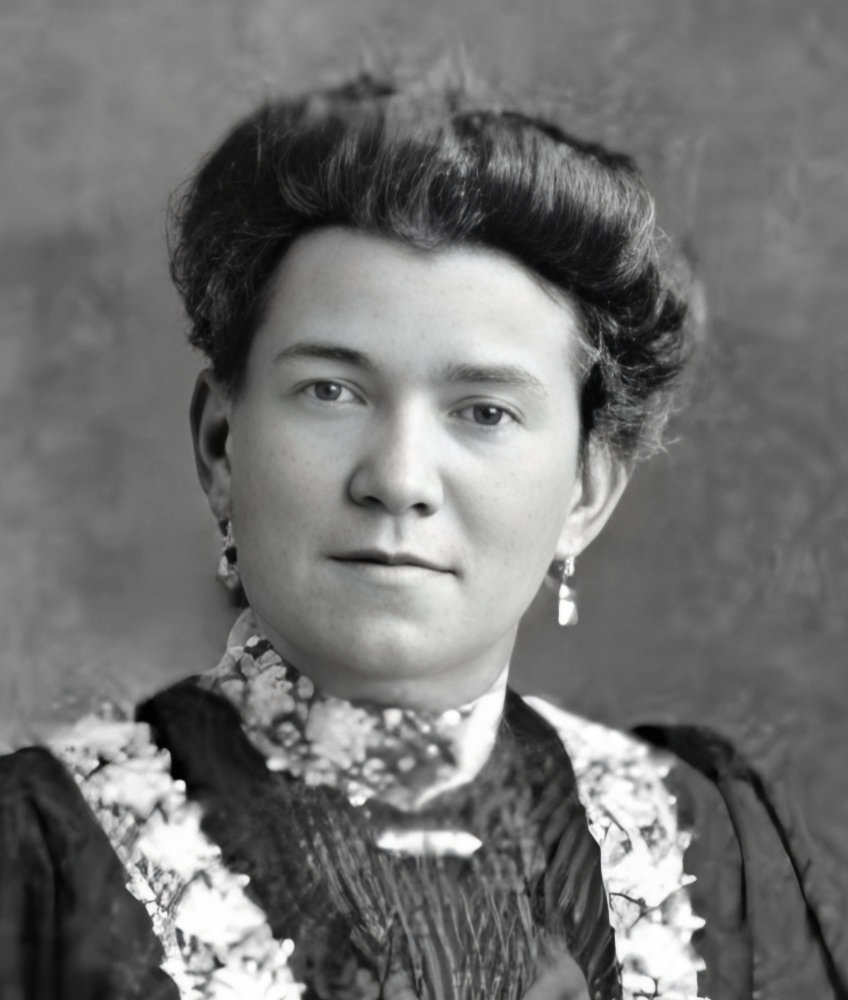
Christine "Sophie" Schneider
m. Johann Friedrich "August" Dickfos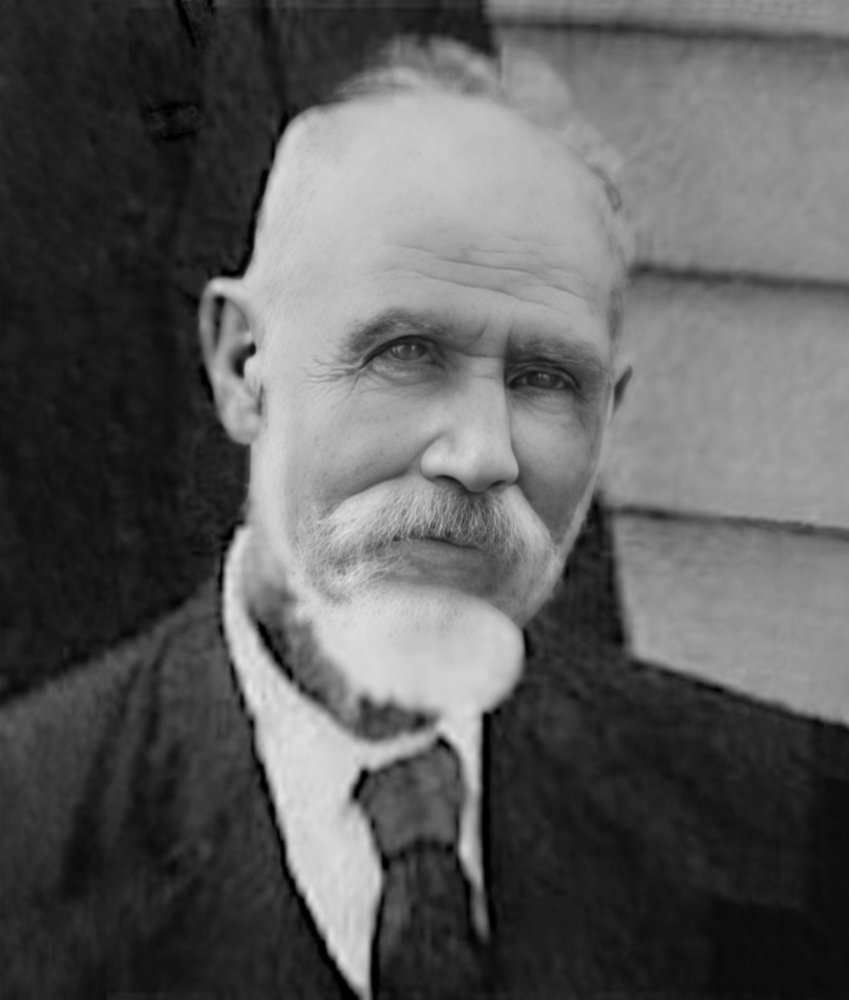
Johann Georg "George, sometimes John" Schneider jr.
m. Auguste "Friederike" Henselin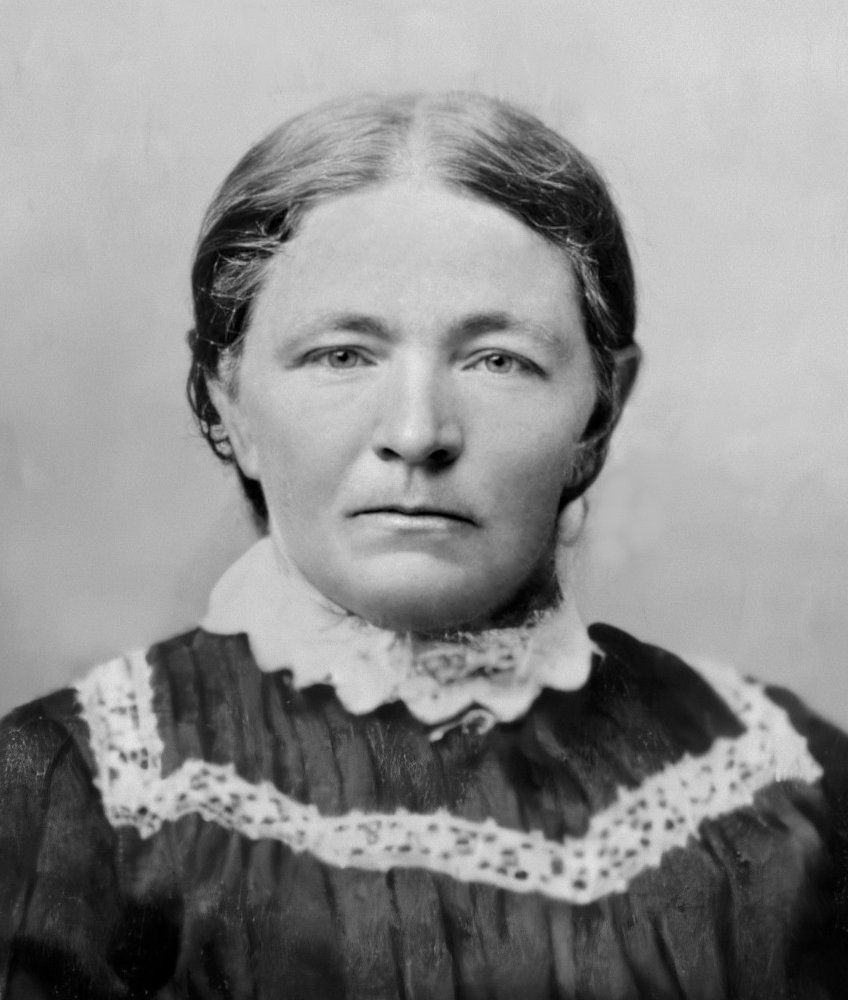
Christine Elisabeth Schneider
m. Carl Gottlieb Dickfos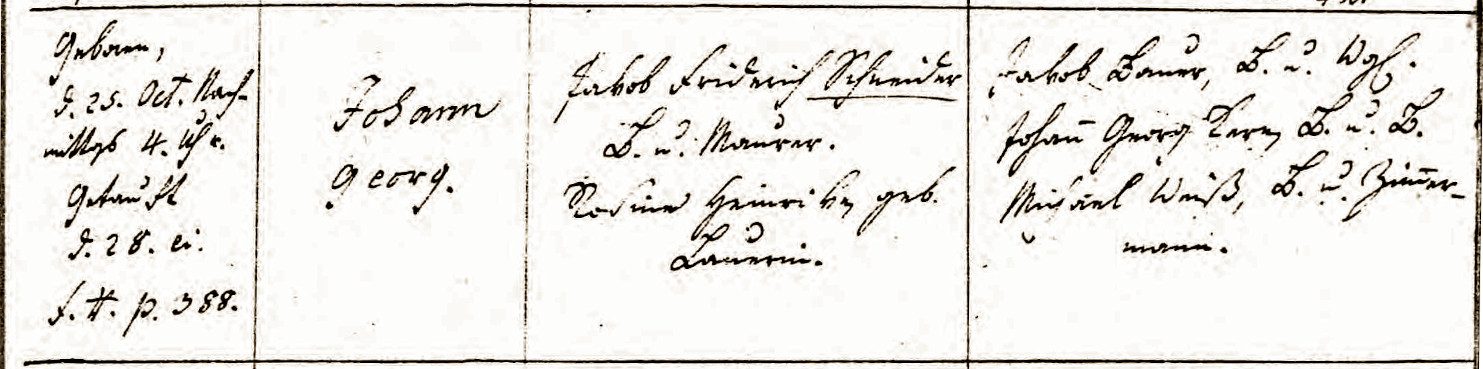 1810 birth 25 Oct, baptism 28 Oct, in Ellhofen, of Johann Georg Schneider, son of Jakob Schneider, Resident and Mason and his wife Rosina Heinrike born Lauer
Eberstadt Family Register of Johann Georg Schneider
1810 birth 25 Oct, baptism 28 Oct, in Ellhofen, of Johann Georg Schneider, son of Jakob Schneider, Resident and Mason and his wife Rosina Heinrike born Lauer
Eberstadt Family Register of Johann Georg Schneider
Housefather: Schneider, Joh. Georg, Maurermeister,
born 1810 25 Oct
father Jakob Friedr. Schneider Ellhofen
mother Rosine Heinricka born Lauer
Baptist with family
This family migrated in April 1865 to Australia.
Married 1836 10 Mar
Housemother: Heinricke Margaretha
born 1809 31 Dec
father Joh. Martin Lauer
mother Sophie Barb. born Mang
1836 Marriage of Johann Georg Schneider and Heinricke Margaretha Lauer (extract from 1865)
TRANSLATION
Kingdom of Württemberg
Administrative Office of Weinsberg
District of Eberstadt
According to this Family Register
on the 10th of May 1836 married in church
Johann Georg Schneider,
at the time a Master Mason in this place
to
Heinricke Margaretha born Lauer from
Ellhofen
The authenticity of this extract is certified
Eberstadt 16 February 1865
Royal Rectory
Wolff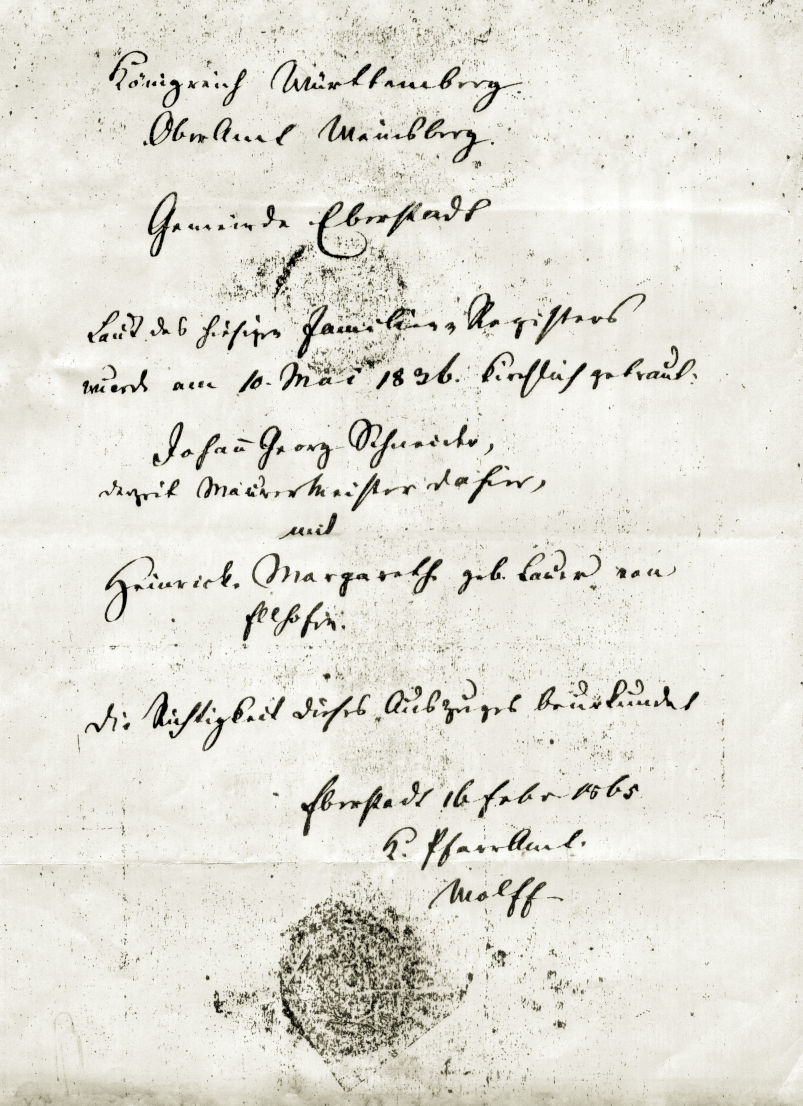 TRANSCRIPTION
Königreich Württemberg
Oberamt Weinsberg
Gemeinde Eberstadt
Laut des hiesigen Familien Registers
wurde am 10. Mai 1836. kirchlich getraut
Johann Georg Schneider,
derzeit Maurermeister dahier
mit
Heinricke Margaretha geb. Lauer von
Ellhofen
Die Gültigkeit dieses Auszuges beurkundet
Eberstadt 16 Febr. 1865
K. PfarrAmt.
Wolff
 Death 1859 Johann Georg's son Friedrich Karl, aged 21
single, Baptist, 21yrs 6mths, broke neck by unlucky fall from scaffold in Hölzern 12 Nov. 7:00
(Hölzern is 1km east of Eberstadt)
» Johann Heinrich Schneider (Henry)
and his 1st wife Rosina Friederike Eckert
and his 2nd wife Wilhelmine Friederike (Topp) Lobegeiger
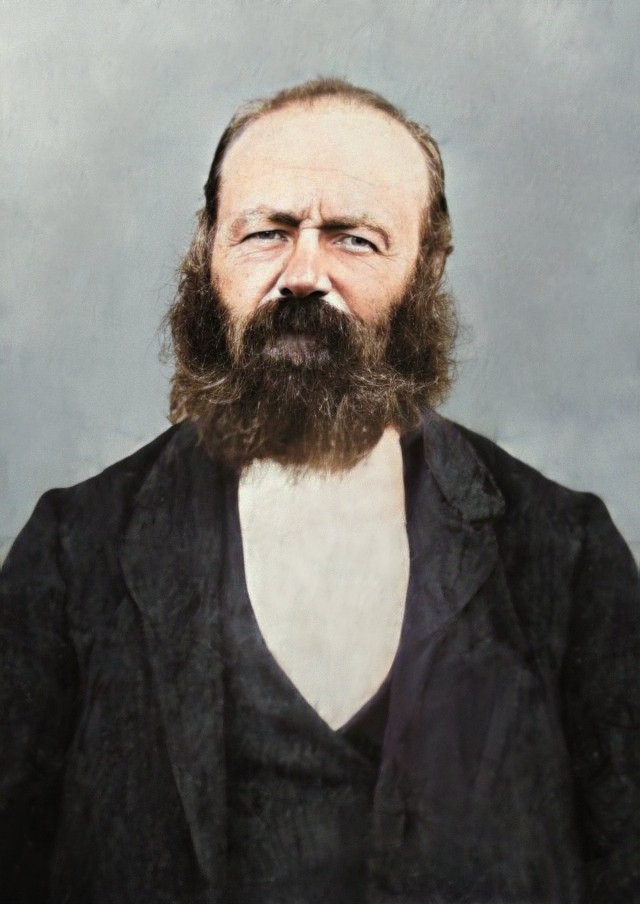
Johann Heinrich Schneider
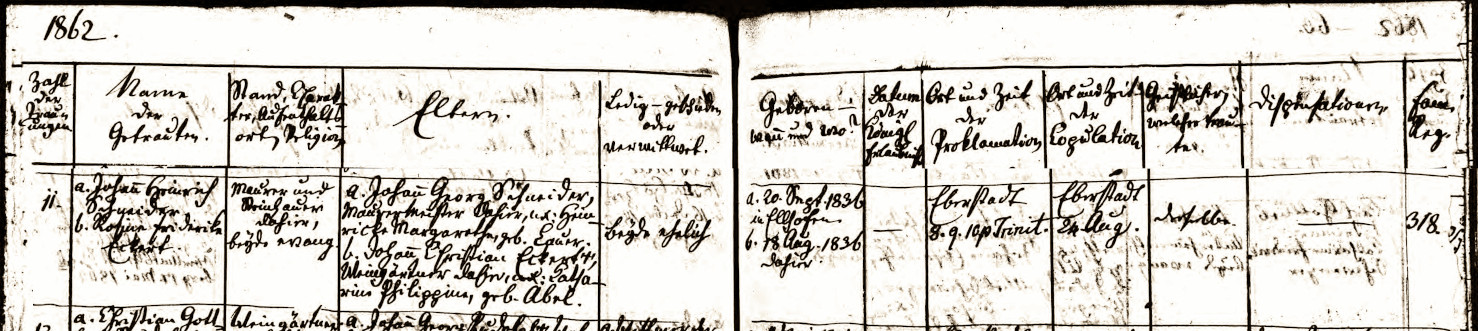
1862 1st Marriage to Rosina Friederike Eckert
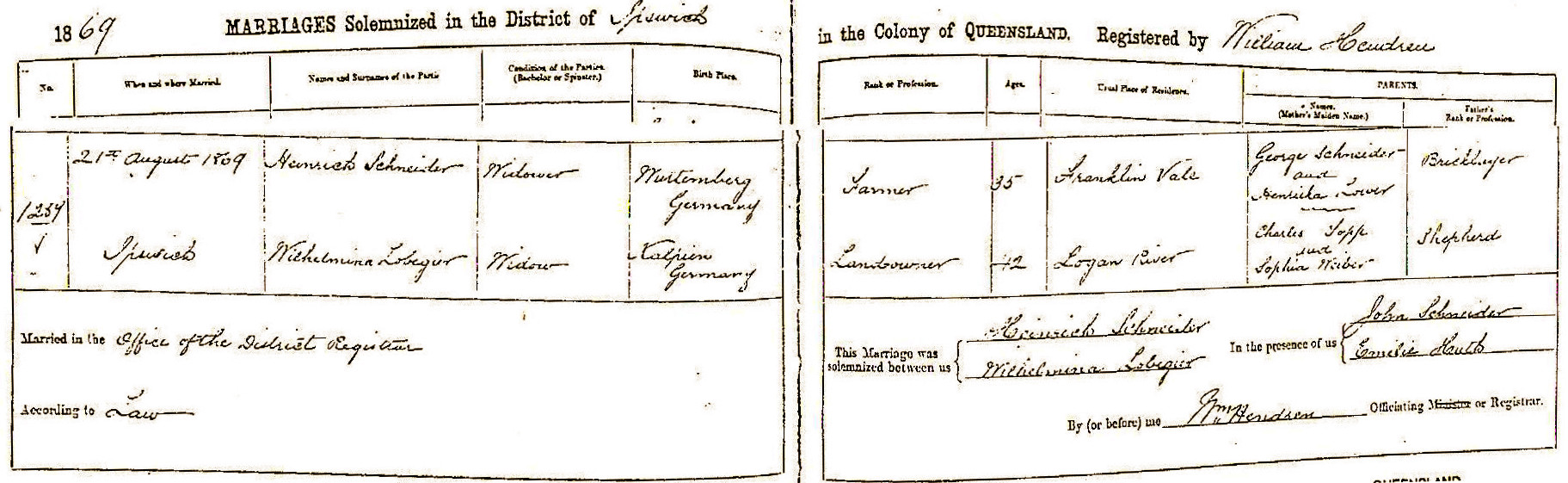
1869 2nd Marriage to Wilhelmine Friederike (Topp) Lobegeiger
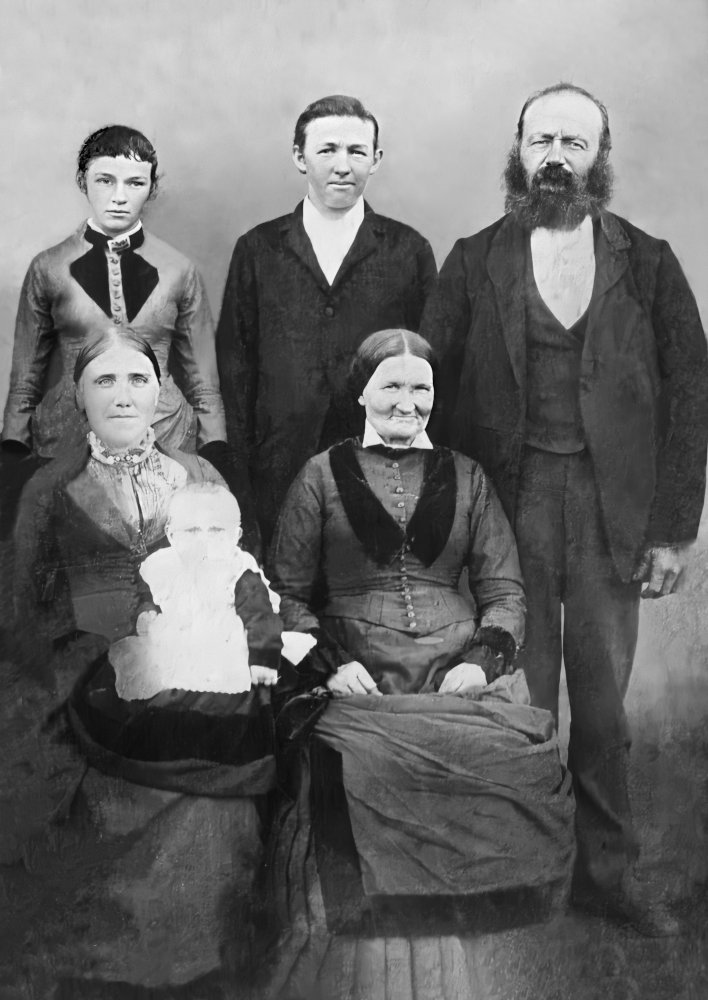
c1889 Family of Johann Heinrich with Wilhelmine at his side
Johann Heinrich (Henry) Schneider (20.09.1836 – 10.06.1905)
and his 1st wife Rosina Friederike Eckert (18.08.1836 – 06.01.1869)
were married in Eberstadt on 24.08.1862
and they had the following children:
Friederike Sophie Schneider 24.02.1862 –
*Eberstadt17.12.1863
†Eberstadt(22 months old)
(born 6 months before marriage)Friederike Christina Schneider 05.06.1863 –
*Eberstadt31.03.1938
†Murgonm. August Carl Hermann Lobegeier
in Harrisville, 23.02.1882Rosine Sophie Schneider 06.01.1866 –
*Qld04.09.1936
†Boonahm. Wilhelm Christian Friedrich Rieck
in Qld, 23.02.1882Louise Friederike Schneider 29.11.1867 –
*Qld07.01.1944
†Qldm. Edward Appleby in Qld, 30.06.1887 Wilhelmina (Minnie) Schneider 23.12.1868 –
*Qld02.04.1946
†Coalfallsm. Joseph (Job) Harding in Qld, 25.03.1891
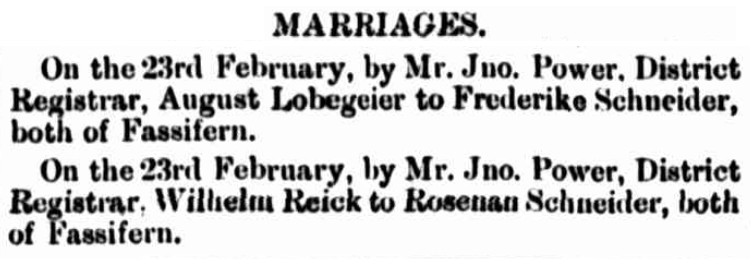
1882 Double wedding for sisters Friederike and Rosina
Friederike married August Lobegeier
and Rosina married Wilhelm Rieck
Johann Heinrich (Henry) Schneider (20.09.1836 – 10.06.1905)
and his 2nd wife Wilhelmine Friederike (Minnie) Topp (28.12.1829 – 17.08.1915)
were married in Ipswich on 21.08.1869
and they had the following children:
» Johann Heinrich (Henry) Schneider 14.07.1870 –
*Rosewood14.04.1946
†Kalbarm. Annie Lobegeiger 09.02.1898
Martha Schneider 05.01.1873 –
*Calvert05.11.1941
†Marburgm. Albert John Kuss 30.04.1896 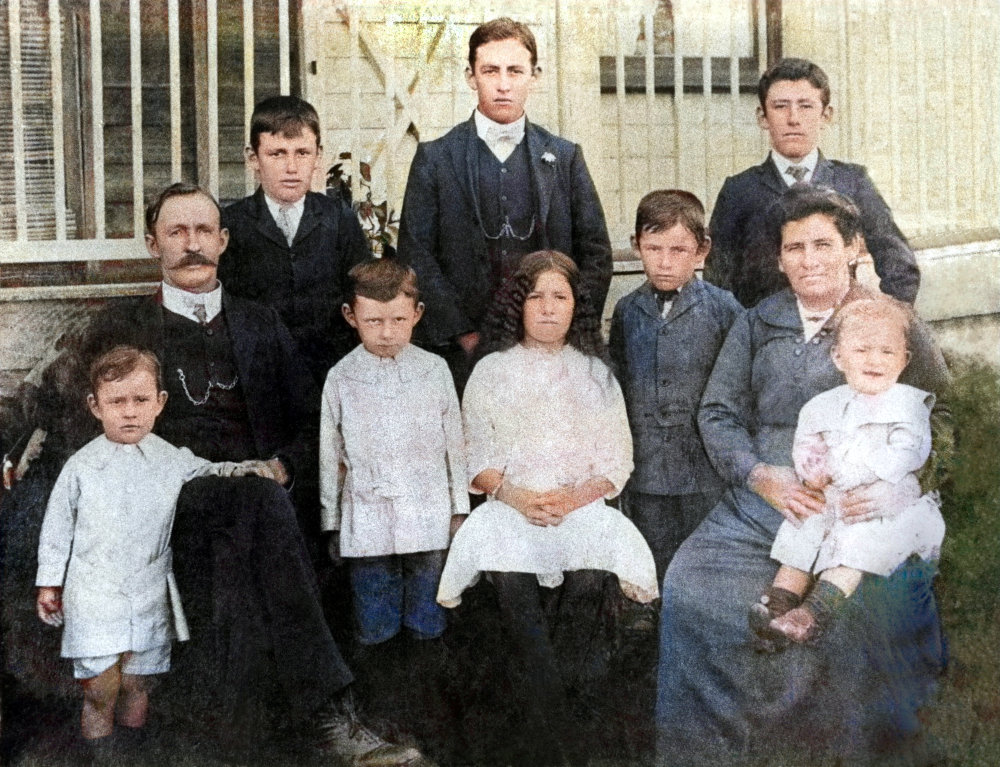
Johann Heinrich (Henry) Schneider and family c.1914
Standing at back L-R: Ben, Arthur, Harry
Front L-R: Norman, Henry, Ambrose, Lilly, Edward, Annie and Fred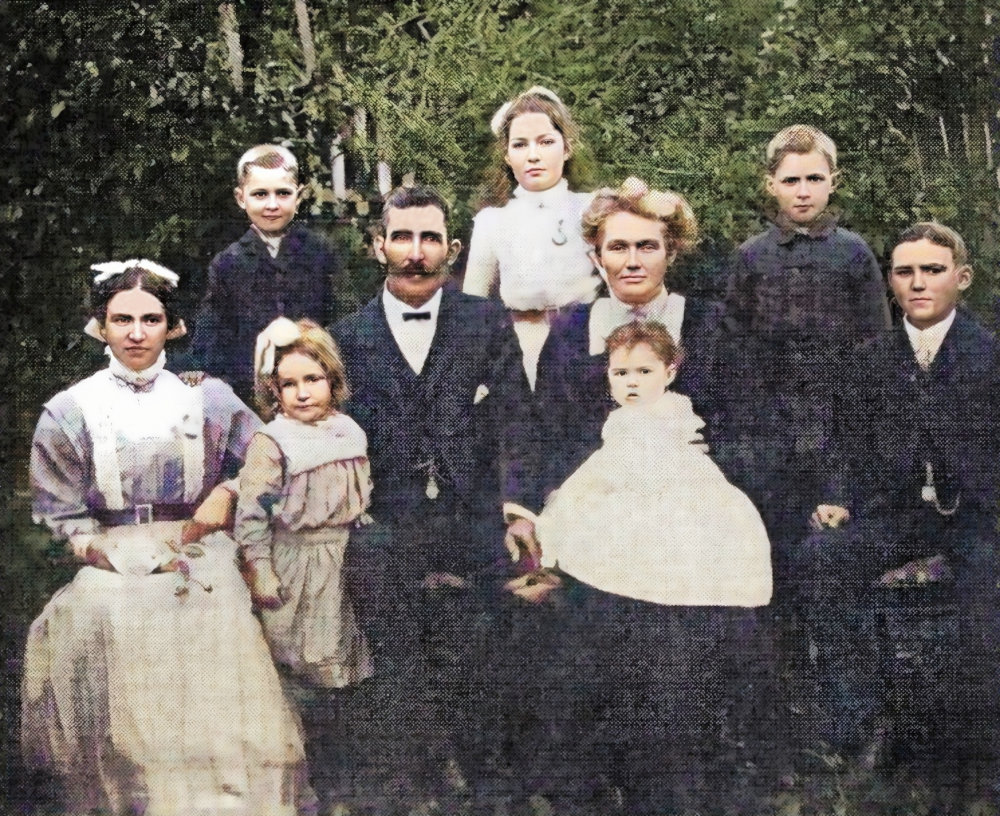
Martha Schneider and family, c.1910
Standing at back L-R: Herbert, Violet, Albert
Front L-R: Eva, Minnie, Albert, Martha with Dorothy, Albert
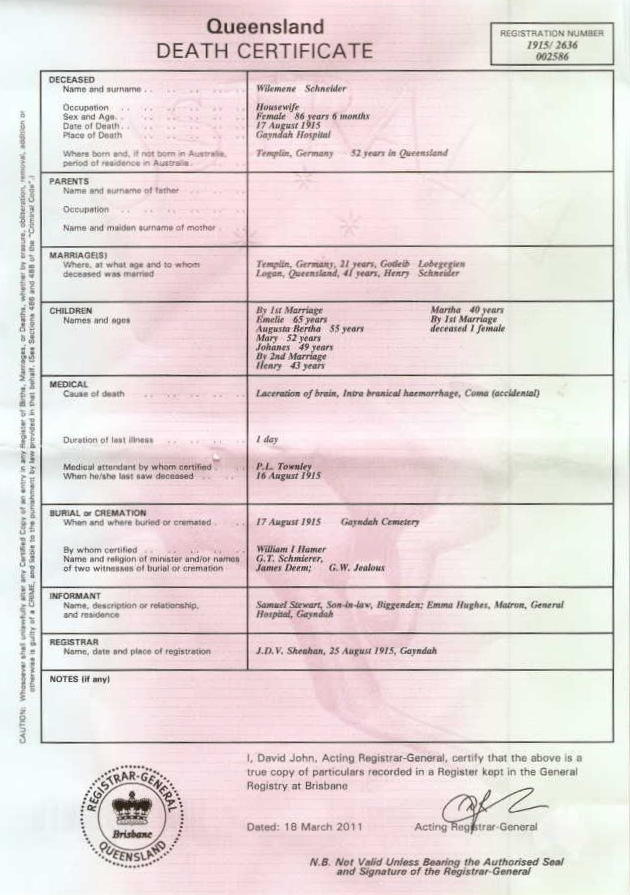
1915 Death Certificate of Wilhelmina in Gayndah
All in the family
Johann Heinrich (the younger) married Annie, the daughter of his mother's first husband's brother: Annie's father was Friedrich Wilhelm August Lobegeiger whose father, also named Friedrich Wilhelm August Lobegeiger was the brother of Friedrich Gottlieb Ferdinand Lobegeiger who was the first husband of Wilhelmine Friederike Topp.
Johann Heinrich's half sister Friederike Christine married Annie's uncle: Annie's father was Friedrich Wilhelm August Lobegeiger who was the brother of August Carl Hermann Lobegeier who married Friederike Christine
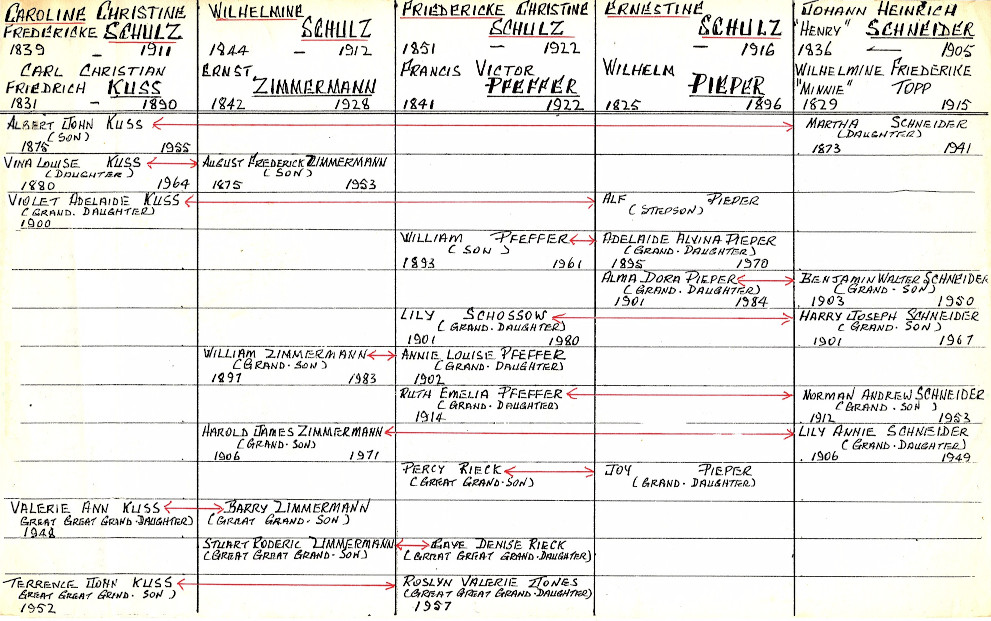
More connections
The Family Chronicle (Familien-Chronik) of Johann Heinrich Schneider senior
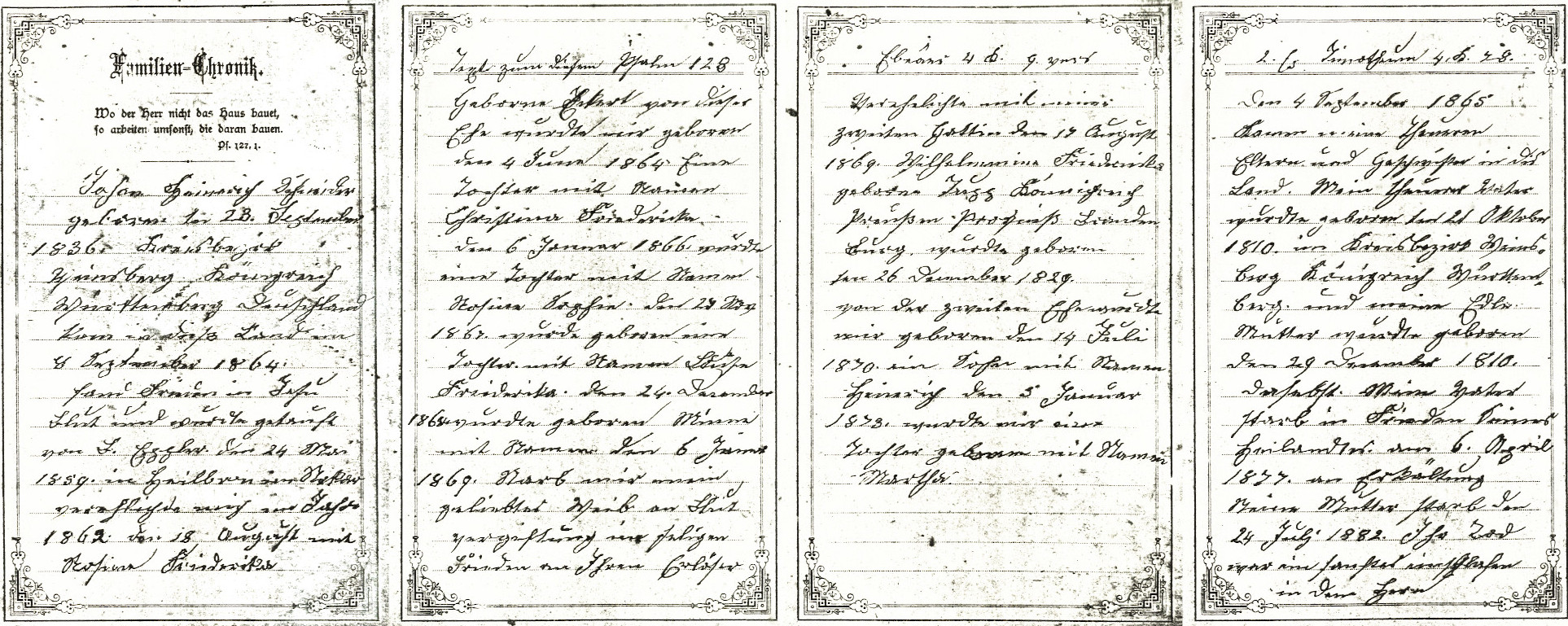
Family-Chronicle
Johann Heinrich Schneider
born on the 23rd of September
1836 in the district of
Weinsberg, Kingdom of
Württemberg, Germany
who came into this land on
8th September 1864,
found peace in Jesus
blood and was baptised
by B. Eggler on 24th March
1859 in Heilbronn on the Neckar
married in the year
1862 on 18th August
Rosine Friederikenee Eckert and from this
marriage was born
on 4th June 1864 a
daughter with the name
Christina Friederike,
on 6th January 1866 was born
a daughter with the name
Rosina Sophie, on 29th Nov
1867 was born a
daughter with the name Louise
Friederike, on 25th December
1868 was born Minna
with that name. On 6th January
1869 my beloved wife died of blood
poisoning in the blessed
peace of the Lord RedeemerI was married to a
second wife on 17th August
1869, Wilhelmina Friederika
nee Topp of the Kingdom
of Prussia, Province Branden-
burg, who was born
on 26th December 1829.
From this second marriage was
born on 14th July
1870, a son by the name of
Heinrich. On 5th January
1873 was a
daughter born with the name
Martha.On the 4th of September 1865,
came my dear
parents and siblings to this
land. My dear father
was born the 21st October
1810 in the district Weins-
berg in the Kingdom of Württem-
berg and my precious
mother was born on
the 29th December 1810
in the same place. My father
died in the peace of his
Saviour on 6th April
1877 of a chill.
My mother died on
24th July 1882. Her death
was a gentle falling to sleep
in the Lord.
» Johann Heinrich Schneider (Henry)
and Annie Lobegeiger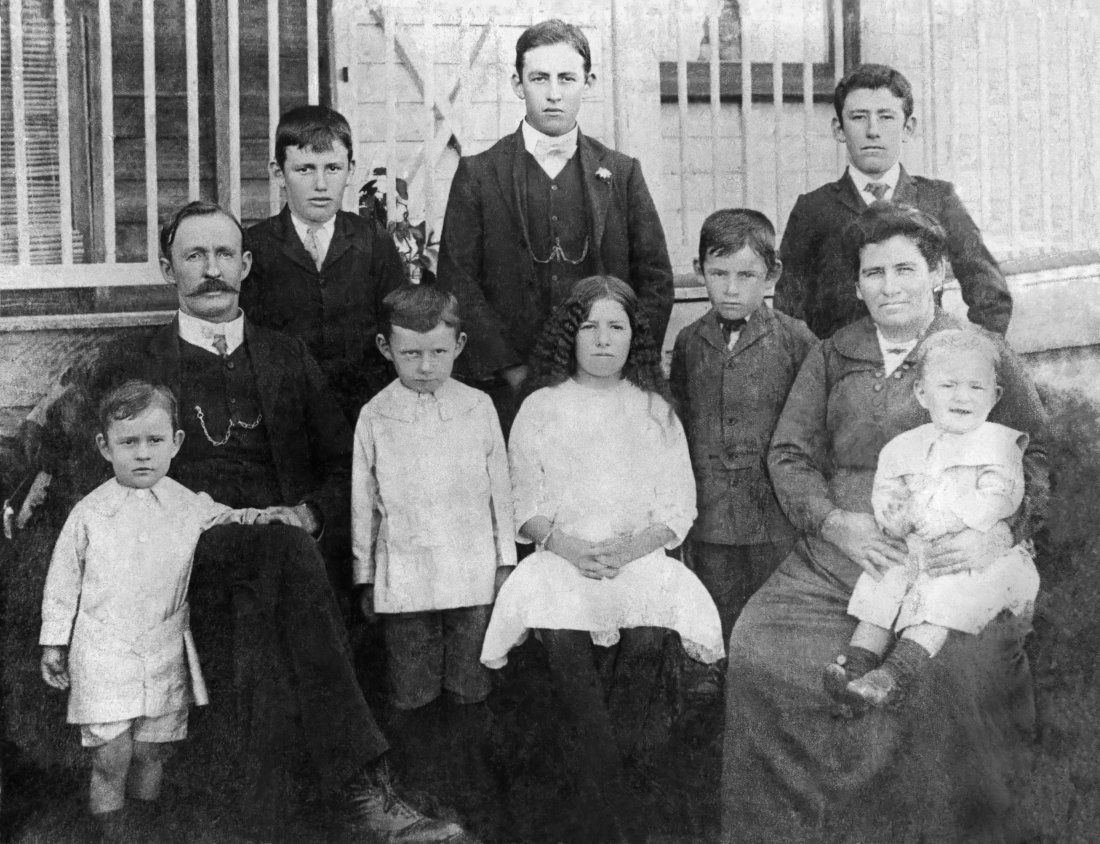
Henry and Annie with their eight children, from left: Norman, Ben, Ambrose, Arthur, Lily, Edward, Harry, Fred
» Johann Heinrich (Henry) Schneider (14.07.1870 – 14.04.1946)
and Anna (Annie) Lobegeiger (22.10.1871 – 07.05.1919)
were married in Coleyville, 09.02.1898
and they had the following children:
Arthur Henry Schneider 27.06.1899 –
*Kalbar23.06.1949
†Sydneym. Adelaide Krueger in Qld, 24.07.1919 Harry Joseph Schneider 13.02.1901 –
*Roadvale26.11.1967
†Kalbarm. Lilly Schossow in Qld, 22.08.1923 » Benjamin Walter Schneider 31.12.1903 –
*Kulgun29.05.1950
†Wondaim. Alma Dorothy Pieper in Ipswich, 01.09.1924 Lilly Annie Schneider 15.11.1905 –
*Roadvale16.08.1949
†Boonahm. Harold James Zimmerman in Qld, 29.04.1924 Edward John Schneider 28.07.1907 –
*Harrisville03.12.1951
†Harrisvillem. Esther Karen Muller in Qld, 03.07.1929 Ambrose Harold Schneider 19.06.1909 –
*Boonah30.03.1950
†Kalbarm. Vina Isabel Niebling in Qld, 29.03.1933 Norman Andrew Schneider 20.04.1912 –
*Boonah26.11.1953
†Clevelandm. Ruth Amelia Pfeffer in Qld, 20.02.1935 Frederick Allen Schneider 12.08.1913 –
*Hoya02.03.1977
†Kalbarm. Bertha May Prenzler in Kalbar, 28.06.1941 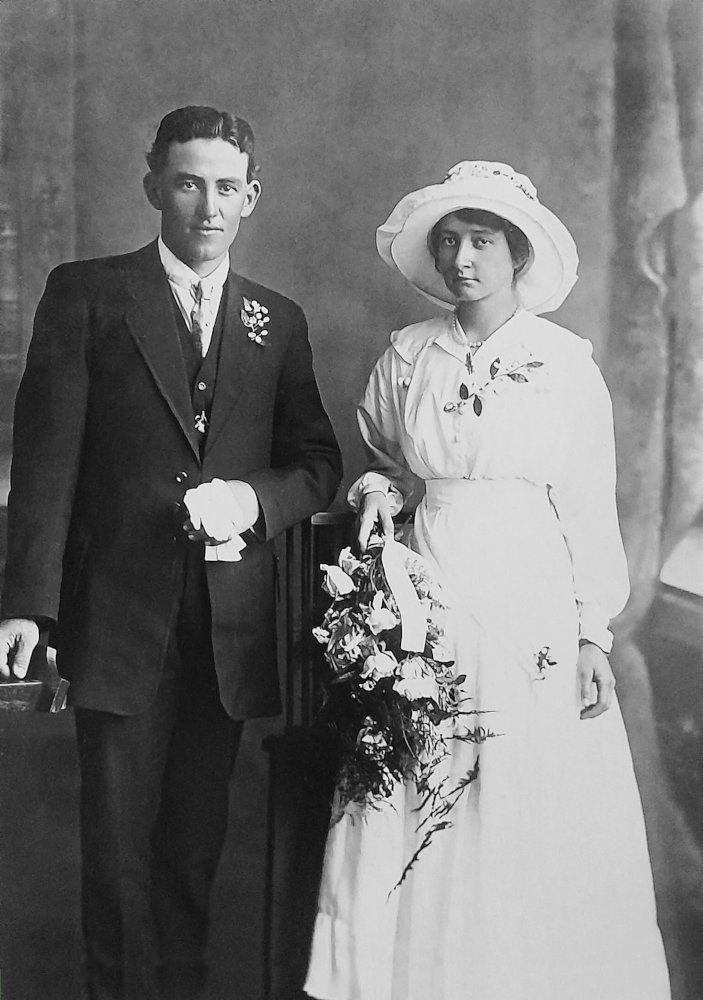
Arthur Schneider
and Adelaide Kruger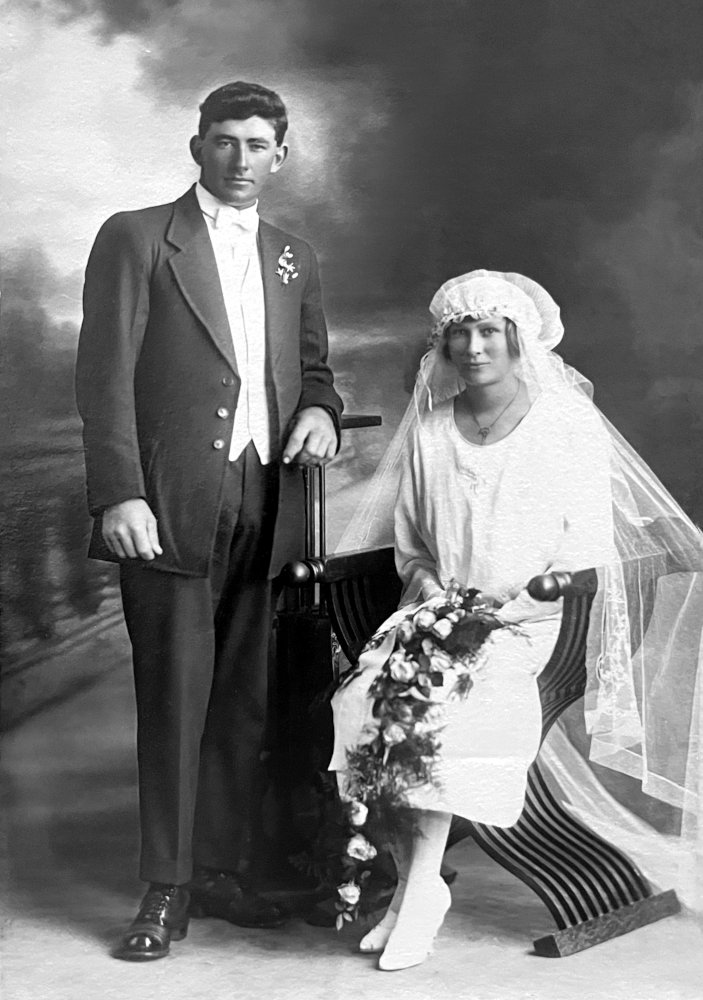
Harry Schneider
and Ruth Schossow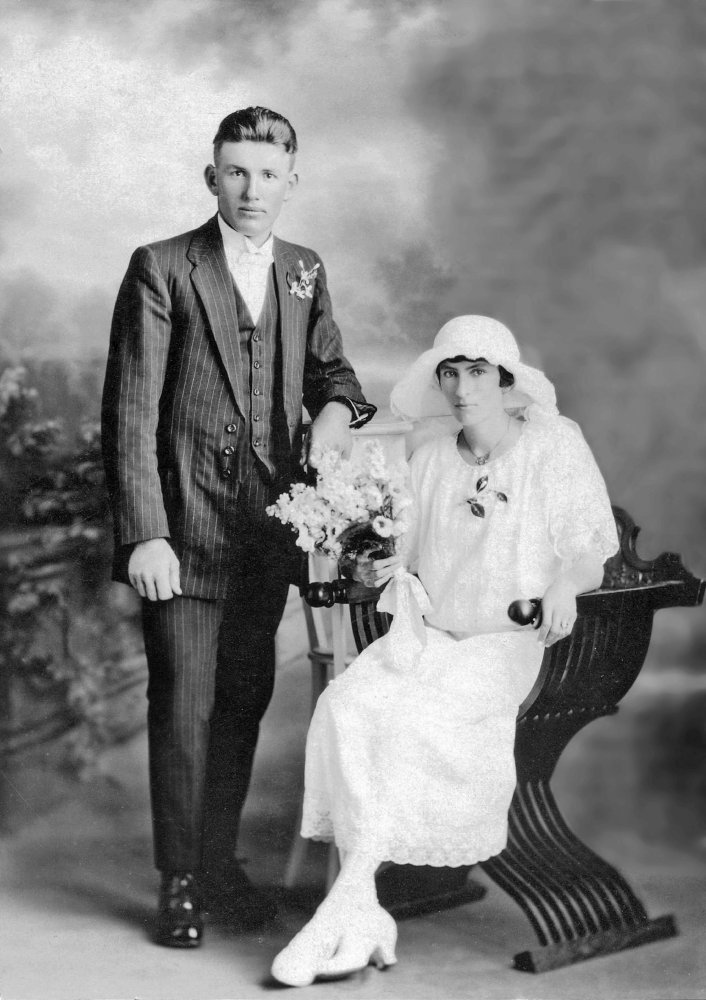
Ben Schneider
and Alma Pieper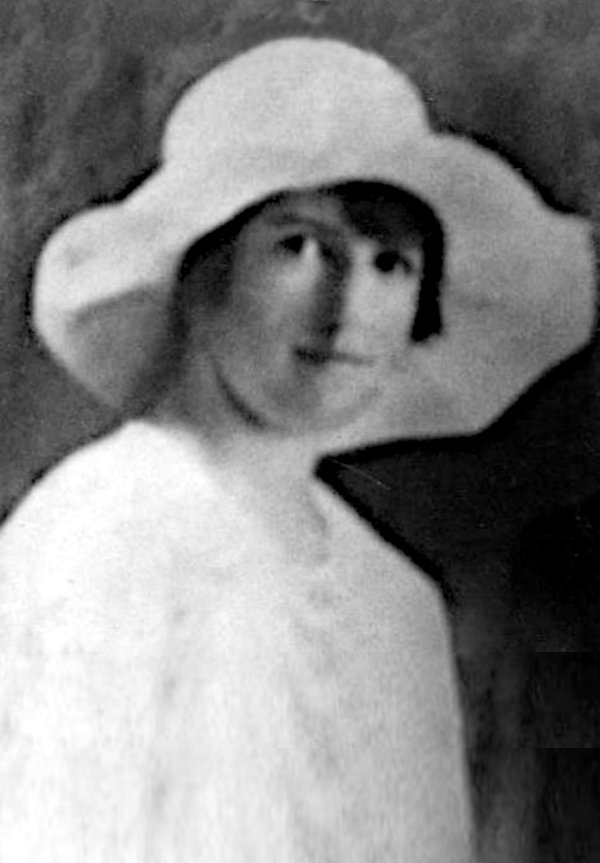
Lilly Schneider
(m. Harry Zimmermann)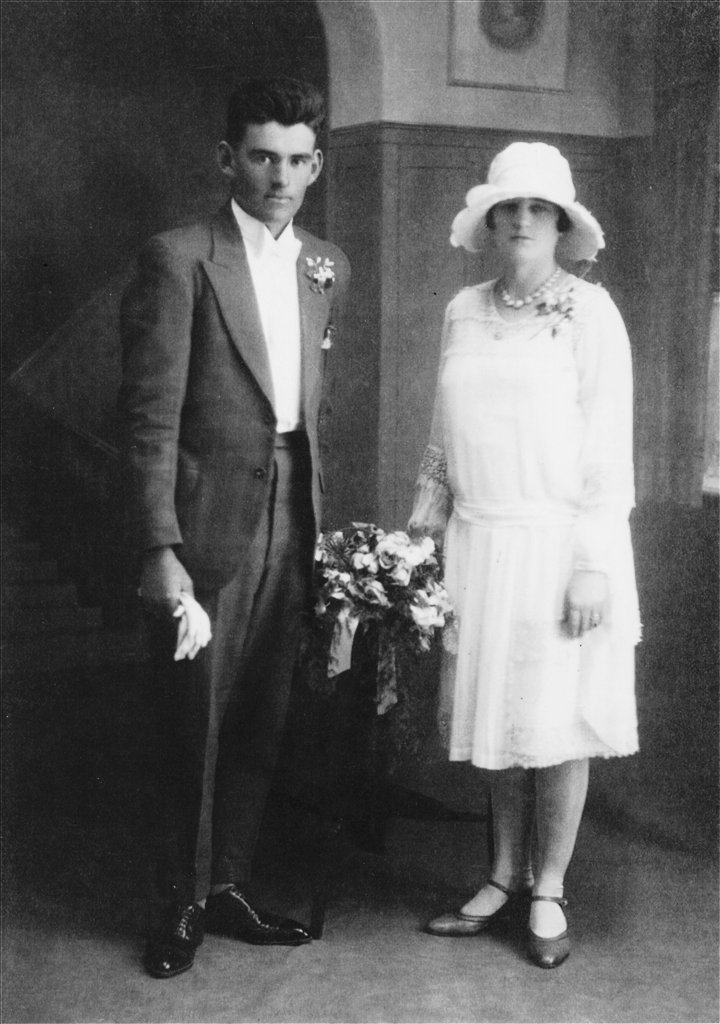
Ted Schneider
and Esther Muller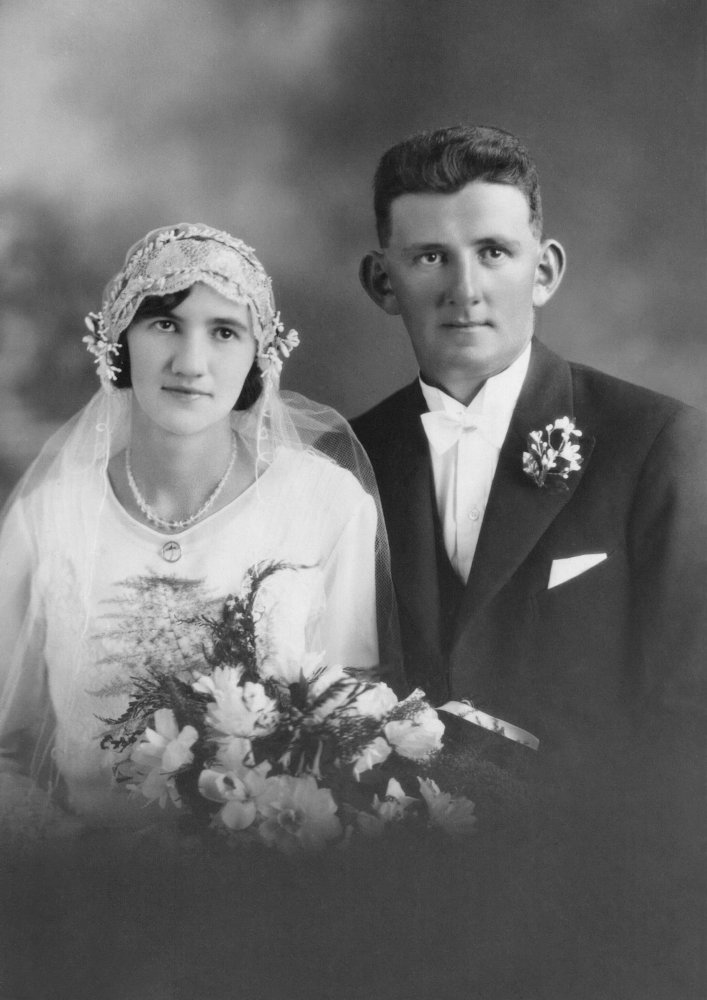
Ambrose Schneider
and Vina Niebling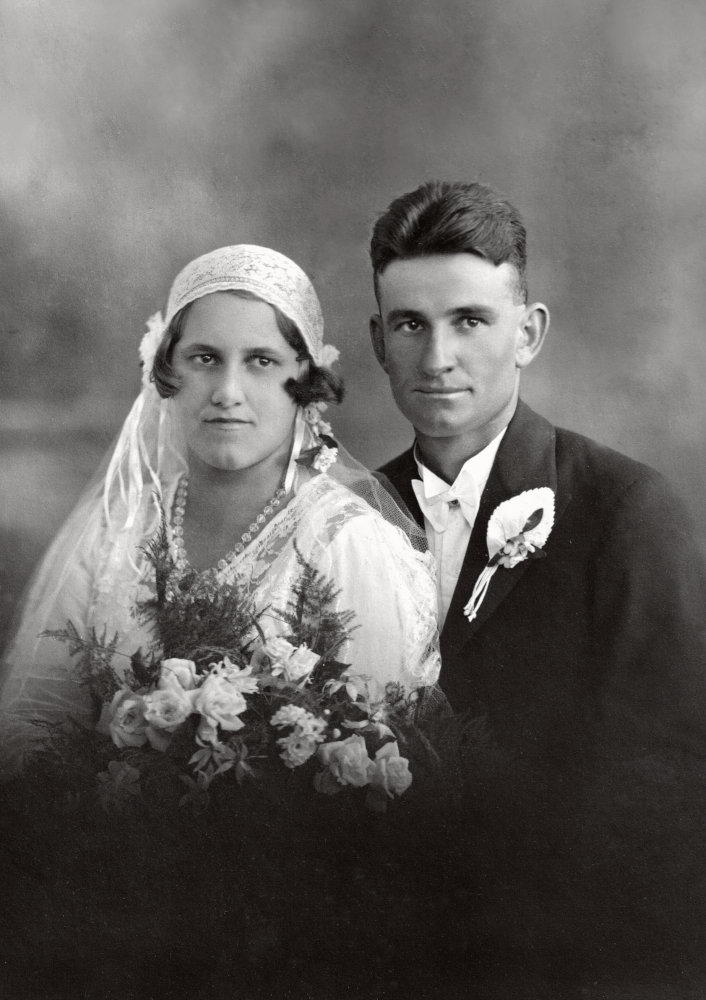
Norman Schneider
and Ruth Pfeffer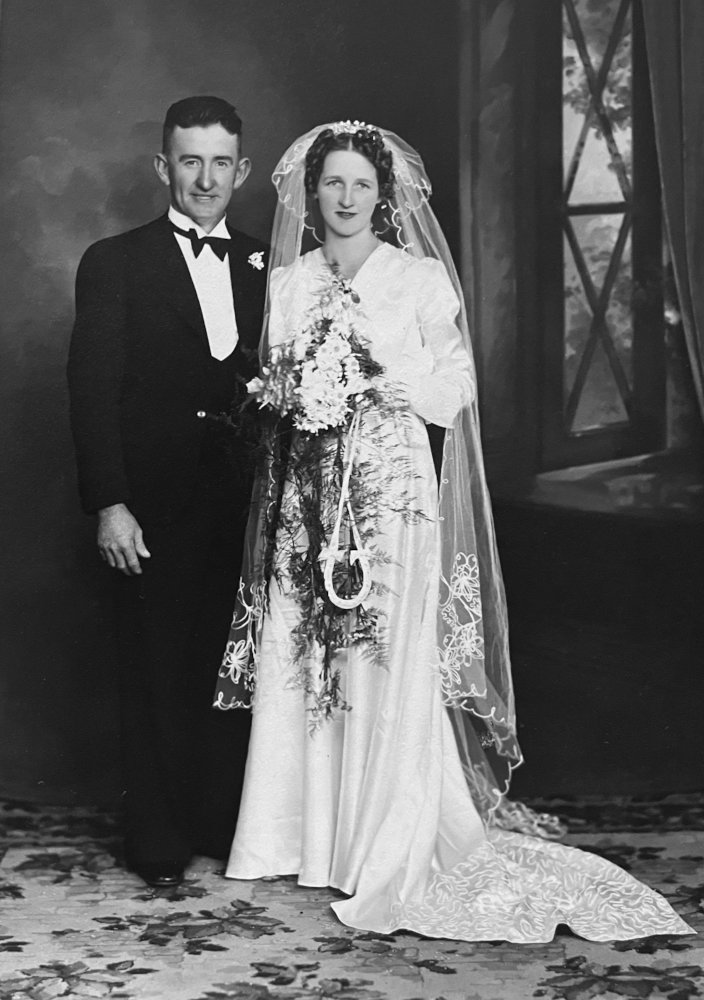
Fred Schneider
and Bertha Prenzler
Themes
It's not too much of a coincidence that the Schneiders in Germany had a thing about building walls. In the old days, walls were a necessary part of defence for city, town, castle and house. In Australia, those defences were down. It was nigh on impossible to protect property and farms from marauders. And that's exactly where Henry (Johann Heinrich) senior got himself into trouble. Big trouble. Around two o'clock in the morning of January 24, 1875, one Michael Portley with accomplices attempted to steal Henry's watermelons (again). Henry saw this as the last straw, having been under attack many times before.
He issued a warning: "Stop! I shoot!"and upon no response, fired what he thought was a warning shot from across the field, in the dead of the night. Unfortunately, he hit the miscreant. Also unfortunately, he was found guilty in August the same year of unlawfully injuring and sentenced to one month hard labour at the Brisbane prison.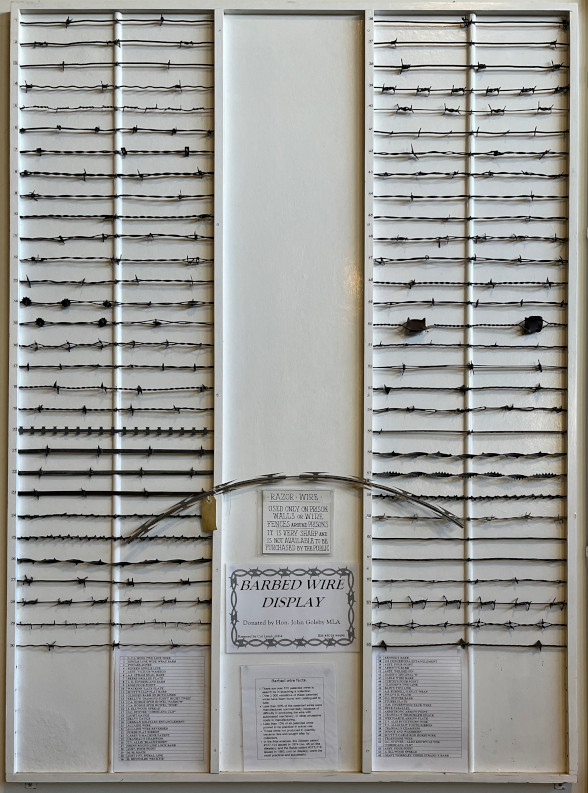
Barbed Wire which completely changed the game
Of course, in America at the same time, watermelon theft was regarded as a crime against the national order and was heavily sentenced. In fact it was such a problem, it was number one on the list of the most frequently occurring crimes, and the state did something about it to protect both the farmers and their produce.
A Barbed Solution
Some time afterwards, at the end of the nineteenth century, farmers took to using barbed wire fences to protect their properties. Not only could these fences keep precious livestock contained, they were also able to deter intruders from getting in. The most famous type of barbed wire is the one invented and patented in the 1870s by Joseph Glidden, a teacher, farmer and businessman from New Hampshire. The barbs for his prototype he had made in a coffee mill and kept in place on a strand of wire by another strand twisted around them.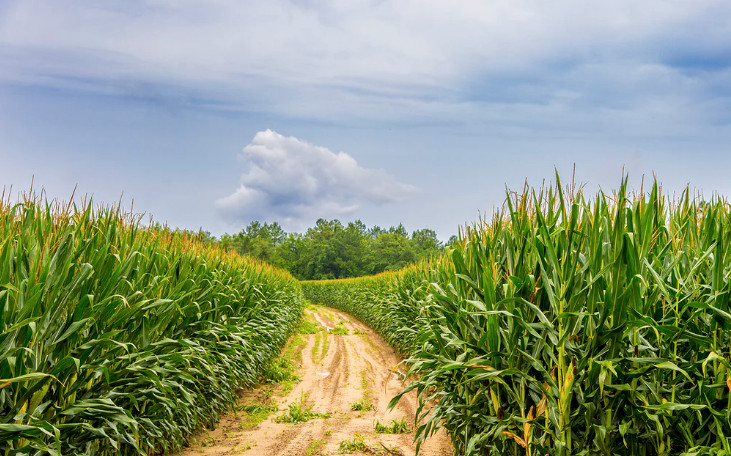 The Circle of Summertime
The Fassifern way of life and living can be nicely summarised
by the text to 'Vivaldi's Song' by Michael Franks:
We weather the wind and rain
We grow the farm
We're safe from harm
Inside this circle of summertime
 Mother
 Julius
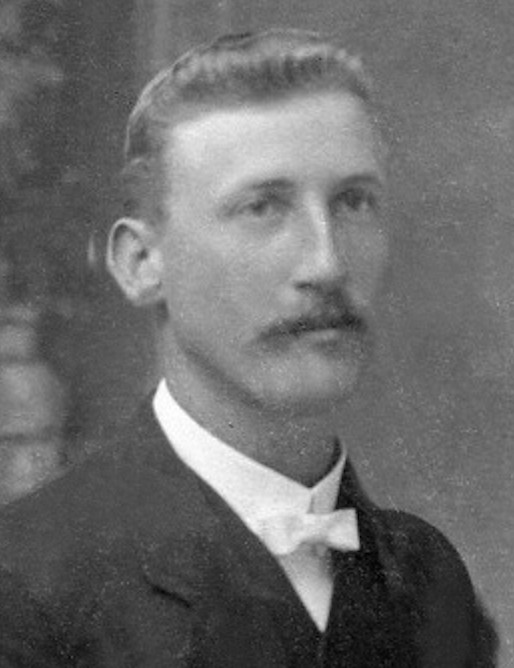 Daniel
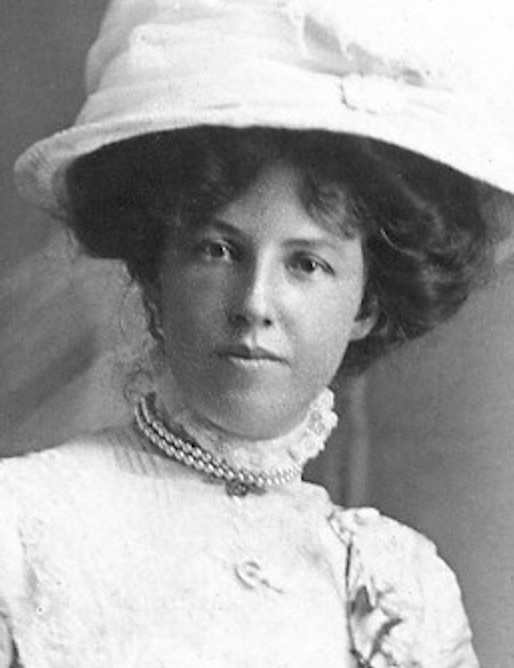 Adina
Adina
 Rosa
Rosa
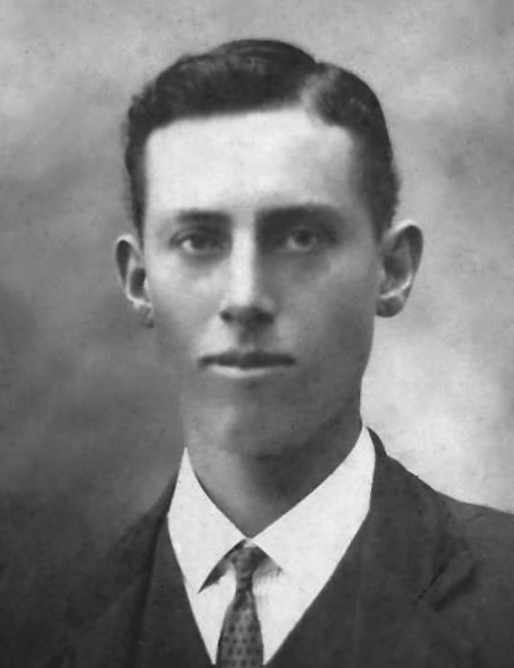 George
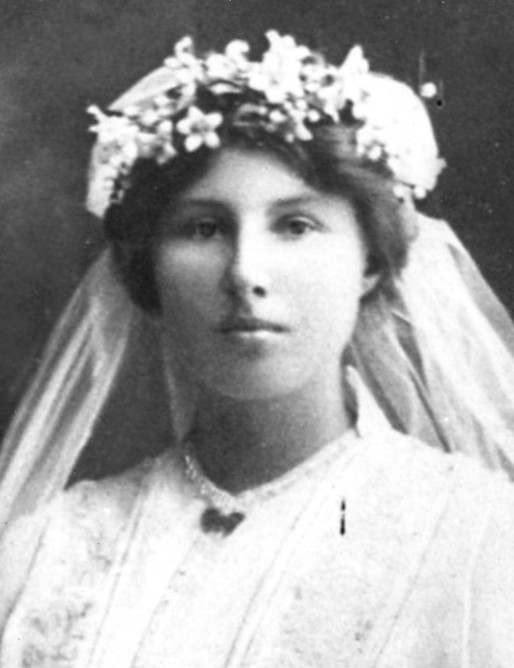 Louisa
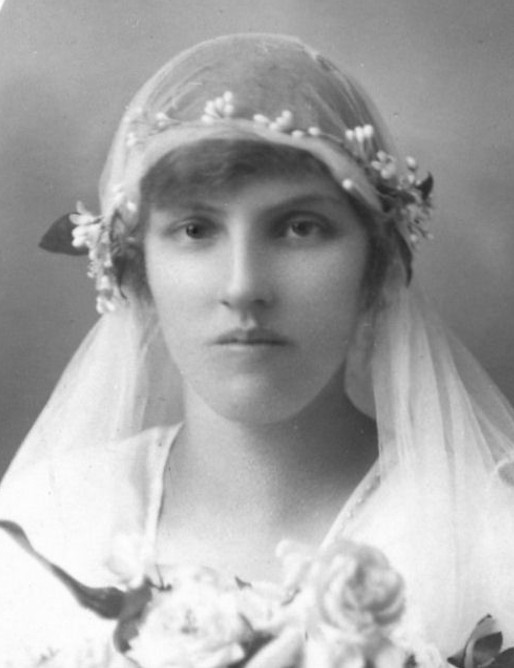 Ellen
Ellen
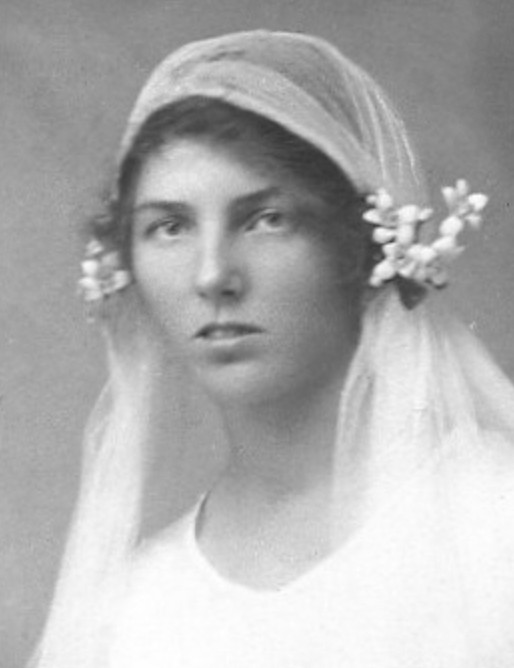 Christina
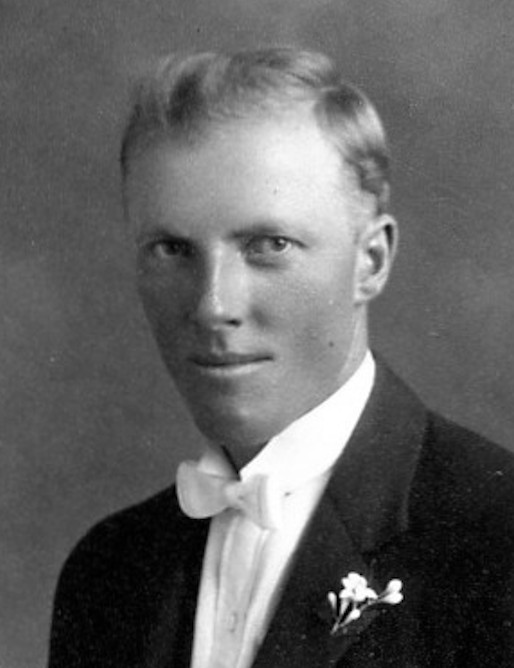 Albert