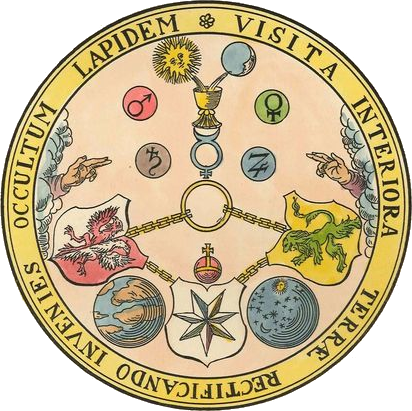
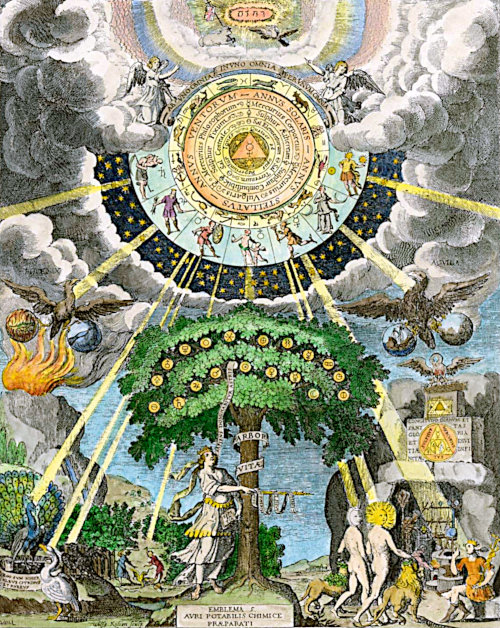
Hermetic Cosmology c.16th century
Fundamental Cosmology of Hermetical Astrology
- Nicholas Copernicus De Revolutionibus, 1543
For historians, Hermetism is comprised of two main streams, the philosophical, outlining ideas and beliefs, and the technical, regarding more practical subjects. This distinction was not made in ancient or medieval times. Indeed, as Garth Fowden has argued in his book, The Egyptian Hermes, they are not distinct from one another and each part relies on the other to make sense. Nevertheless, it should be mentioned that since this section is dealing with concepts, the topics covered here are nowadays regarded as part of the Philosophical Hermetica.
Sources for this information include the seventeen texts forming the so-called Corpus Hermeticum brought together in Italy in the Renaissance, the Poimander which was very popular throughout the middle ages, three of the fifty-two Nag Hammadi manuscripts (5th c. CE) discovered in Egypt in 1945, the Stobaean Hermetica from Johannes Stobaeus (5th c. CE) and the Kybalion from the 20th century. There are also many references and extracts to be found in the writings of the great thinkers of the past, such as the Stoics, Neoplatonists, Gnostics and Scholastics. So, let's start at the beginning.
Yet, before we do, there are some technical terms of a philosophical kind which should be discussed, so as to make sense of them when they are encountered within the context of the Hermetic texts.
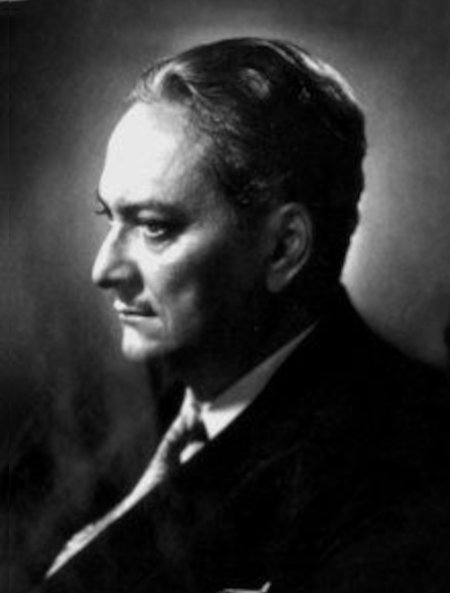
The arcana of the ancient Mysteries were never revealed to the profane except through the media of symbols. Symbolism fulfilled the dual office of concealing the sacred truths from the uninitiated and revealing them to those qualified to understand the symbols. Forms are the symbols of formless divine principles; symbolism is the language of Nature. With reverence the wise pierce the veil and with clearer vision contemplate the reality; but the ignorant, unable to distinguish between the false and the true, behold a universe of symbols. (p.597)
"A little philosophy inclineth man's mind to atheism; but depth in philosophy bringeth men's minds about to religion". (p.12, quoting Francis Bacon)
- Manly P. Hall, The Secret Teachings of All Ages, 1928
God, Eternity, Cosmos, Time, Becoming
These terms are fundamental to Hermetism, which often describes chains of creation for everything in existence. Many such chains will be encountered but the start is always with the Hermetic God: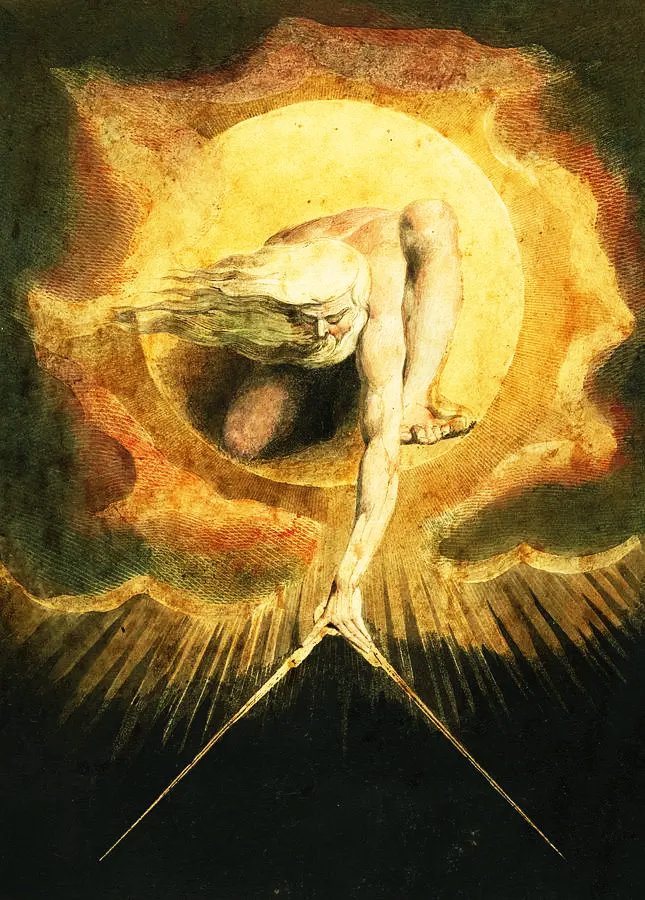 The Ancient of Days by William Blake, c.1794,
depicting the craftsman,
The Ancient of Days by William Blake, c.1794,
depicting the craftsman, first son of God, creator of all.
The English writer and artist, William Blake, said of Hermeticism, "Every age renews its powers from these works".
Yet many of the earliest Greek philosophers strongly criticised the traditional religion. Xenophanes (560-478 BCE), for instance, argued that there is only one supreme deity and not anthropomorphic at all. Heraclitus (c.535–c.475 BCE) said, "They talk to these statues as if one were able to hold conversation with houses". Anaxagoras (c.500-c.428 BCE) was put on trial for impiety for saying that some heavenly bodies are simply rocks, and instead, held that a cosmic mind (nous) was the deity.
Long ago, Stobaeus commenced his philosophical instruction with God. Primal, or "pre-existent", God is not the cosmos, or a deity in the cosmos. God is a supreme, ineffable being, transcending language, bodies, and all perceptible reality. The creation of this God is eternal as are the (probably astral) bodies that he makes. The image of God is not the whole cosmos, but the Sun. The Sun is the creator of the cosmos and of all bodies that change. Yet the Sun is so far below the primal God that his ability to truly imitate him is limited. The way to God is lived by cultivating devotion and the spiritual senses. Reaching God ultimately involves an ascent beyond the material world.
Comparing this to the text from the Corpus Hermeticum above, makes the Sun and Eternity identical.
 The Weeping Philosopher by Peter Paul Rubens, 1636-1638, depicting Heraclitus of Ephesus (c.535-c.475 BCE)
(Encyclopedia of Religion, 2nd ed., 2005, p.5500).
We must suppose, if the Ionian philosophers identified Word with Cosmic Reason and first principle, that they were induced and influenced by some well-known semi-philosophical use of the term "Word of the gods" as the personification of divine agency.
(S. Langdon, "The Babylonian Conception of the Logos").
Logos was a common term in the Greek language of the late sixth century BCE and is derived from légō (λέγω, "say", "speak") and has the basic meanings of "word" (spoken or written) or "utterance."
(Jack Lawson, "Mesopotamian Precursors to the Stoic Concept of Logos").
Logos and Cosmos
Two of the most important terms in Hermetism are "Logos" and "Cosmos". The earliest record of these two words being employed as technical terms was with Heraclitus of Ephesus (c.535–c.475 BC) who was very likely a contemporary of the writer(s) of the first Hermetic texts. For Heraclitus, Logos was in flux, in the same way as was meant by the earliest Hermetic texts.The Sophists were quick to pick up on the term Logos, and attributed the meaning of "discourse" to it. This was very likely because they were wandering philosophers readily giving speeches on any subject in return for money. Aristotle (c.384 c.322 BC) expanded the meaning into "reasoned discourse", alongside pathos and ethos, as the three parts of rhetoric.
At the end of the 5th century BC, the Stoics took another path referring to the "logos spermatikos" as the generative principle of the universe. Philo (c. 20 BC – c.50 AD) integrated the term into Jewish philosophy. From there, the Christian and hence modern usage, meaning "Word" or "Discourse", were settled upon for the word Logos.
As a divine, universal governing principle of order and knowledge, Logos combines everything into an orderly structure, for which Heraclitus termed "Cosmos", a word which already meant "pattern", "adornment" and "order".
For Heraclitus, there were two distinct versions of Cosmos. The "idios kosmos" (Greek: ίδιος κόσμος) is a person's "own world" or "private world" as distinguished from the "common world" or "common cosmos" (koinos kosmos). The origin of the term is attributed to fragment B89 (Diels–Kranz numbering) of the Pre-Socratic philosopher Heraclitus: "The waking have one common world, but the sleeping turn aside each into a world of his own." The term has various interpretations: idios kosmos is associated with dreaming, imagination, and delusion; koinos kosmos with wakefulness, reason, and consensus reality. (wikipedia)
Much, if not all of the ideas from Heraclitus are in tune with Hermetism. This is not surprising, for as Heraclitus himself says that he uses his Personal Logos to speak the truths of the true, Divine Logos. Although it was possibly the fashion at the time, Heraclitus did not take the word "Logos" to mean "discourse" (see T.M.Robinson, Heraclitus, Fragments, p.74-75). Instead, he more likely meant "true explanation" or "true statement" as "divine law". Heraclitus often used the terms "koinos logos" meaning "Common Logos" and "eidos logos" for "Personal Logos" (modern: "Soul's Logos").
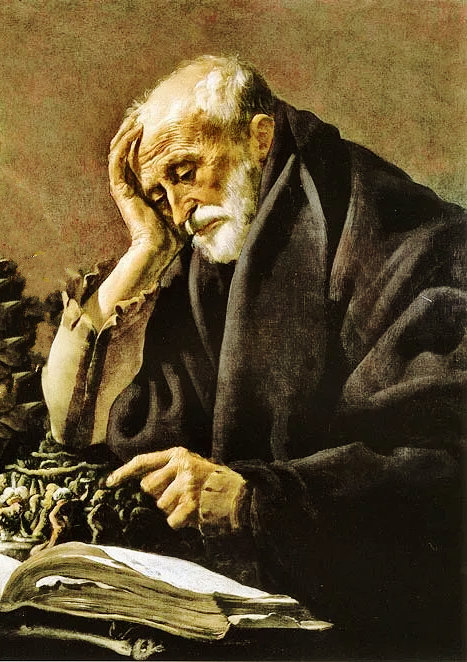 Heraclitus of Ephesus,
a thinker ahead of his time
- The logos is common to all (fragment 2)
- Unless you expect the unexpected you will never find truth, for it is hard to discover and hard to attain.(fragment 18)
- What even the most respected man knows and defends are imaginings/opinions. (fragment 28A)
- Uncomprehending, even when they have heard the truth about things, they are like deaf people. The saying 'absent while present' fits them well. (fragment 34)
-
For those who are awake there is a single, common universe,
where as in sleep each person turns away into an own, private universe. (fragment 89) - Thinking is common to all. (fragment 113)
- Soul possesses a logos which increases itself. (fragment 115)
Heraclitus held that the recurrent fire is everlasting, and that destiny is a logos which fashions existent things through the contrariety of the directions in which they tend to run. He tried to show that that logos which pervades (the) essence of the universe is (the) essence of destiny. Heraclitus says, then, that this 'common' and divine logos - by participation in which we become rational - is the yardstick of truth. So that which appears (such and such) to all in common is trustworthy (for it is grasped by the 'common' and divine logos), but that which strikes only an individual as (such-and-such) is - for the opposite reason - untrustworthy.
For having in these words expressly stated the view that we do and apprehend everything thanks to our participation in the divine logos, he goes on a little further, then adds: That is why it is necessary to follow that which is (common). Though the account (logos) is common, however, the many live as though they had a private understanding' (fragment 2). This logos is nothing else than an explanation (exposition, articulation, exegesis) of the mode of arrangement of the universe. That is why we speak truly whenever and in so far as we share in the recollection of it (i.e. of the logos) but are invariably mistaken on matters of private opinion.
So here and in these words he states clearly that the common logos is the yardstick (of truth); the things that appear such and such in common are trustworthy, as being judged by the common logos, whereas those that appear (such and such) to each person privately are false.
Logos, Hyle, Chaos, Dynamis and Energeia
Hyle is a term that apparently was coined by Aristotle to name the matter out of which all substances (ousia), have been formed. He was also attributed with the expression of first matter or prime matter (Greek: hyle prote, Latin: materia prima) but Anaxagoras had used the term earlier.From J. E. Cirlot, Dictionary of Symbols:
Logos is the light and the life, at once spiritual and material, which combats both death and night. It is the antithesis of disorder and chaos, of evil and darkness. It is also cognate with the word and with thought.
Other concepts from Aristotle, such as energeia (ἐνέργεια), "actuality", and dynamis/dunamis (δύναμις), "potentiality", were picked up by the mathematician, Gottfried Leibniz (1646-1716), and taken into physics as energy and dynamic.
The word dynamis/dúnamis (δῠ́νᾰμῐς) can mean potential, ability, power, might, strength, skill, authority, influence, magic, magical substance, magical power, manifestation (of divine power), faculty, capacity, worth, value, and meaning (as the force of a word). These are all important in Hermetism because they address what can be, rather than what is, which is the domain of energeia (ἐνέργεια). Within the context of Personal Identity, the potential is something positive, which can become actual or realised, in both the sense of making something real as well as gaining awareness of something.
The concept of dynamis embraces characteristics which are present and inherent, even if, or when, they are not being exerted, applied or expressed. To this end, many characteristics of the astrological chart may be seen as inborn dynamis which await activation, actualisation, manifestation or energising (energeia). Particular forces flow through astrological configurations which, when duly recognised, can offer help for these potentials to be applied.
Logos, Soul and Nous
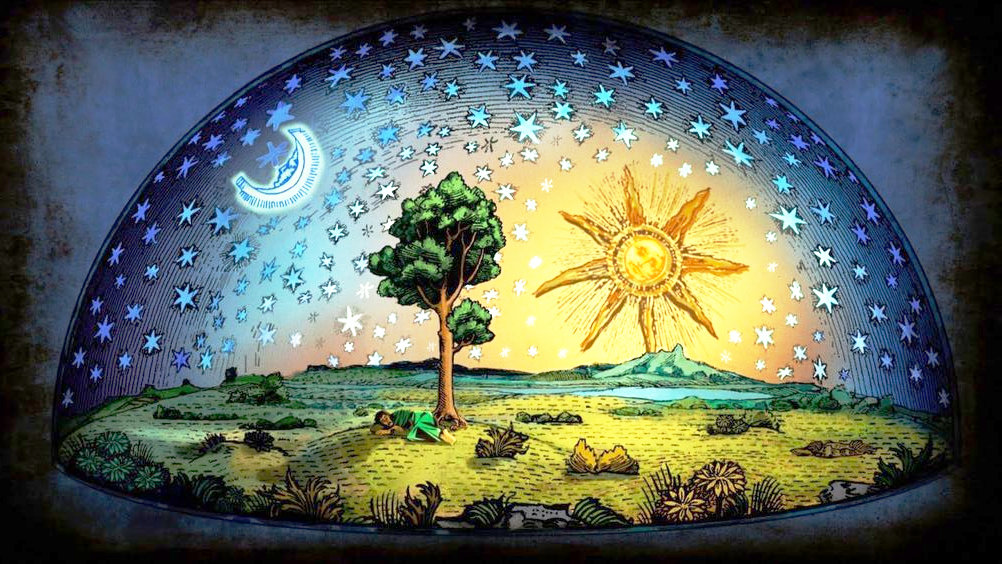
Throughout time, the words Logos and Nous, although still not regarded as being identical, have been attributed the same meanings, such as light, word, understanding, thought, reason and so on. The only sensible explanation for this phenomenon is the lack of thorough understanding of the meanings of these words on the part of theologians, philosophers, scribes, authors, historical translators and philologists. Notably, in more recent times, there has been a shift, moving the seat of spiritual human faculties away from the heart and chest area, into the intellectual and mental arena claimed to be occurring only in the head. This is due to the claim that the spiritual and heart-felt issues lie in the domain of religion, as "heart and soul".
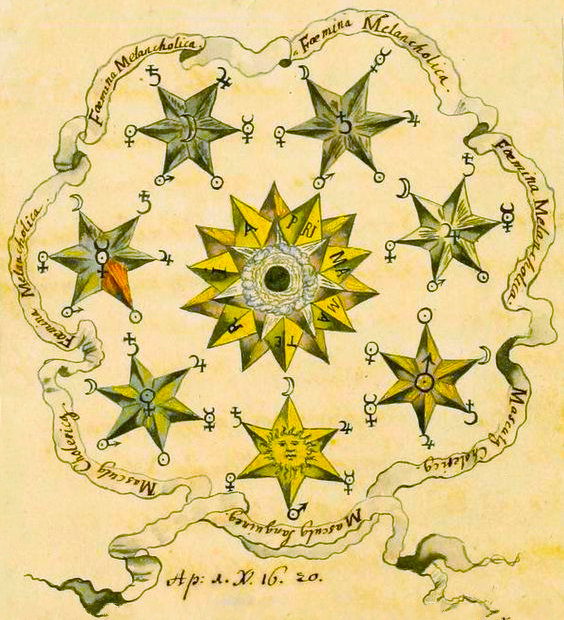
In Hermetic philosophy, Logos and Nous are quite different aspects of the Divine, which become more apparent by learning about the Cosmology of Hermes Trismegistus:
Nous is the image of the One.
Nous is the Eye of the Heart which can see truth.
Nous created the Logos.
Logos is the image of the Nous.
Logos is truth.
Logos was used by Nous to create the Cosmos.
Cosmos is the image of the Logos.
Cosmos is the All.
Cosmos was made out of the four elements separated from unformed matter (Hyle).
But there are variations within the ancient philosophies.
(in the entry for eikon (image, reflection) in F. E. Peters, Greek Philosophical Terms, p51).
In Plato:
time is an image of eternity
the created world is an image of its Father (Enneads. v, 8, 12), and
matter (hyle) is an image of being (on)
Nous - The Intellect of the Soul
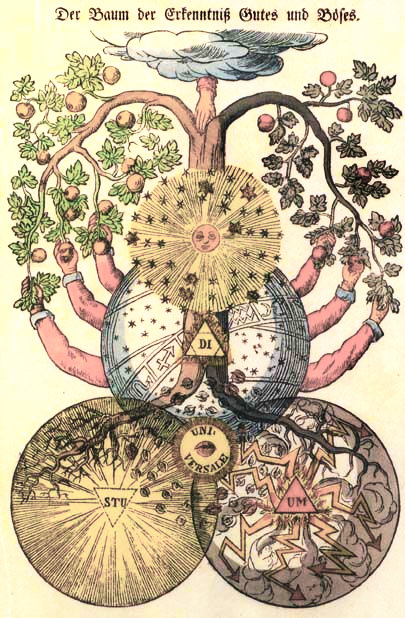 The Tree of Knowledge, 17th Century, German School
The Personal Nous, is at birth only having the potential for development, and through experience has the chance to increase personal intelligence, which in turn relies on the Divine Nous to grow. This relationship remains, and in turn provides a connection to the Personal Logos which can access the Divine Logos. In Hermetism, the Personal Nous is not in any way bound up with matter, being completely immaterial.
The Greek philosopher, Parmenides (c. late 6th C.- c. 5th C. BCE) held that sense-perception doesn't lead to truth, but only opinion. For him, it was only the personal nous which was able to tell what was true by having the ability to perceive it directly, in the same way as Daimons are able to do.
Plato considered nous to be the only immortal part of the human soul. In the Republic, Plato has Socrates explain to Glaucon "the analogy of the divided line" whereby he describes a division into two segments each of which are also divided into two. The four resulting segments then represent four separate "affections" (pathēmata, Greek: παθήματα, sufferings) of the psyche. The lower two divisions relate to the visible while the upper two correspond to the intelligible. These four affections equate to increasing levels of reality and truth, starting with conjecture (eikasía, εἰκασία, a guess), then belief (peîsis, πίστις, faith), onto thought (dianoia, διάνοια, cognition) and finally understanding (nôsis, νόησις, intelligence).
Andre-Jean Festugiere (15.03.1898-13.08.1982), the historian, philologist and priest, who also translated the Corpus Hermeticum, said about Logos and Nous:
Bertrand Russell (1872-1970) said in A History of Western Philosophy about the usage of 'nous' in Neoplatonism:
The Soul as Pneuma and Psyche
Although the ancient Greek word for soul was pneuma, in the modern world, the word psyche (ψυχή, literally meaning "life"), is used. The meaning has been extended to refer to the spiritual human soul. This was adopted by Christian philosophers from Aristotle's philosophy. The modern usage of psyche also refers to the animating part of the human body, the meaning of which is the foundation of psychology, which describes psyche as "the totality of the human mind, conscious and unconscious". This version of psyche is held responsible for the enlivening of the body in a physical sense. In Latin this is called the "anima", which in ancient Greek was more often referred to as "bios", meaning "life".This all comes about from a treatise about the psyche written by Aristotle, entitled "Peri Psyches" in Greek, "De Anima" in Latin, and "On The Soul" in English. But Aristotle also claimed there were three nested souls, the nutritive (as also in plants), sensitive (as also in animals) and logos (rational and only in humans). Of course, it is difficult to ascertain what makes a body alive. Whether it be a physical, natural, enlivening force called life, or a non-physical, spiritual, wilful and mindful action of the mind. The latter is taken to be the case in Hermetism, both for the Divine Soul and the Personal Soul.
In Plato's Republic, Book IV, soul is divided into three parts:
- nous ("intellect", "reason"), which is or should be the controlling part which subjugates the appetites with the help of thumos
- thumos ("passion", "spirit"), the emotional element in virtue of which we feel joy, amusement, etc.
- epithumia ("appetite", "affection"), to which are ascribed bodily desires
But a century earlier, Heraclitus said:
- Soul [psyche] possesses a logos which increases itself.
(Like nous, logos is also "intellect" and "reason".)
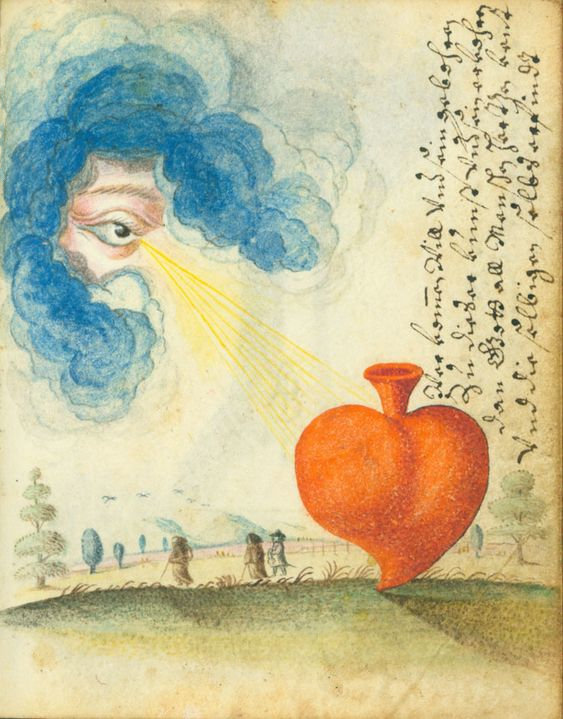 Alchemical Manual, Ulrich Ruosch (1628-1690), c.1680
Heart and Nous
The heart is the locus of physical and spiritual being, and represents the "central wisdom of feeling as opposed to the head-wisdom of reason" (Cooper, 82). It is compassion and understanding, life-giving and complex. It is a symbol for love. Often known as the seat of emotions, the heart is synonymous with affection. In Egypt, it represented life-essence, as the mummified had their hearts preserved, first part of man to live, last to die. Hearts also carry senses of intellect and understanding, as well as connotations of the soul, along with come will and courage. Is the central point (with the brain and sexual organs being the endpoints) of the vertical scheme of the human.(from Dictionary of Symbolism, Allison Protas, Geoff Brown, Jamie Smith, Eric Jaffe)
Babua ben Asher, a rabbi of the eighteenth century, commenting on this commandment, said that the heart was the first part of us to be created and will be the last to die, so to love with our whole heart is a promise to go on loving till our last breath.
(frpm The Heart as a Universal Symbol, David Richo)
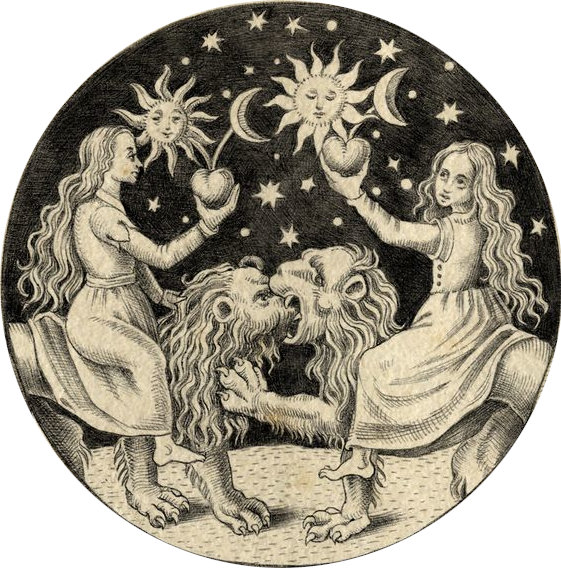 From The Alchymist by Sveta Dorosheva
Heart and Sun
The Stoics claimed that the senses were ruled by what they called the hegemonikon which they took to be the human heart or residing in it, as the ruler of all emotions and thoughts, as well as the seat of the soul. One of the Stoics, Cleanthes c.330–230 BCE), went further and located the hegemonikon of the Cosmos in the Sun (see under sympátheia in F. E. Peters, Greek Philosophical Terms, p186). In astrology, the Sun is the ruler of the heart. In the melothesia of astrological medicine there is a correspondence between the human heart and the Sun in an astrological chart.This symbolism comes about from consideration of what is central to (at the heart of) both the Cosmos as macrocosm, and the human as microcosm.
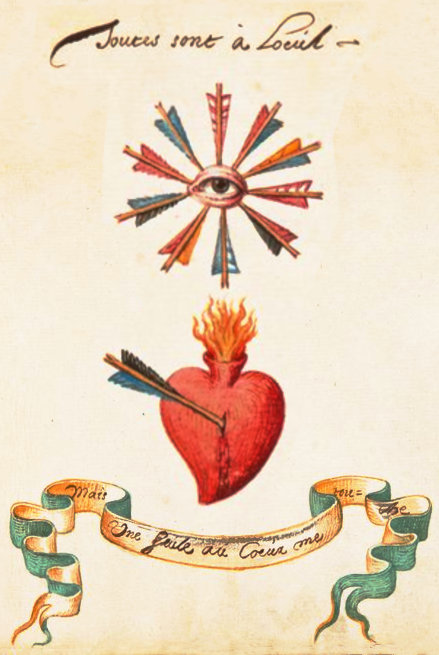 "all arrows go to the eye but only one hits my heart" (early 17th century)
Heart and Phren
In Ancient Greek philosophy, phren (Ancient Greek: φρήν, romanized: phrēn, lit. 'mind'; plural phrenes, φρένες) is the location of thought and contemplation. The kind of mental activity conducted in the Phren involves what 20th and 21st Century Western thinkers consider both feeling and thinking; scholars have remarked that Ancient Greeks located this activity in the torso as opposed to the head.For example, phren is where Achilles considered his sadness about losing Briseis, and his duty to join the Greeks against Troy. Phren, however, is not exclusively applied to humans. In Empedocles' system, phren is a general psychological agent to which moral blame and praise can be extended, that darts through the universe as effluences, steers and controls the cosmos in the process and is the measure of what is harmonious and what is fit to exist. It is said that it is strongest at the region found beyond the universe where strife reigns. (wikipedia)
phrḗn (Greek: φρήν) feminine (genitive φρενός); third declension
- The seat of emotions, heart; seat of bodily appetites such as hunger
- The seat of intellect, wits, mind
- Will, Purpose
- (often in the plural) The midriff, stomach and lower chest or breast
Words derived from Phren:
- phrensy (Hippocrates. Of the Epidemics)
- phrensies, phrenzy, phrensy (Nicholas Culpeper)
- phrenitis, phrenitic
- phrenology (Dr. Charles W. Roback)
- astro-phrenology, phrenological (Carrington Bolton)
Hermetic Cosmology
In the Beginning...
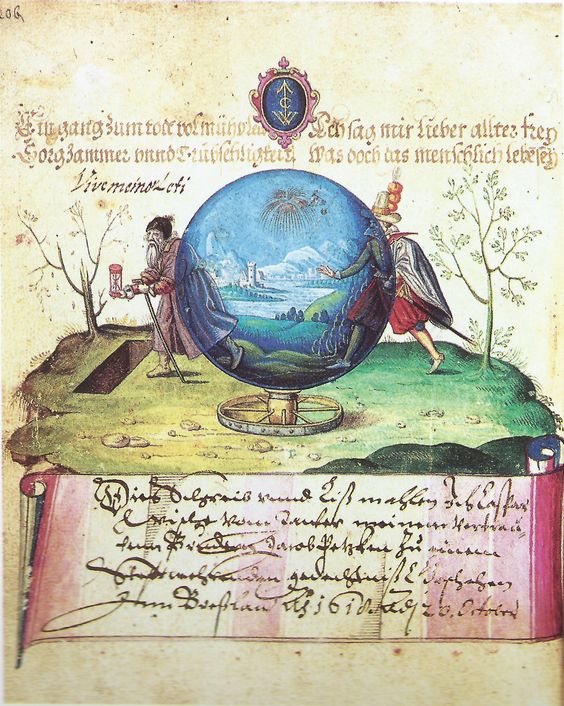
The cultures which formed the basis included Babylonian, Sumerian, Akkadian, Egyptian and Anatolian. All of these originally had their own cosmologies, often with commonalities, and were eventually absorbed into the Hermetic Cosmology. It would be safe to say that the new Hermetic thought created its own cosmology to cover the concerns previously addressed by its predecessors. That's not unique. Even the young Johann Wolfgang von Goethe at the onset of Romanticism tried his hand at making up his own Cosmology.
The Hermetic Creation Myth
There are lots of creation myths stemming from the ancient world and naturally, Hermetism comes with its own. What is especially outstanding though, is the form in which the story is presented. All the way through the seventeen texts of the Corpus Hermeticism as well as the Pymander, the Nag Hammadi and others, is a technique employed whereby a mysterious all-knowing figure, usually Hermes himself or Poimandres, appears to an unsuspecting receiver of some great wisdom. Sometimes this person is called Tat, another time Asclepius or King Ammon.The Cosmos and The Logos
First and foremost is the Hermetic story of how the Cosmos was created but it might be best to first mention a few observations about the message of the Hermetic texts. Since God is All and is All Mind without material substance, the one thing God was lacking was to experience anything of substance. A vast and limitless mind thinking of nothing. The myth seems to tell of the urgency of bringing something into being which would gather experiences and provide a means to bring them back to report on life, the cosmos and everything. That means was, and still is, meant to be humanity.This is not automatic and naturally enough not everyone can achieve this aim without much effort and as Madame H. P. Blavatsky put it, in Isis Unveiled, Vol.1 p346:
The Cosmology and Cosmogony - The Details of Creation
The All (To Pan) was All Mind (Nous) and Light and was All God and contained that which became The Cosmos and Everything within it. The All was limitless, light and sweet. And a darkness began to settle like a coiled snake which turned into Moist Nature which tossed about and wailed with fiery smoke.Then out of The Light came the Holy Word, The Logos, which descended upon Nature. And upwards leapt fire, followed by air out of the earth and water, which were intermingled and too heavy to rise. Yet they were moved to hear by reason of The Spirit-Word-Logos pervading them.
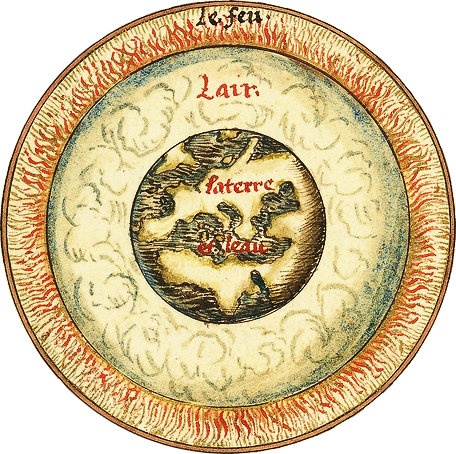 The Created Elements
 Fire, Air, Water and Earth
The Light-Word-Logos is the son of God.
What one hears and sees in oneself is the Lord's-Word-Logos but Mind is Father-God.
And they are a unity
(Note that these are referred to in this work as Personal Logos and Cosmic Logos).
Upon Creation of The Cosmos, The All, The Mind and God, all also came into existence. This was an act of Will within The All to bring about primary matter out of which everything is created. The primary matter in turn divided into the four elements of fire, air, water and earth.
God then ordered the four elements into becoming the seven heavens of the seven planets. Out of the materialising of the four elements, The Logos, The Word, sprang forth into being. Nous then ordered that the planets spin and move in their orbits. They moved within the 8th heaven of the fixed stars and all within the 9th heaven, The Primum Mobile.
The movement of the heavens brought forth creatures without reason or speech. The Earth was then separated from The Water and animals except for man were created. The God then created androgynous mankind, in God's own image, and handed over creation to mankind.
Note that the process of creation is advanced by the power of speech/logos. As the manifestation of will, speech places sounds into the air which represent ideas. These are carried with the power by will, and the result of this action was creation. However, creation through speech was possible only due to the use of God‘s speech. God‘s logos guided Cosmos‘ Nous (the craftsman‘s mind) during his participation in the creation. Cosmos‘ main attributes were concerned with the handling of all forms of matter.
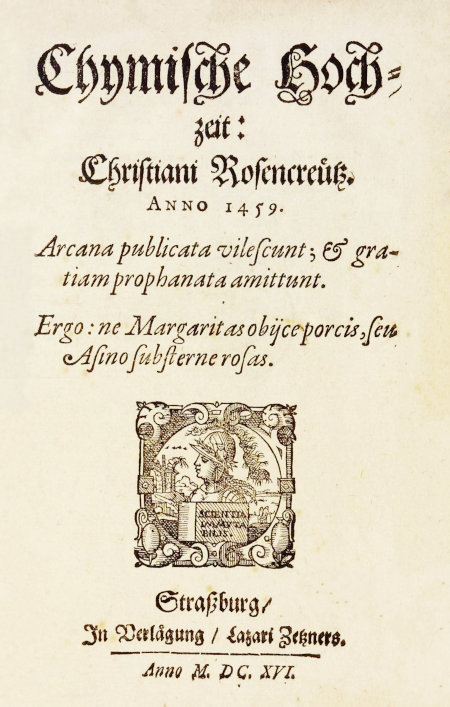 Chymical Wedding of Christian Rosenkreutz (Chymische Hochzeit Christiani Rosencreutz anno 1459, published 1616
Hermetic Organisations and People
For those who prefer to study esoterics in a group similar to mainstream education, or perhaps as in an ancient style secret cult, there has been a number of organisations to help them out. As a result of their nature, most of these organisations and people are somehow affiliated with Freemasonry or Gnostic ideas. This can be misleading as far as Hermetism is concerned because even though the basic ideas are Hermetic, they have been modified to fit in with later frameworks, namely to incorporate that the world is bad and the only release from it is after death. Many people have tried to align Freemasonry with Hermetic ideas, with some claiming to have succeeded, others claiming there is no valid association. The name Hermetic in the Rosicrucian arena invariably refers to alchemical, for which the word Hermetic was used. For all concerned, the word Hermetic was employed to validate their activity as being beyond the ordinary or mundane.The Rosicrucians (c.1610-) (Rosenkreuzer/Rosencreutzer) firstly started to form in Germany then all across Europe, after the publications of some seminal works. The first was in 1610 and circulated anonymously as a manuscript entitled "The Fame of the Brotherhood of the Rosy Cross" (Fama Fraternitatis Rosae Crucis). A second text, entitled "The Confession of the Brotherhood of RC" (Confessio Fraternitatis) from 1615, attempted to clarify confusions which arose from the previous publication. In 1616, another text followed, entitled "Chymical Wedding of Christian Rosenkreutz" ("Chymische Hochzeit Christiani Rosencreutz"). These texts were later attributed to Johannes Valentinus Andreae (1586-1654).
The Order of the Golden and Rosy Cross (1760-1787) (Orden des Gold- und Rosenkreutz) was a German Rosicrucian order which became the model for "The Societas Rosicruciana in Anglia" and later, "The Hermetic Order of the Golden Dawn". It was founded by an alchemist going under the pseudonym of Hermann Fictuld in the mid 1750s, and demanded that its members were not only alchemists but also Master Masons from the Masonic Lodges of the Freemasons. It was claimed that the inspiration for the fraternity came from a 1710 publication entitled The perfect and true preparation of the Philosophers Stone according to the secret of the Brotherhoods of the Golden and Rosy Cross. The King, Frederick William II of Prussia, was known to be a member, having achieved the highest rank.
The Theosophical Society was founded in New York City in 1875 by Helena Blavatsky (1831-1891), a Russian Mystic, and Henry Steel Olcott (1832-1907), an American military officer, lawyer, journalist, Freemason, Buddhist, and first President of The Theosophical Society.
The Hermetic Order of the Golden Dawn (1887-1903) (Latin: Ordo Hermeticus Aurorae Aureae), better known as "Golden Dawn" was formed as a secret society devoted to the study of Hermetism, Metaphysics and the Occult. It was founded in 1877 by three Freemasons and members of the "Societas Rosicruciana in Anglia", William Robert Woodman (1828–1891), William Wynn Westcott (1848-1925), and Samuel Liddell MacGregor Mathers (1854-1918). The society and its precepts became the largest inspiration and influence for most of modern occultism and ritual magic, such as Wicca and Thelema.
The Rosicrucian Fellowship ("An International Association of Christian Mystics") (1909-) was founded in 1909 by Max Heindel, as a Christian esoteric association. Together with his later wife, Augusta Foss, Heindel travelled, lectured, wrote extensively and gained a lot of popularity for the Fellowship. The association is based on a highly developed system of ideas shared amongst many international communities.
Some Hermetic Thinkers:
| Marsilio Ficino | (1433-1499) | scholar, priest, astrologer, humanist philosopher, translator of Plato and Corpus Hermeticum |
| Theophrastus Paracelsus | (c.1493-1541) | physician, alchemist, lay theologian, philosopher, author, medical pioneer |
| Nicholas Copernicus | (1473-1543) | polymath, mathematician, astronomer, Canon, formulator of heliocentricity |
| Giordano Bruno | (1548-1600) | priest, monk, philosopher, poet, alchemist, astronomer, cosmological theorist, esotericist, hermeticist |
| Sir Francis Bacon | (1561-1626) | philosopher, statesman, essayist, pioneer of scientific method and empiricism |
| Robert Fludd | (1574-1637) | physician, Paracelsian, universal scholar, mathematician, astrologer, cosmologist, Rosicrucian, Kabbalist |
| Sir Isaac Newton | (1643-1727) | universal scholar, mathematician, physicist, astronomer, alchemist |
| Gottfried Wilhelm Leibniz | (1646-1716) | universal scholar, mathematician, physicist, philosopher, linguist, historian, Rosicrucian Secretary, Occultist |
| Benjamin Franklin | (1706-1790) | writer, scientist, politician, philosopher, Freemason, a USA founder, student of Hermetism |
| Karl von Eckartshausen | (1752-1803) | writer, Rosicrucian, philosopher, member of Illuminati, leading figure of Enlightenment |
| Ludwig van Beethoven | (1770-1827) | composer, taught by Illuminati, Hermetic, Freemason, Rosicrucian members |
| Georg Wilhelm Friedrich Hegel | (1770-1831) | philosopher, Idealist, claimed by Glenn Magee in 2001 to be a "Hermetic Thinker" |
| Giuseppe Garibaldi | (1807-1882) | Italian general, freedom fighter, Martinist, alchemist, Kabbalist |
| Claude Debussy | (1862-1918) | composer, Rosicrucian, Martinist, Cabbalistic Occultist, Christian Mystic |
| Erik Satie | (1866-1925) | composer, Rosicrucian, Martinist, Kabbalist, Christian Mystic |
| Carl Gustav Jung | (1875-1961) | psychiatrist, psychotherapist, psychologist, student of Hermetism, Alchemy, Astrology |
| Albert Einstein | (1879–1955) | physicist, Nobel Prize winner, Kabbalist, developer of the theory of relativity |
| James Joyce | (1882-1941) | novelist, poet, critic, in 1954, Willam York Tindall wrote about Joyce's involvement in the Hermetic Tradition |
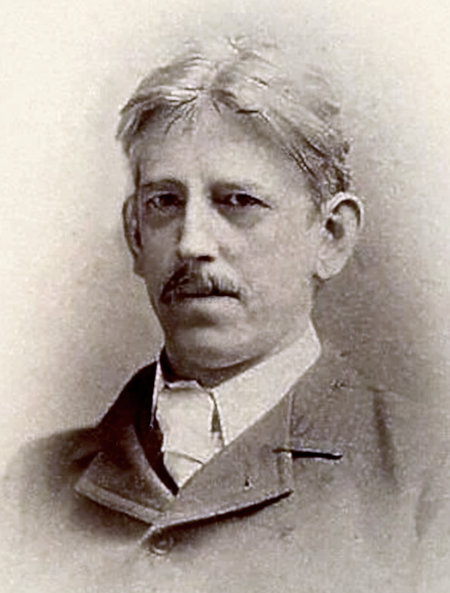 Samuel Liddell MacGregor Mathers
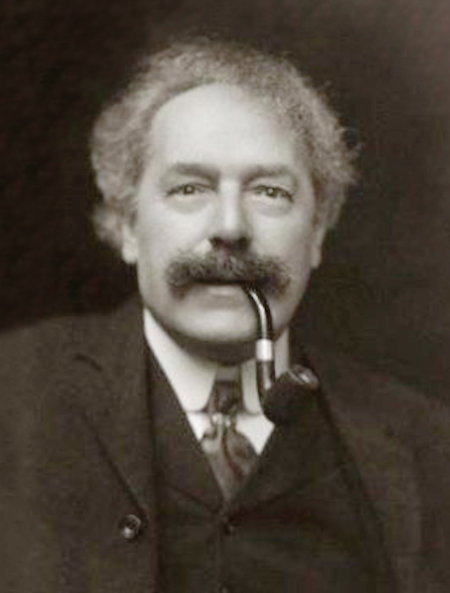 Arthur Edward Waite
Samuel Liddell MacGregor Mathers (1854-1918) was a British Occultist, Freemason, member of the SRIA (Societas Rosicruciana in Anglia), and one of the founders of the Golden Dawn. His prominence was such that one of the scholarly members, Israel Regardie, said that "the Golden Dawn was MacGregor Mathers". Mathers was known to be a practising vegetarian, some said vegan, a non-smoker and with his main interest being magic. He apparently was an eccentric figure, becoming increasingly so in later years, as was noted by the poet, and member of the Golden Dawn, W. B. Yeats. Mathers had added the MacGregor part to his name as a claim to Highland Scottish ancestry.
Walter Scott (1855–1925) was an English classical scholar and professor of classics at the University of Sydney from 1885 and later McGill University, Montreal from 1905. He is best known as the translator and editor of a well respected edition of the Hermetica in four volumes, the first of which was published in 1925.
Arthur Edward Waite (1857–1942), born in New York, was a poet and scholarly mystic who wrote extensively on occult and esoteric subjects, and was the co-creator of the Rider–Waite tarot deck. When Waite was a small child, his father died, and his widowed mother moved them to her home country, England. In 1891, he became a member of the Golden Dawn but withdrew from it in 1893. In 1896, he rejoined and in 1901, became a Freemason. A year later, he was also a member of the "Societas Rosicruciana in Anglia".
 Max Heindel
Manly P. Hall
Max Heindel
Manly P. Hall
Manly Palmer Hall (1901–1990) was a Canadian born astrologer, philosopher, mystic, lecturer and author of over 150 books. His most well known work is The Secret Teachings of All Ages: An Encyclopedic Outline of Masonic, Hermetic, Qabbalistic and Rosicrucian Symbolical Philosophy (1928). In 1919, Hall became a preacher at the Church of the People in Los Angeles and a year later was made a "permanent pastor". The early 1920s saw Hall as the recipient of a large portion money belonging to Caroline Lloyd and her daughter Estelle, of the family controlling an oil field in Ventura, California. With that money, he travelled extensively in Europe, wrote many books and acquired a collection of rare books about alchemy and esotericism. When Carolyn Lloyd died in 1946, Hall was left a house, $15,000 cash and $10,000 yearly income for 38 years.
Important Hermetic Works
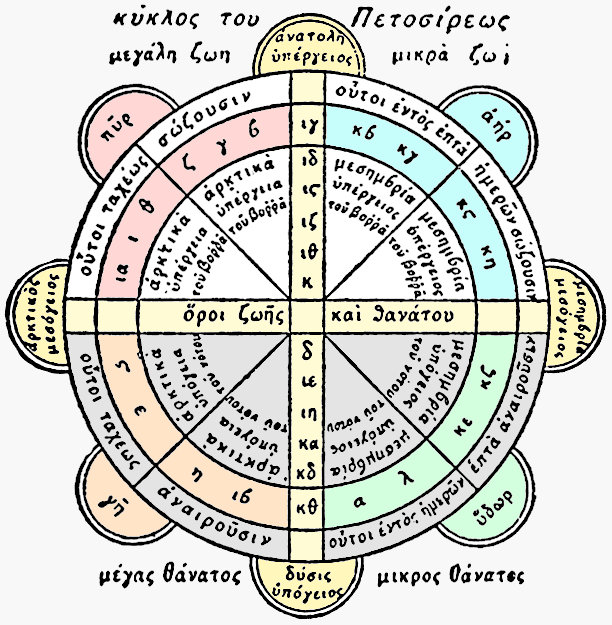
Circle of Petosiris from the Nechepso-Petosiris texts, used for medical prognosis, (from the 15th C. Manuscript Grec 2419, in L'astrologie grecque by Auguste Bouché-Leclercq, Leroux 1899, p540).
Across the top is written "Circle of Petosiris" (κύκλος του Πετοσίρεως). Across the middle, is written "the border of life and death" (ὅροι ζωῆς καὶ θανάτου) where the upper half is life, the lower half is death, and the four quadrants are, from top-left:
- In pink, Great Life (ἡ μεγάλη ζωή) and element of Fire (πῦρ). In yellow, arctic Sun [star] under the earth, midnight (ἀρκτικός μεσόγειος).
- In blue, Small Life (ἡ μικρά ζωή) and element of Air (ἀήρ). In Yellow, Sun rising above the earth (ἀνατολή ὑπέργειος).
- In green, Small Death (μικρός θάνατος) and element of Water (ὕδωρ). In yellow, midday Sun over the earth (μεσημβρία μεσόγειος).
- In orange, Great Death (ὁ μέγας θάνατος) and element of Earth (γῆ). In yellow, setting Sun under the earth (δύσις ὑπόγειος).
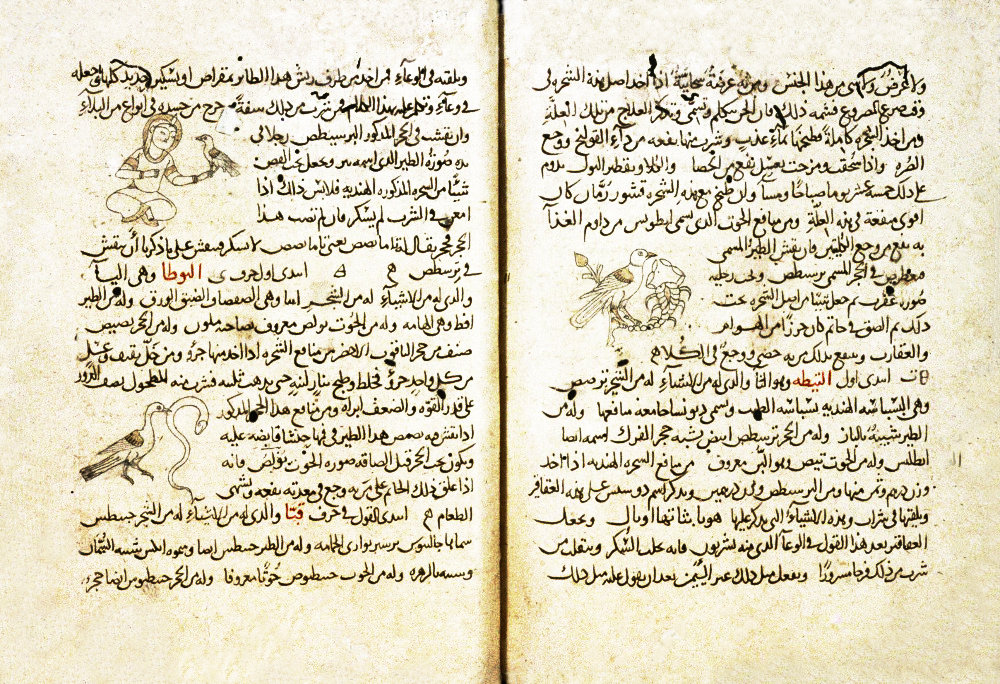
The Cyranides, a work on healing magic, Arabic manuscript 14th C.
 Asclepius, Rome, 1469
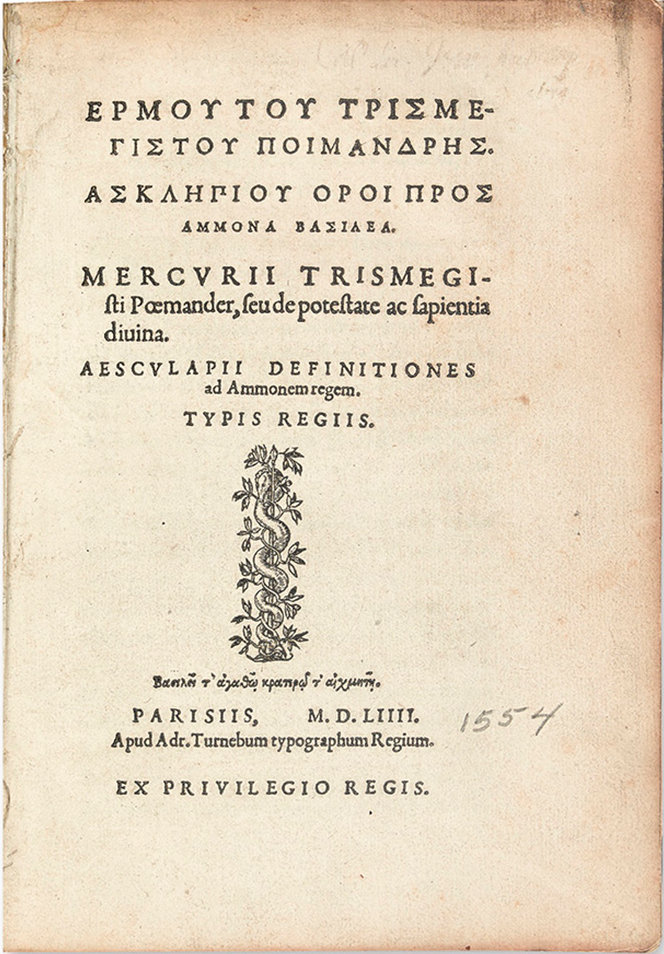 1554 edition of Corpus Hermeticum with Asclepius, in Latin and Greek, auctioned in 2015 for $3,750
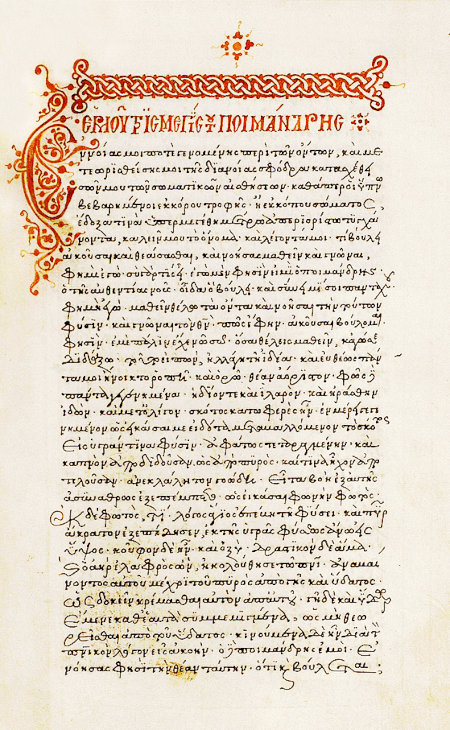 Poimandres, in the manuscript Venice,
Biblioteca Nazionale Marciana
Gr. Z. 263. The manuscript was owned by Cardinal Bessarion.
Poimandres, in the manuscript Venice,
Biblioteca Nazionale Marciana
Gr. Z. 263. The manuscript was owned by Cardinal Bessarion.
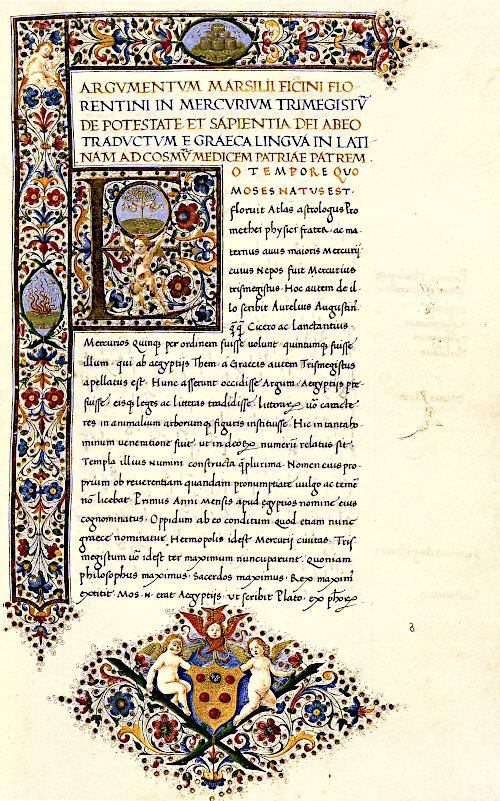 Marsilio Ficino's introduction (argumentum) to his Latin translation of the Corpus Hermeticum in a manuscript dedicated to Lorenzo il Magnifico, 1491.
Technical Hermetica
The oldest known texts associated with Hermes Trismegistus are a number of astrological and alchemical works which likely go back as far as the second to fifth century BCE. Here is a list from various sources:- Iatromathematics of Hermes Trismegistus (» English translation available on this site)
- The Salmeschoiniaka (The "Wandering of the Influences") (on the stars)
- The Nechepso-Petosiris texts (fragments of various texts)
- The Art of Eudoxus (on astronomy per Hermes)
- The Liber Hermetis ("The Book of Hermes") (on the decans)
- The Brontologion (on the various effects of thunder)
- The Peri seismōn ("On earthquakes")
- The Holy Book of Asclepius Called Myriogenesis (on astrological medicine)
- The Fifteen Stars, Stones, Plants and Images (on astrological mineralogy and botany)
- The Cyranides is a work on healing magic
- The Greek Magical Papyri (practical instructions for spells and incantations)
- The Liber Sacer (astrological botany)
- From Hermes Trismegistus to Asclepius: On Plants and the Seven Planets (botanical)
- On the Plants of the Twelve Signs by Hermes Trismegistus
- Organon of Hermes Trismegistus
- Panaretos, the Secret Method of Hermes Trismegistus
- On the Denomination and Power of the Twelve Places
Philosophical Hermetica
Caution is required when reading these texts. They have been extensively modified to suit the agendas of later philosophies, in particular Gnosticism, Judaism, Neoplatonism, Sophism, Stoicism and Christianity, to name but a few. This has led to the introduction of terms peculiar to those disciplines but alien to the original texts. Not only that, some parts have been removed, to better suit the tastes and expectations of the new audiences. Modern historians have turned this around to state that Hermetism is not only younger than those mentioned but borrowed from them. This of course is untrue because more ancient writers have already mentioned Hermetism and recent archaeological findings and historical research in museums have discovered Hermetic texts and horoscopes predating all of the other fields.- The Corpus Hermeticum in 17 Books (» English translation available on this site) previously known as The Divine Pymander
- Asclepius in 15 Parts, also known as The Perfect Discourse/Logos (» English translation available on this site) (medieval versions circulated before the Corpus Hermeticum)
- Definitions of Hermes Trismegistus to Asclepius, a collection of aphorisms (which Jean-Pierre Mahé claims to be core teachings)
- The Discourse/Logos on the Eighth and Ninth or The Ogdoad Reveals the Ennead (in the Nag Hammadi texts)
- Prayer of Thanksgiving (in the Nag Hammadi texts)
- Excerpts from Asclepius, 21-29 (in the Nag Hammadi texts)
- Stobaean Excerpts (contains a significant number of discourses and dialogues attributed to Hermes)
- Korē kosmou or The Daughter (or Eye) of the Cosmos (the longest of the Stobaean excerpts)
- The Kybalion: A Study of the Hermetic Philosophy of Ancient Egypt and Greece, published in 1908 by "Three Initiates" (possibly William Walker Atkinson, 1862–1932) concentrating on "Seven Hermetic principles"
» Asclepius
known also as The Perfect Discourse
or A Treatise on Initiations
translated by Dr. Anna Kingsford and Edward Maitland
» English translations available on this site:
- Part 1 The Unwisdom of Indiscriminate Disclosure of Spiritual Mysteries
- Part 2 The One and The Many, The Type and The Individuality
- Part 3 The Dual Nature of Man
- Part 4 God, The World, and Man
- Part 5 The Reason For Man's Dual Nature
- Part 6 The Threefold Nature of God
- Part 7 Of Mind and Similar Things
- Part 8 The Primordial Principles of Things
- Part 9 The Relationship and Resemblance Between Men and Gods
- Part 10 Contrast Between The Immortal and The Mortal
- Part 11 The Eternal Consciousness and Being of Deity
- Part 12 Form, Place and The Non-existence of a Void
- Part 13 Man and The Divine Gift of Reason
- Part 14 The Role of Destiny or Fate in The Grand Scheme
- Part 15 Conclusion
» The Corpus Hermeticum
known until the 19th century as The Divine Pymander
translated by Doctor John Everard
» English translations available on this site:
- Book 1 The First Book
- Book 2 Pimander
- Book 3 The Holy Sermon
- Book 4 The Key
- Book 5 That God Is Not Manifest and Yet Most Manifest
- Book 6 That In God Alone Is Good
- Book 7 His Secret Sermon of Regeneration, and the Profession of Silence, to His Son Tat
- Book 8 That The Greatest Evil In Man, Is, The Not Knowing God
- Book 9 A Universal Sermon to Asclepius
- Book 10 The Mind To Hermes
- Book 11 Of The Common Mind To Tat
- Book 12 His Crater Or Monas
- Book 13 Of Sense and Understanding
- Book 14 Of Operation and Sense
- Book 15 Of Truth To His Son Tat
- Book 16 That None of The Things That Are, Can Perish
- Book 17 To Asclepius, To Be Truly Wise
The Order and Names of the Treatises in the Corpus Hermeticum, 1471
- I. Discourse of Pymander to Hermes Trismegistus (also known as Poimandres, Poemandres, Poemander, Poimander or Pimander)
- II. Hermes to Asclepius
- III. A Sacred Discourse/Logos of Hermes
- IV. A Discourse/Logos of Hermes to Tat: The mixing bowl or the monad
- V. A Discourse/Logos of Hermes to Tat, his son: That God is invisible and entirely visible
- VI. Hermes to Asclepius: That the good is in God alone and nowhere else
- VII. That the greatest evil in mankind is ignorance concerning God
- VIII. Hermes to Tat: That none of the things that are is destroyed, and they are mistaken who say that changes are deaths and destructions
- IX. Hermes to Asclepius: On understanding and sensation: [That the beautiful and good are in God alone and nowhere else]
- X. Hermes to Tat: The key
- XI. Mind (Nous) to Hermes
- XII. Hermes to Tat: On the mind shared in common
- XIII. Hermes to Tat, a secret dialogue on the mountain: On being born again, and on the promise to be silent
- XIV. Hermes to Asclepius: health of mind
- XV. -----------------
- XVI. Asclepius to King Ammon: Definitions on God, matter, vice, fate, the sun, intellectual essence, divine essence, mankind, the arrangement of the plenitude, the seven stars, and mankind according to the image
- XVII. Asclepius to King Ammon
- XVIII. Tat to a king: On the soul hindered by the body's affections
The first fourteen (I–XIV) were translated into Latin by Marsilio Ficino (1433–1499).
The last three (XVI–XVIII) were translated by Lodovico Lazzarelli (1447–1500).
The chapter numbered fifteen (XV) of early modern editions was once filled with an entry from the Suda (a tenth-century Byzantine encyclopedia) and three excerpts from Hermetic works preserved by Joannes Stobaeus (fl. fifth century), but this chapter was left out in later editions, which therefore contain no chapter XV. (- wikipedia)

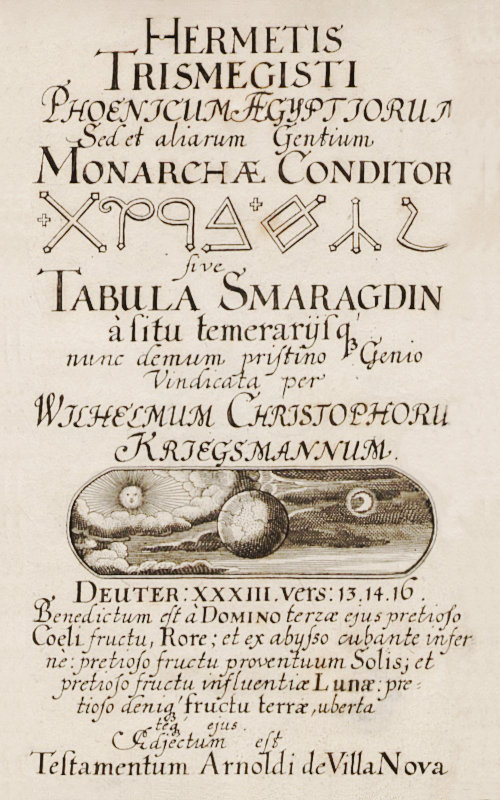
The Emerald Tablet of Hermes Trismegistus
As legend has it, a cornerstone of Hermetic wisdom is embodied in an emerald stone tablet covered with inscriptions outlining details of the highest held principles of Hermetism and supposedly alchemy. At the beginning of the twelfth century, The earliest known text of the Emerald Tablet to appear in Europe was a Latin translation of an Arabic manuscript within a work entitled Liber de secretis naturae. The text made little impact on the intellectual world at the time. In 1140, another version appeared within the work Secretum Secretorum from Johannes Hispalensis but this time it became one of the most famous and celebrated manuscripts of the middle ages. The text from which that translation was made was an Arabic copy from the year 825, the original authorship being attributed to the Greek mystic Apollonios von Tyana.In 1923, E. J. Holmyard discovered an older Arabic version of the text in the Kitāb al-Uṣṭuḳuss al-t̲h̲ānī of Ḏj̲ābir b. Ḥaiyān. Julius Ruska revealed that the original source of that document is to be found at the end of the Sirr al-k̲h̲alīka, composed by Hermes, and said to have been found by Balīnās (Apollonius of Tyana) in the tomb of Hermes. This threw light on many points of the history of the Tabula Smaragdina from the time of Hugo Santelliensis to the present day. He was also able to show that Ḏj̲ābir b. Ḥaiyān already was acquainted with the book of Apollonius, so that it is fairly certain that the work originated in Gnostic circles.
As Above, So Below
This paraphrase of the opening lines of the emerald tablet was first used in 1877 by Helena P. Blavatsky's in her book Isis Unveiled. Since then it has captured the imagination of many a writer, not only within the esoteric or occult but in all fields of diverse interests."As above, so below; as in heaven, so on earth."
(H. P. Blavatsky, Isis Unveiled Volume 1, 1877, p294)
According to Garth Fowden in The Egyptian Hermes, astrology, which formed as the syncretism of Greek, Mesopotamian and Egyptian knowledge of the Cosmos, predates the Philosophical Hermetic texts. This makes sense because the Cosmology of Hermetism is woven out of concepts regarding the nature of planets and elements. This would also mean that the Technical Hermeticum also predates the Philosophical. This is corroborated by the dating of these texts in modern times. Therefore the likelihood that at the basis of alchemy, is also astrology. When it comes to dealing with the Emerald Tablet, the concepts are indeed astrological, even though claimed centuries later to be alchemical.
Bearing that in mind and viewing the Emerald Tablet from an astrological point of view, a very obvious explanation of what the text means is not so difficult. What is being described here is the basis of astrology, namely what astrology is and does. Fundamental is the course of the Sun through the sky above and below the horizon. This course, or Logos in Greek, is known as the ecliptic.
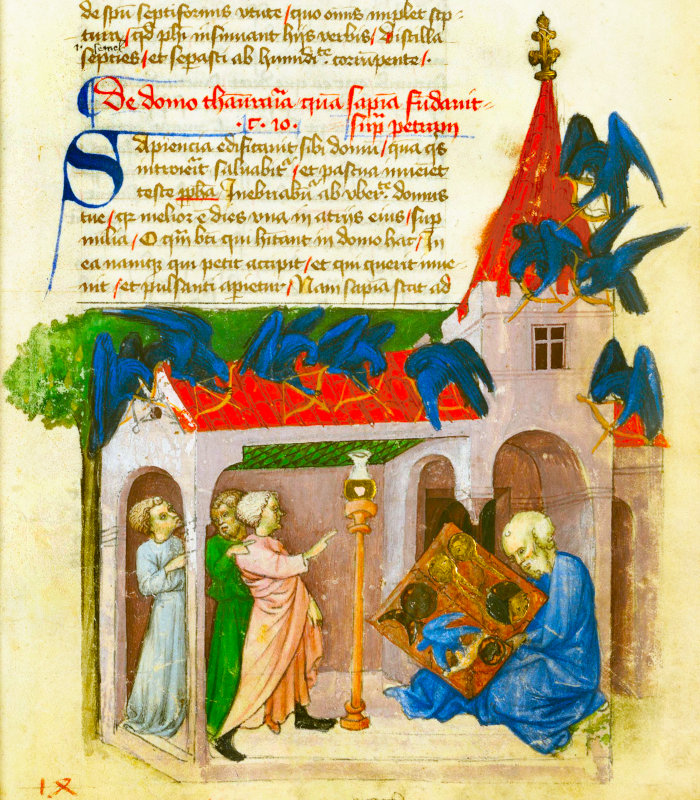
15th century depiction in The Aurora Consurgens of the discovery of the Emerald Tablet
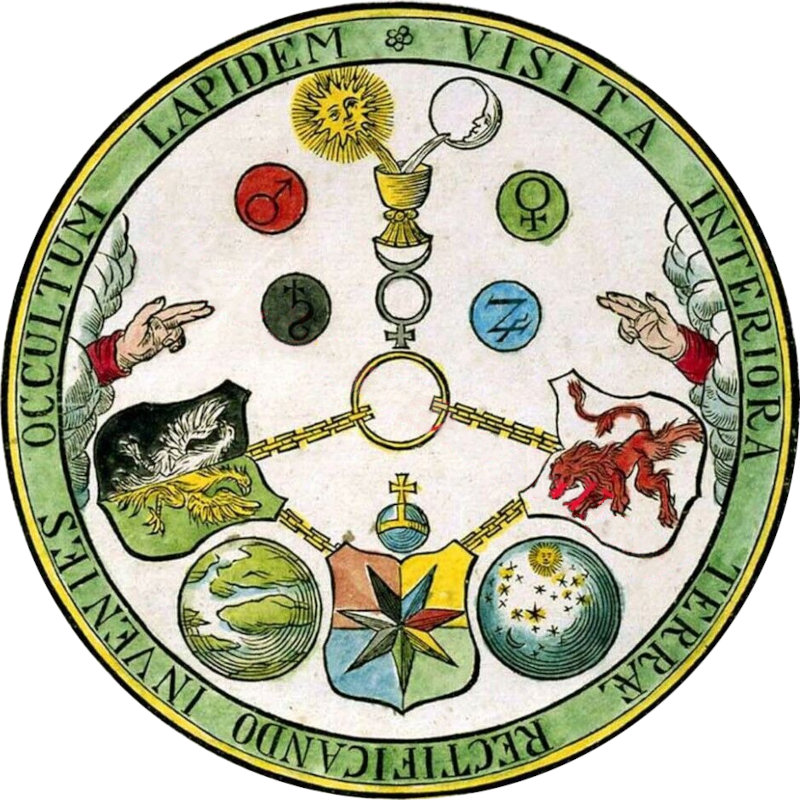
From the late 16th century onwards, the Emerald Tablet is often accompanied by a symbolic figure called the Tabula Smaragdina Hermetis
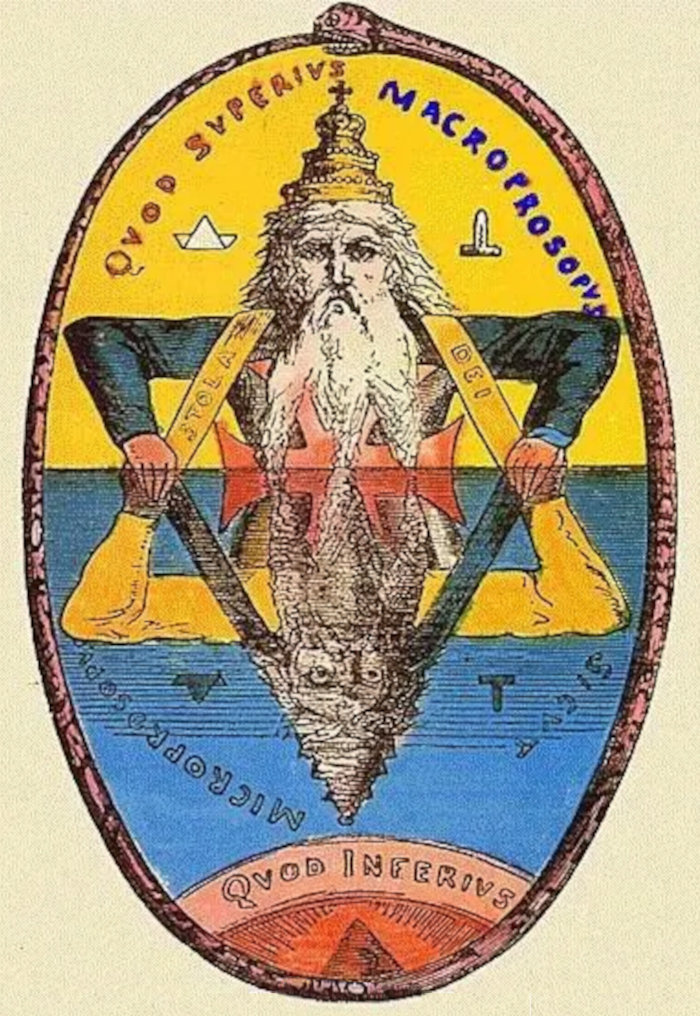
The dictum "As Above, So Below" has captured the imagination of many for centuries. This illustration is from Eliphas Levi, Transcendental magic, its doctrine and ritual, 1896, which shows the (kabbalistic) Double Triangle of Solomon, the Macroprosopus and the Microprosopus, the God of Light and the God of Reflections.
THE EMERALD TABLET OF HERMES TRISMEGISTUS
numbered and with brief comments1. I speak not fiction, but what is certain and most true.
Hermetic Logos is word, is truth.2. What is below is like that which is above,
and that which is above is like that which is below
for performing the miracle of one thing.
Half of the ecliptic is always above the horizon and the other half is under.Everything is astrologically generated from the ecliptic.
3. And as all things are produced from one, by the mediation of one,
so all things are produced from this one thing by adaptation.
Since the planets are on the ecliptic, the planetary forces emanate from there.
4. Its father is the sun, its mother was the moon,
the wind carried it in its belly, its nurse is the earth.
The Sun's path forms the ecliptic. The Moon is there too. The wind here describes the upper atmosphere and
the earth is where manifestations are nurtured.
5. It is the cause of all perfection throughout the whole world.
Hermetic notion of Creation brought about by planetary influences.6. Its power is perfect if it be changed into the earth.
i.e. when brought into being.7. Separate the earth from the fire, the subtle from the gross,
gently, and with judgement.
Hermetic again, whereby fire rises up and away from the earth and what is left is the manifestation.
8. It ascends from the earth to heaven, and descends
again to earth, thus you will possess the glory of the whole world
and all obscurity will fly away.
The ecliptic starts at the eastern horizon, at the degree of the ascendant, rises up into the sky, then falls back to the western horizon,
before going beneath the horizon but it is not obscure
because the astrologer knows where the lower realm is.
9. This thing is the fortitude of all fortitude,
because it overcomes all subtle things,
and penetrates every solid thing.
Reference to the astrological effects.
10. Thus are all things created.
Hermetic cosmology again.11. Thence proceed wonderful adaptations
which are produced in this way.
All astrological moments have their own character.
12. Therefore am I called Hermes Trismegistus,
possessing the three parts of the philosophy of the whole world.
Possible reference to Greek, Mesopotamian and Egyptian celestial wisdoms.
13. What I had to say about the operations of the sun is complete.
The course and effect of the sun's path form a complete circle or cycle.About
Hi, my name is Rod Schneider and I have created this website to illustrate how, with the help of astrology, that negativity can be converted into something more positive. The astrology being shown here is rooted in the most ancient inceptions derived from Hermetism. It is technical but in the hands of a practitioner already familiar with astrology has great potential to be helpful. There is also much help for non-astrologers to use astrology in a different manner, namely with cycles and phases.Comments and contributions are always welcome.
Contact: rodschneider35@gmail.com